Complete guide
How to teach and practise 1st grade place value worksheets - standard theme (easy)
How to use this 20-item place value worksheet
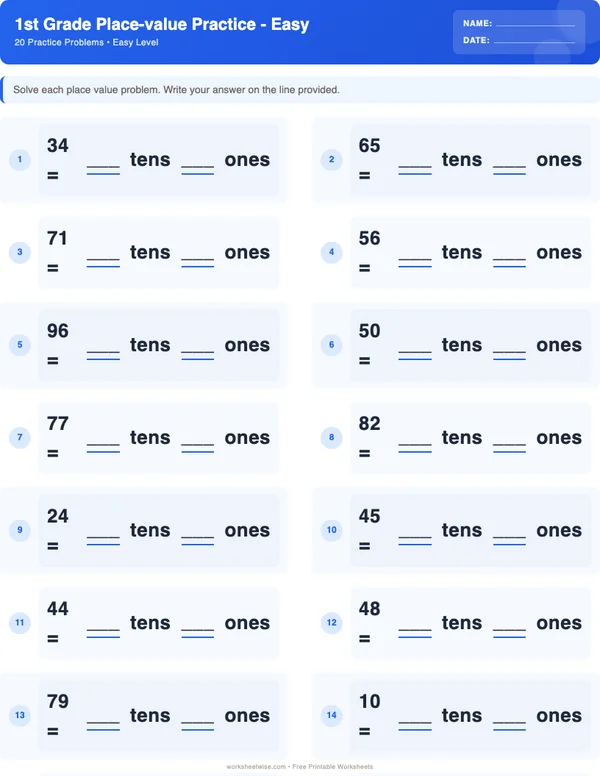
The free 1st Grade Place Value worksheet provides 20 easy-level exercises covering place value, expanded form, number comparison, and rounding. Use it as a short lesson sequence: preview the four task types, model one example, solve a few items together, assign a manageable independent portion, and then review errors by concept rather than by score alone.
Do not assume all 20 items should be completed in one sitting. The learner’s observed work should determine the pace. If the first few responses are accurate and explained clearly, continue. If the learner begins guessing, confusing tens with ones, or relying on adult prompts, pause and return to objects, drawings, or a place-value chart.
Grade labels describe the intended practice level; local curricula and instructional sequences differ. In particular, an adult should preview the comparison and rounding items to make sure their form matches what the learner has already been taught. The Common Core State Standards for Mathematics can provide broad context for first-grade number and place-value expectations, but that does not mean every item on this mixed-skill printable matches every local first-grade sequence.
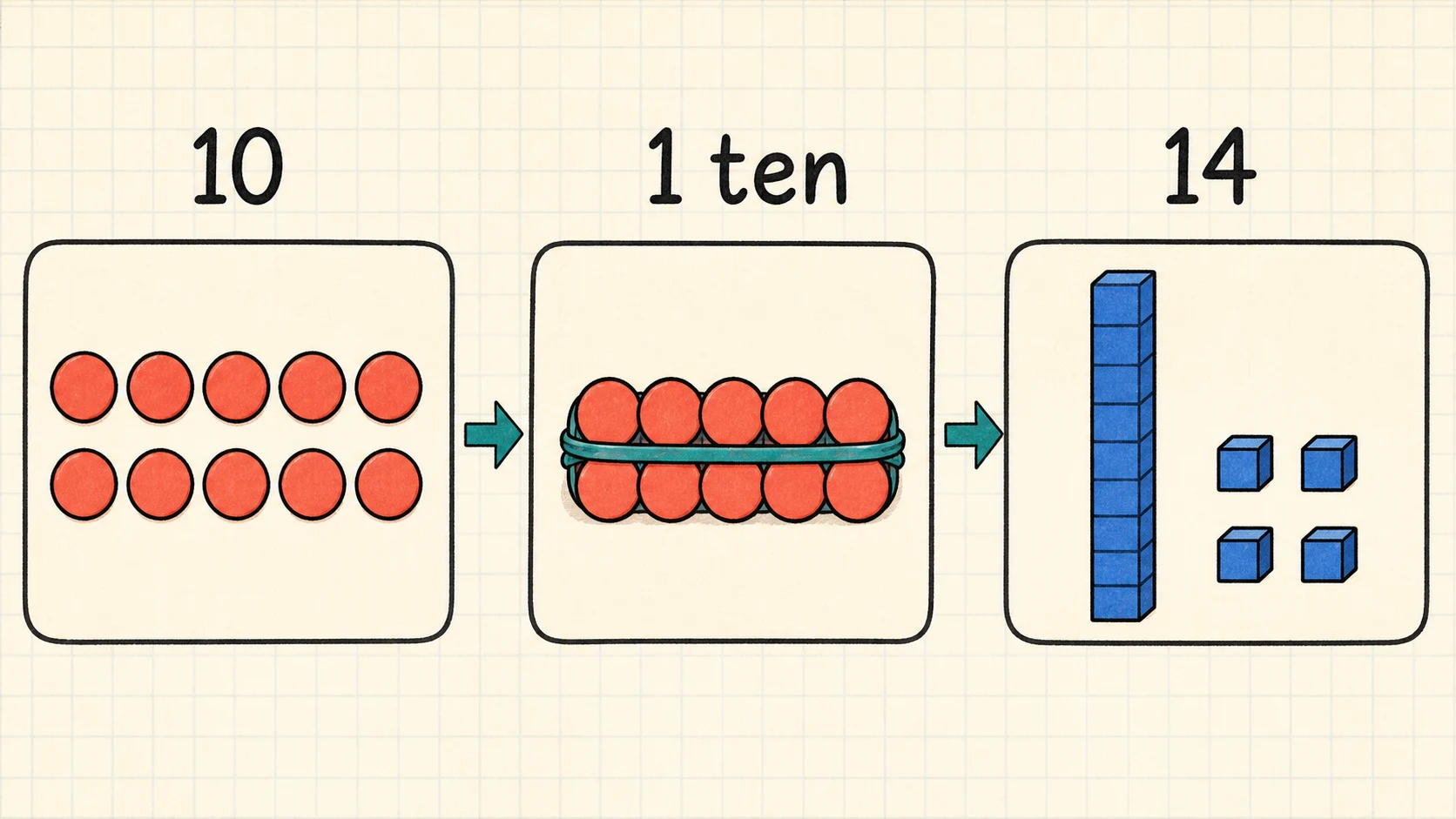
Preview, model, guide, release, check, and revisit.
What the worksheet practices
The directions are simple: “Solve each place value problem. Write your answer on the line provided.” The mathematical work, however, includes four related skills:
- Identifying the value represented by a digit’s position
- Writing a number in expanded form
- Comparing numbers
- Rounding
These skills share a place-value foundation, but they are not identical tasks. A learner might successfully state that 42 contains 4 tens and 2 ones yet still reverse the parts in expanded form. Another might decompose both numbers correctly but choose the wrong comparison symbol. Rounding adds another decision: identifying the requested place and using the nearby benchmarks.
For a broader explanation of how these ideas develop across grades, use the place value topic guide. This lesson focuses narrowly on launching and interpreting this particular printable rather than repeating the topic’s full progression.
Materials that keep the lesson concrete
Prepare the worksheet, a pencil, and the separate printable answer key. If available, add one or two simple representations:
- Small counters grouped into sets of ten
- Craft sticks bundled in tens
- Base-ten blocks
- A hand-drawn tens-and-ones chart
- A short open number line for rounding
The objects are instructional supports, not separate skills. They should help the learner connect a written number to tens and ones. For example, 34 can be represented as three groups of ten and four individual ones. Once that connection is secure, the learner can return to the printed item.
The Institute of Education Sciences guide Teaching Math to Young Children offers high-level guidance about building young children’s mathematical understanding through purposeful instruction, representations, and mathematical language. It did not review this WorksheetWise printable, so use it as general instructional framing only.
A practical lesson progression
This sequence can be completed in one session or divided across several short sessions. Move according to the learner’s accuracy, explanations, and level of independence rather than a fixed clock.
| Phase | Adult action | Learner action | Evidence to watch |
|---|---|---|---|
| Preview | Scan all 20 items and identify the four task types. | Look over the page without solving. | Notices that directions or symbols change. |
| Launch | Build or draw one two-digit number. | Names its tens and ones. | Connects each digit to a place. |
| Model | Solve one example while explaining each decision. | Watches, then restates the reasoning. | Uses “tens,” “ones,” and “value” meaningfully. |
| Guided practice | Solve two or three similar examples together. | Handles an increasing share of each solution. | Needs fewer prompts across examples. |
| Independent practice | Assign a small group of worksheet items. | Solves and records answers alone. | Maintains method without copying the model. |
| Check | Compare work with the answer key after reasoning is visible. | Explains or repairs selected answers. | Can identify where a solution changed direction. |
| Retrieve | Revisit a few mixed examples later. | Solves without looking at prior work. | Recalls the idea after time has passed. |
A learner does not need to complete every phase at the same speed. If an item type has not yet been introduced locally, mark it for later instead of turning the worksheet into a guessing exercise.
Launch the lesson with tens and ones
Begin with a number the learner can represent, such as 23. Place two bundles of ten and three single objects on the table, or draw two tens rods and three dots.
Ask the learner to describe what is visible. If necessary, supply precise language: “There are 2 tens and 3 ones. Two tens have a value of 20. Three ones have a value of 3. Together they make 23.”
Then write:
23 = 20 + 3
Point to each digit in 23. The 2 does not mean two individual objects in this number; its position gives it a value of two tens, or 20. The 3 is in the ones place and has a value of 3.
This short launch establishes the reasoning needed for both place identification and expanded form. It also gives the adult something concrete to return to if later answers become uncertain.
Keep “digit,” “place,” and “value” distinct
These words are related but not interchangeable.
In 47:
- The digit is 4.
- Its place is the tens place.
- Its value is 40.
The digit 7 is in the ones place and has a value of 7. Asking “What digit do you see?” is different from asking “What is the value of that digit?” If the worksheet wording changes between those questions, have the learner underline the requested information before answering.
Model one full response
Use a fresh example rather than completing a worksheet item the learner will later solve independently.
Say: “I see 36. The 3 is in the tens place, so it represents 3 tens, which is 30. The 6 is in the ones place, so it represents 6 ones. The expanded form is 30 + 6.”
Write the answer only after explaining it. This keeps the demonstration centered on reasoning rather than answer production.
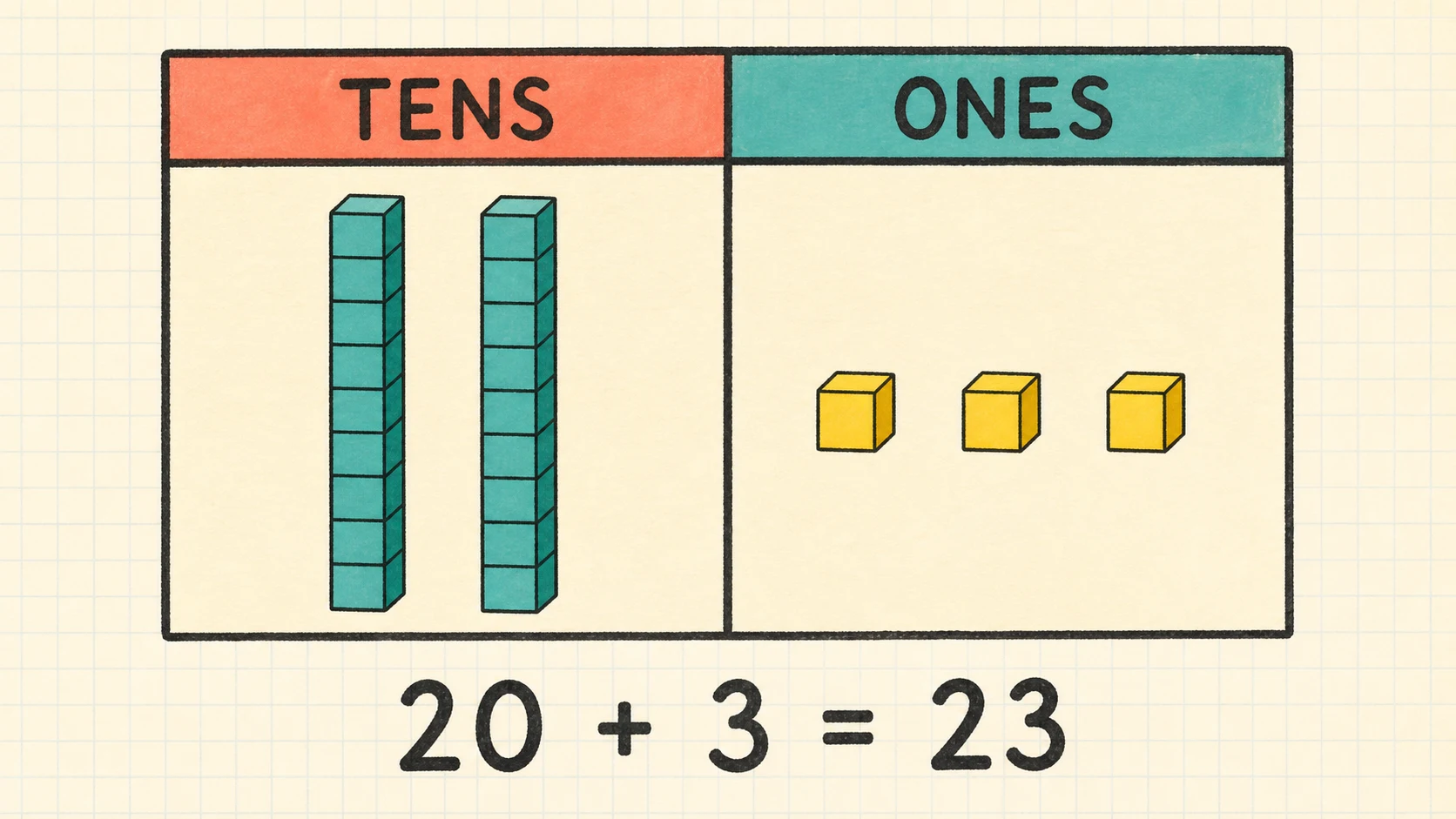
Connect each written answer to the value of its digits.
Four fully checked examples
The following examples are instructor-created demonstrations of the listed skills. They are not presented as verbatim items from the printable.
Example 1: Identify a digit’s value
Problem: What is the value of the 5 in 58?
The 5 is in the tens place. It represents 5 tens.
5 tens = 50
Answer: 50
Check: Decompose the whole number.
58 = 50 + 8
Because 50 is the part contributed by the digit 5, the answer is confirmed.
A common incomplete response is 5. That names the digit but not its value in 58. Ask, “Is that 5 ones or 5 tens?” Then have the learner point to the place.
Example 2: Write expanded form
Problem: Write 42 in expanded form.
The 4 represents 4 tens, or 40. The 2 represents 2 ones, or 2.
42 = 40 + 2
Answer: 40 + 2
Check: Combine the parts.
40 + 2 = 42
An answer such as 4 + 2 lists the digits but does not show their place values. Rebuild 42 with four tens and two ones, then connect each group to the written addends.
Example 3: Compare two numbers
Problem: Compare 37 and 32.
Both numbers contain 3 tens, so the tens do not decide the comparison. Compare the ones: 7 ones are greater than 2 ones.
37 > 32
Answer: 37 is greater than 32.
Check: Decompose both numbers.
37 = 30 + 7
32 = 30 + 2
The numbers share 30. Since 7 is greater than 2, 37 is greater than 32.
If the learner reverses the symbol, first ask for the comparison in words. After the learner says “37 is greater than 32,” connect that spoken statement to the symbol.
Example 4: Round using benchmarks
Problem: Round 34 to the nearest ten.
The neighboring multiples of ten are 30 and 40. The distance from 34 to 30 is 4. The distance from 34 to 40 is 6.
34 − 30 = 4
40 − 34 = 6
Because 34 is closer to 30, it rounds to 30.
Answer: 30
Check: Place 34 on a number line between 30 and 40. Its position is closer to 30.
This is an instructional example, not a claim that every rounding item uses the same place or number range. Read each worksheet prompt carefully and use the requested rounding place. A number line preserves the reasoning more clearly than a memorized slogan.
Move from guided to independent practice
After modeling, solve two or three examples with the learner. Keep the pencil in the learner’s hand whenever possible.
For the first guided example, provide a full prompt: “Which digit is in the tens place? What value does it have?” For the next, shorten the prompt: “What do you check first?” Then ask the learner to solve one while explaining the steps without interruption.
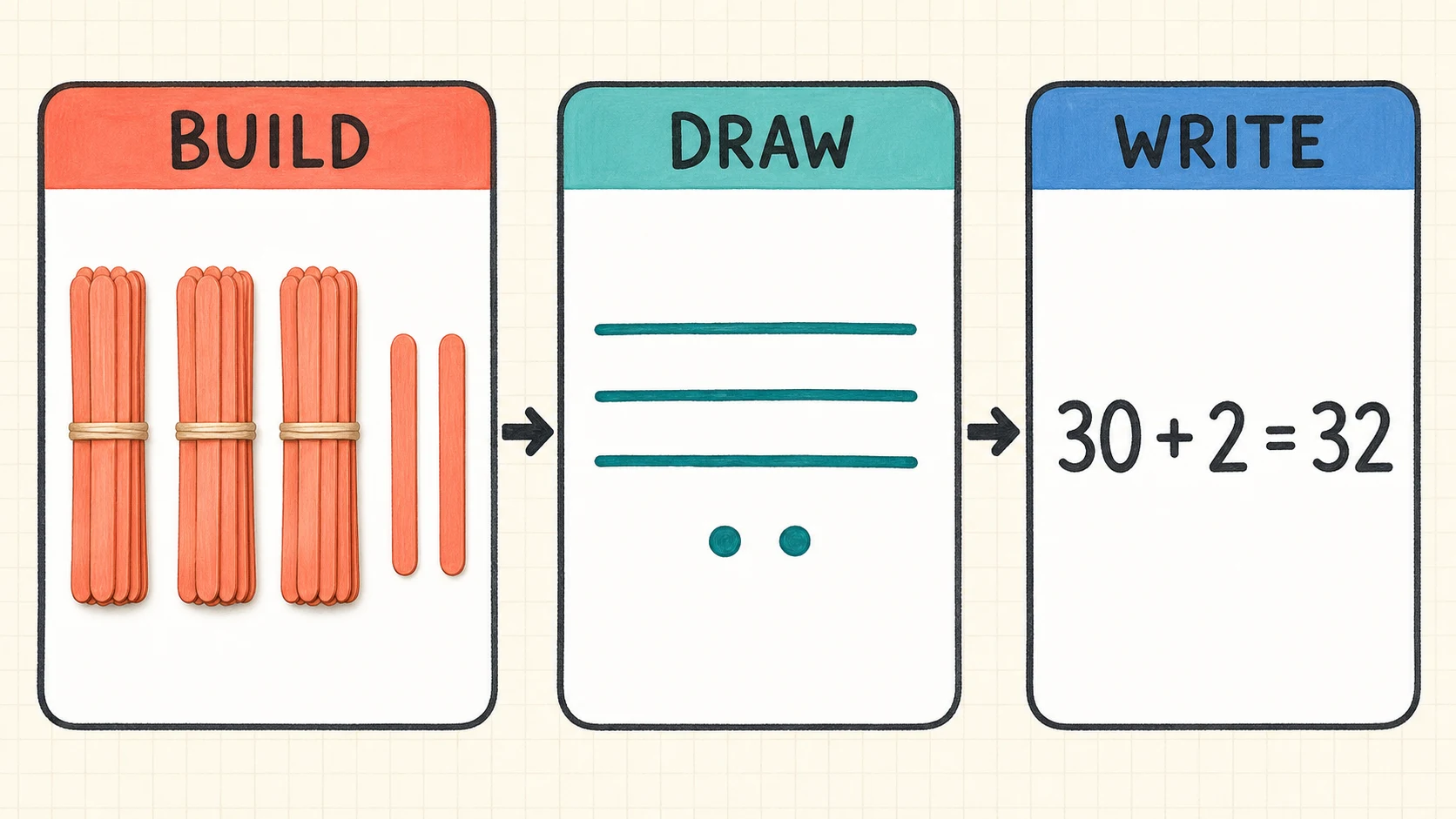
Reduce prompts gradually as the learner takes over the reasoning.
Decide when to release responsibility
Independent work is appropriate when the learner can do three things:
- Identify the task type without being told
- Choose a relevant method, such as decomposition or a number line
- Explain a completed answer in a short sentence
These are practical lesson signals, not universal mastery criteria. If the learner can calculate but cannot yet explain, ask for one explanation before assigning several items. If the explanation is sound but writing is slow, allow an oral explanation and keep the mathematical response brief.
Assign a small set first. Check whether the learner applies the modeled method consistently. Continue only while the work remains purposeful. A sudden cluster of place reversals, skipped symbols, or unexplained guesses is a reason to pause.
Preserve the skill during help
Useful support makes the place-value relationship visible without supplying the answer.
For an expanded-form item, draw a two-column chart labeled tens and ones. For comparison, ask the learner to compare tens before ones. For rounding, mark the two relevant benchmark numbers and let the learner locate the target number.
Avoid converting the work into unrelated copying. If an adult writes the decomposition and asks the learner only to copy it, the written page may look complete while offering little evidence of understanding.
Adapt support without changing the mathematics
Different learners may need different access points. Keep the target skill intact: understanding and using place value.
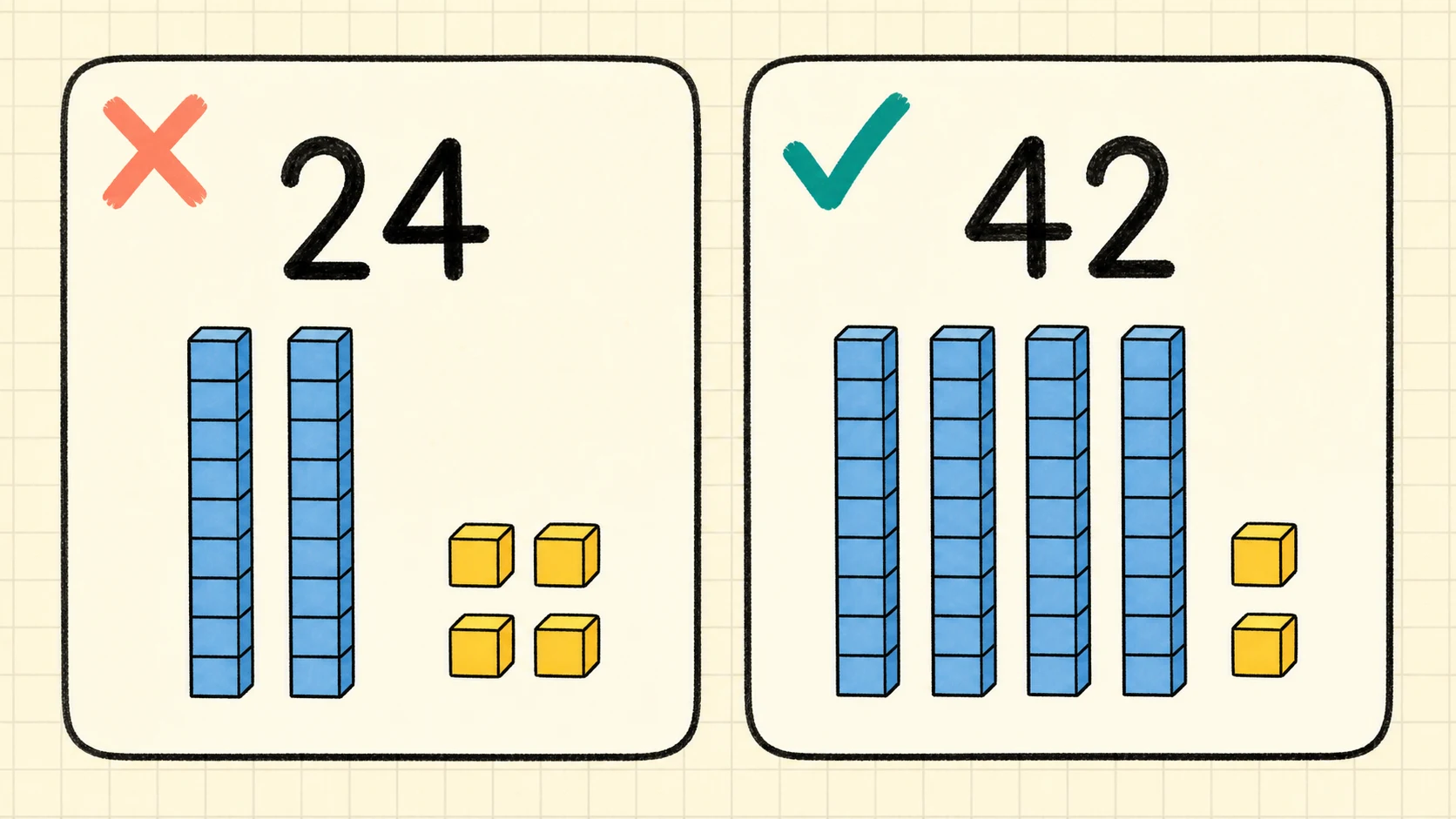
Change the representation, amount, or response mode while preserving the place-value decision.
Increase concrete support
Build the number with grouped objects before writing it. Ask the learner to touch each ten while counting by tens, then count the loose ones. Transfer the result to a tens-and-ones chart.
This support is especially useful when a learner treats both digits as separate ones. Remove the objects gradually: objects first, then a quick drawing, then numerals alone.
Reduce the amount, not the thinking
Cover the lower part of the page and show only a few items. A learner can still identify values, expand numbers, compare, and round; the visual and endurance demand is simply smaller.
You can divide the 20 items across sessions. Do not interpret an unfinished page as a mathematical error when the planned assignment was only part of the worksheet.
Allow a different response route
If recording is interfering with the lesson, let the learner explain orally, point to tens and ones, arrange number cards, or choose a comparison symbol before writing the final response. The answer should still reveal the same mathematical decision.
For additional first-grade practice in other areas, use the 1st Grade worksheet hub or the narrower 1st Grade math collection. Choose follow-up work based on the learner’s demonstrated need, not merely the grade label.
The IES guide Assisting Students Struggling with Mathematics provides broader instructional recommendations for supporting learners who experience difficulty in mathematics. It does not diagnose an individual learner or evaluate this worksheet. Persistent concerns that extend beyond ordinary instructional adjustment require appropriate local professional judgment; this guide does not provide medical or diagnostic advice.
Interpret errors by their likely source
A total score gives less instructional information than a pattern of errors. Sort missed items by skill and inspect the written work.
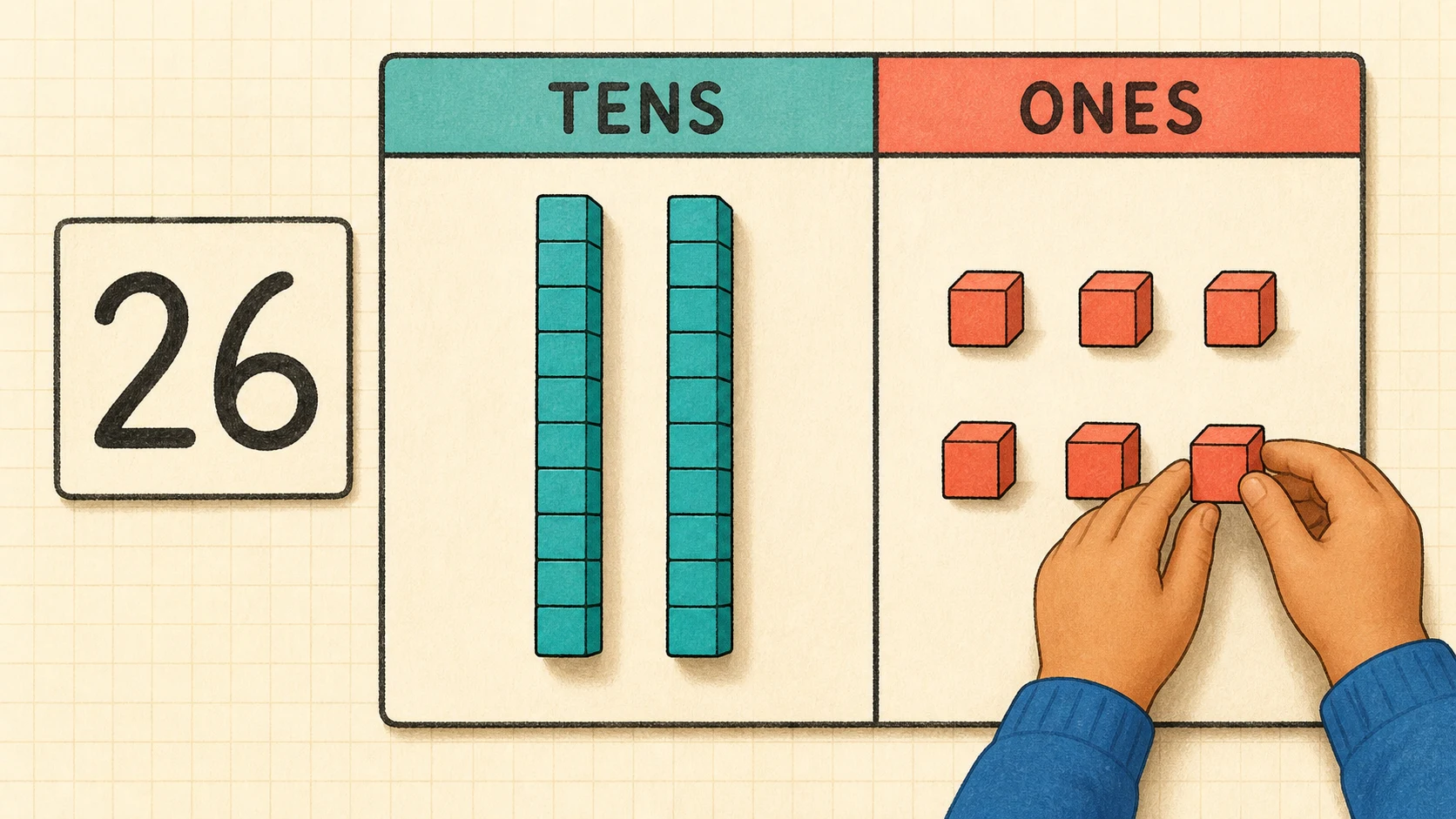
Identify the task, locate the first incorrect decision, repair it, and check the result.
| Observed response | Possible interpretation | Productive next prompt |
|---|---|---|
| Says the value of 6 in 64 is 6 | Confuses a digit with its value | “Which place is the 6 in?” |
Writes 53 = 5 + 3 |
Lists digits instead of decomposing values | “How much are five tens worth?” |
| Compares only the ones in 48 and 52 | Does not begin with the greatest place | “Which number has more tens?” |
Says 46 < 41 but reads 46 as greater |
Understands quantities but reverses the symbol | “Say the comparison in words first.” |
| Rounds without naming benchmarks | May be applying an unexamined rule | “What two benchmark numbers surround it?” |
| Misses several unlike tasks after directions change | May not be identifying the task type | “What is this item asking you to find?” |
“Possible interpretation” matters here. One response cannot prove a misconception. Ask the learner to solve a nearby example and explain the method. If the second response is accurate, the first may have been a reading, attention, or recording error. If the same reasoning repeats, reteach that specific connection.
Boundary cases worth checking
Boundary cases reveal whether the learner understands the structure rather than only a familiar pattern.
A zero in the ones place: In 20, there are 2 tens and 0 ones.
20 = 20 + 0
The zero holds the ones place; it does not erase the two tens.
Equal tens: In 54 and 57, both numbers have 5 tens. The ones decide the comparison, so 54 is less than 57.
Different tens: In 49 and 51, compare tens first. Five tens are greater than four tens, so 51 is greater even though 1 is less than 9.
A rounding midpoint: If the learner has been taught how to handle a number exactly halfway between two tens, use the local rule and representation. Do not infer that rule from unrelated items. The worksheet description confirms rounding practice but does not specify every prompt, number range, or midpoint convention.
A one-digit number beside a two-digit number: If this appears in teaching or extension, 8 has zero tens and 8 ones, while 12 has 1 ten and 2 ones. Therefore, 12 is greater. This is a useful conceptual probe, not a claim about the worksheet’s printed items.
Use the answer key responsibly
The separate answer key is designed for quick checking, but it should confirm reasoning rather than replace it.
First, review the worksheet yourself so you know which type of response each item requests. During independent work, keep the key out of sight. Afterward, compare answers one at a time and mark only items that need attention. Ask the learner to revisit the prompt before revealing the keyed answer.
For a missed item, use this routine:
- Read the prompt again.
- Name the task: value, expanded form, comparison, or rounding.
- Reconstruct the number with a chart, drawing, decomposition, or number line.
- Find the first step that changed the reasoning.
- Solve the item again.
- Compare the repaired response with the answer key.
If your interpretation and the key appear to differ, check the exact wording, requested form, and symbol orientation. Do not teach the learner to force a method to fit a key. Record the issue for adult review and continue with an unambiguous example.
Decide what to teach next
The next step should follow the error pattern.
If the learner identifies tens and ones accurately but misses expanded form, continue with decomposition such as 68 = 60 + 8. If expanded form is secure but comparisons are weak, compare pairs with the same tens before mixing in pairs with different tens. If comparison is sound but rounding is uncertain, return to benchmark tens and an open number line.
If all four task types are accurate and independently explained, use fresh numbers rather than repeating memorized answers. The 1st Grade Place Value Worksheet Pack contains 18 worksheets for broader practice. Adults who need new item sets can also explore the free worksheet generators. Availability does not mean the learner needs more volume immediately; select practice that serves an identified purpose.
A spaced retrieval plan
Retrieval means asking the learner to solve again after some time has passed, without first displaying the completed worksheet. The following is a practical option, not a universal timetable.
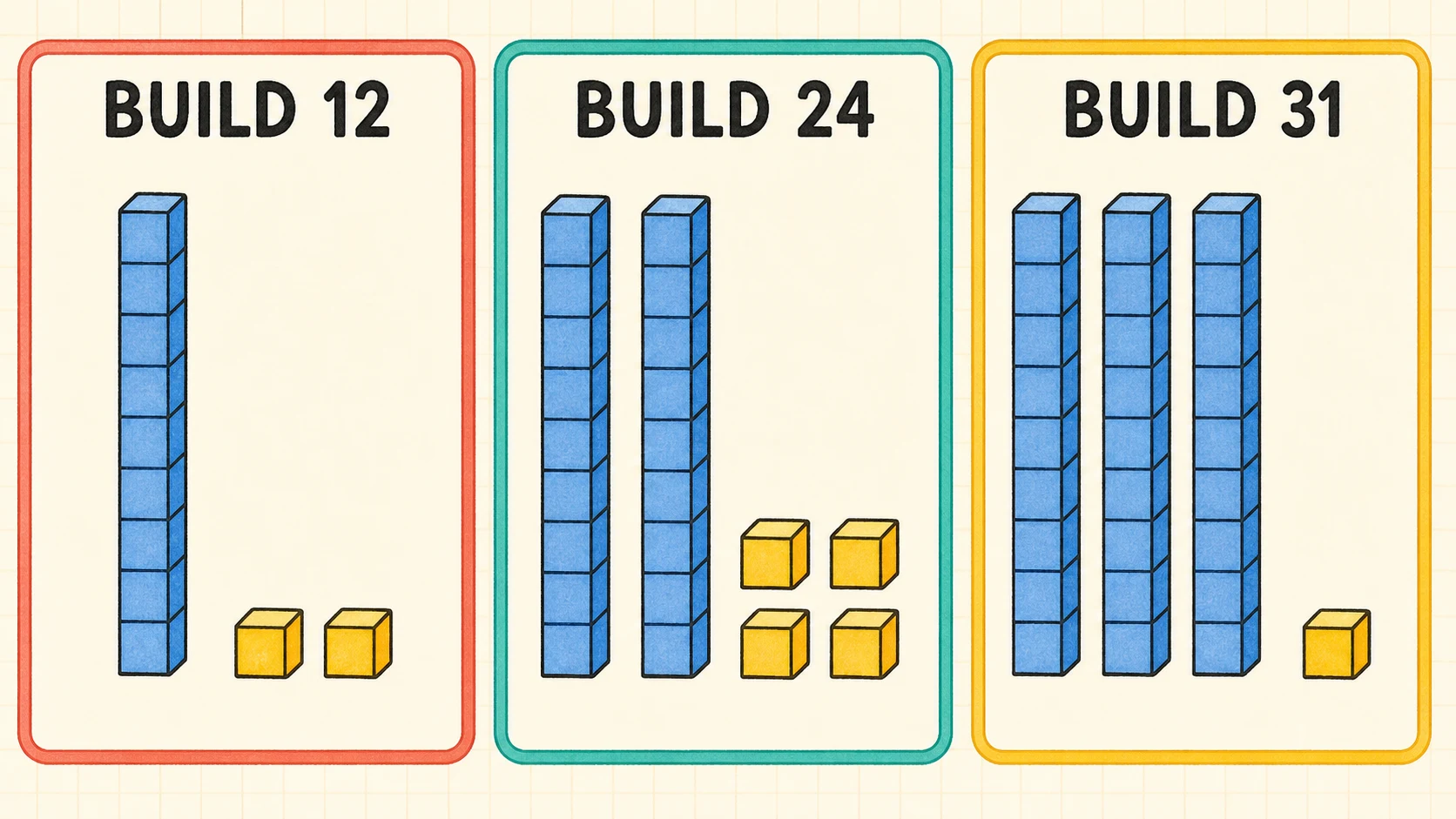
Revisit a small mixed set after increasing intervals and adjust from observed work.
| Review point | Suggested task | Decision |
|---|---|---|
| Later the same day or next lesson | One place-value or expanded-form example | Reteach if the learner cannot connect digits to tens and ones. |
| A few days later | One decomposition and one comparison | Continue if both methods are recalled independently. |
| About a week later | A mixed set including rounding if previously taught | Note which skill, if any, has weakened. |
| In a later unit | One unfamiliar number for each relevant skill | Use the response to choose review, not to assign a permanent label. |
Change the spacing when the evidence calls for it. Shorten the interval after uncertain or heavily prompted work. Lengthen it when the learner retrieves the method accurately and explains why it works.
Limits of this printable
This worksheet supplies 20 easy-level practice exercises and an answer key. It is useful for practice and for noticing patterns, but one printable cannot establish complete place-value understanding. It does not replace conversation, concrete representation, observation across time, or the local curriculum.
The catalogue identifies place value, expanded form, number comparison, and rounding as the covered skills. It does not provide the exact wording and number range of every item in this guide, so the worked examples above are illustrative. Preview the downloaded page before teaching, especially when local instruction has not yet introduced one of the four skills.
Avoid treating a perfect page as guaranteed mastery or a difficult page as evidence of a fixed limitation. Check whether the learner can explain the reasoning, transfer it to a new number, and retrieve it later.
The most useful next action
Download the free 20-item worksheet and answer key, then preview and mark the first item of each task type. Model one similar example, assign only a small initial set, and let the learner’s observed work determine whether to continue, add a representation, or pause.
After checking, record one sentence: “The learner can ___ independently and needs support with ___.” Use that evidence to choose the next activity from the broader place value guide, rather than automatically assigning another full page.
Put it into practice
Use the guide with a real printable
Move from explanation to a short, observable practice task. Check the first item together, then adjust the next session from the learner's actual work.
See the 18-worksheet pack