Complete guide
How to teach and practise 1st grade money worksheets - standard theme (easy)
What this 20-item worksheet practices
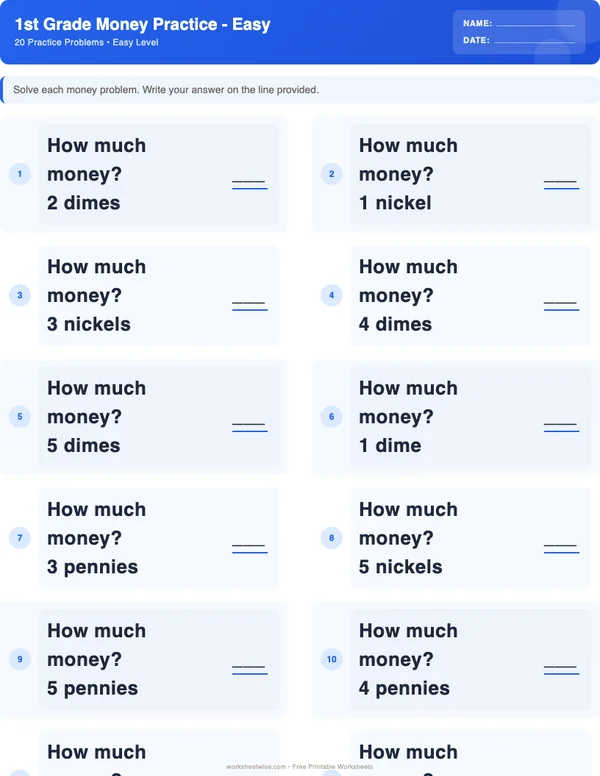
The free 1st Grade Money worksheet provides 20 easy-level exercises involving coin values, counting money, money operations, and making change. The learner solves each problem and writes an answer on the line provided. A separate printable answer key is included.
The most effective way to use this printable is to treat it as a short lesson, not merely a page to finish. Begin with real or realistic play coins, model one problem aloud, solve a few items together, and then release the learner to work independently. Watch how the learner counts and explains—not only whether the final answer matches the key. The observed work should determine whether to continue, pause for more modeling, or divide the worksheet across two sessions.
This worksheet is intended for foundational practice. “1st Grade” describes the intended practice level; it does not establish a universal timetable for mastering money. Local curricula and instructional sequences differ. For a wider view of coin identification, mixed-coin counting, comparison, and later purchase problems, use the broader 1st Grade Money topic guide rather than asking this single printable to cover the entire progression.
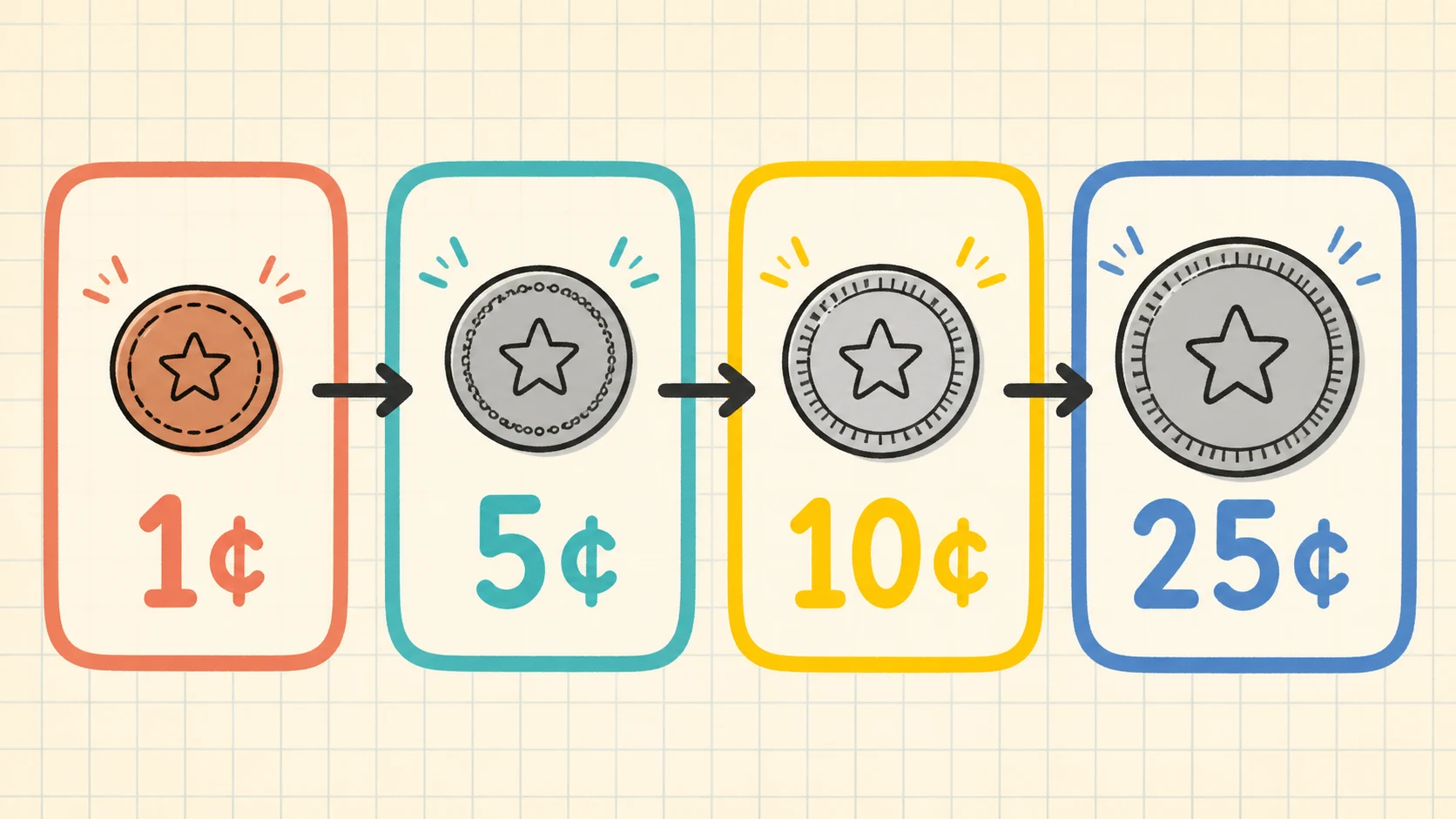
Move from a concrete coin model to guided items, independent work, checking, and later retrieval.
A practical lesson map
The plan below is a suggested teaching routine, not a sourced or universal schedule. Shorten or extend any phase in response to the learner’s work.
| Phase | Adult action | Learner action | Evidence to notice |
|---|---|---|---|
| Prepare | Print the worksheet and keep the answer key separate. Gather pennies, nickels, dimes, and quarters if the printed items use those coins. | Organize coins by type. | Can the learner distinguish the coin types needed for the item? |
| Launch | Read the directions: “Solve each money problem. Write your answer on the line provided.” Preview the symbols and pictures visible on the page. | Restate what each problem asks. | Does the learner know whether to count, combine, or find change? |
| Model | Demonstrate one similar example with coins and a written equation. | Watch, then explain the steps back. | Can the learner connect each coin to its value? |
| Guided practice | Work through two or three actual items together without supplying answers immediately. | Count aloud, move coins, and record answers. | Is the counting sequence stable and accurate? |
| Independent practice | Assign a manageable group of items. | Solve without step-by-step prompting. | Does accuracy continue after support is removed? |
| Check | Compare completed work with the separate key. | Rework mismatches before seeing the keyed answer. | Can the learner locate and repair an error? |
| Retrieve | Revisit a few problem types after a delay. | Solve from memory, using coins only if needed. | Is the method retained beyond the first sitting? |
The IES guide on teaching mathematics to young children provides high-level support for purposeful instruction, helping children monitor their mathematical activity, and using representations while teaching early mathematics. It did not evaluate WorksheetWise or this particular printable. Here, those broad ideas translate into asking the learner to touch or move coins, say the running total, and check whether the result answers the question.
Prepare the learner and the materials
Print only what each person needs
Print the worksheet for the learner. Keep the separate answer key with the adult until checking time. If the learner can see the key during practice, it becomes difficult to tell whether an answer came from reasoning, copying, or memory of a nearby number.
Have a pencil and a small set of real or realistic play coins available. Use only the denominations required by the visible problem. An oversized pile can turn coin selection into a distraction. A simple sorting area—one place for pennies, one for nickels, one for dimes, and one for quarters—makes each coin’s role easier to see.
Real coins differ in size, color, and design, so do not assume that visual size communicates value. A smaller coin can be worth more than a larger one. When coin pictures are unfamiliar, pair each picture with a matching physical or play coin before beginning the arithmetic.
Establish a compact reference
If identification is not yet secure, place a temporary reference beside the page:
| Coin | Value | Useful count |
|---|---|---|
| Penny | 1¢ | Count by ones |
| Nickel | 5¢ | Count by fives |
| Dime | 10¢ | Count by tens |
| Quarter | 25¢ | Count by twenty-fives or add 25 |
This reference preserves the target skill because the learner still has to recognize, count, combine, or use the values. It does not solve the problem for them. Remove it when the learner begins recalling values reliably.
Launch the exact task clearly
Read the printed instruction once: “Solve each money problem. Write your answer on the line provided.” Then point to one item without solving it and ask the learner to identify the job:
- “Are you finding the value of one coin?”
- “Are you counting a collection?”
- “Are you combining money amounts?”
- “Are you finding how much change is needed?”
These prompts are instructional suggestions. They are based on the worksheet’s stated skill range, not on a claim that every one of the four forms appears in a particular order.
Before computation begins, agree on how answers will be written. If an item asks for cents, a response such as 27¢ communicates the unit more clearly than 27. If a printed prompt already supplies the cent or dollar symbol, the learner should follow its format rather than duplicate the symbol. The catalogue states that the worksheet includes money operations, but it does not provide the wording or layout of each item; therefore, the visible prompt must control the response format.
Ask the learner to explain one familiar coin fact. For example, “A dime is worth 10 cents.” If this cannot yet be stated or shown with a reference, take a brief coin-identification detour before counting collections. Counting mixed coins is unnecessarily difficult when the values themselves are unsettled.
Model a repeatable solving routine
Use a consistent routine:
- Identify the task.
- Name each coin or amount.
- State its value.
- Choose a counting or operation strategy.
- Record the answer with the correct unit.
- Check by recounting or using a second representation.
Model the thinking aloud, but keep the language concise: “I see one dime and three pennies. The dime is 10 cents. I count on 11, 12, 13. The total is 13 cents, so I write 13¢.”
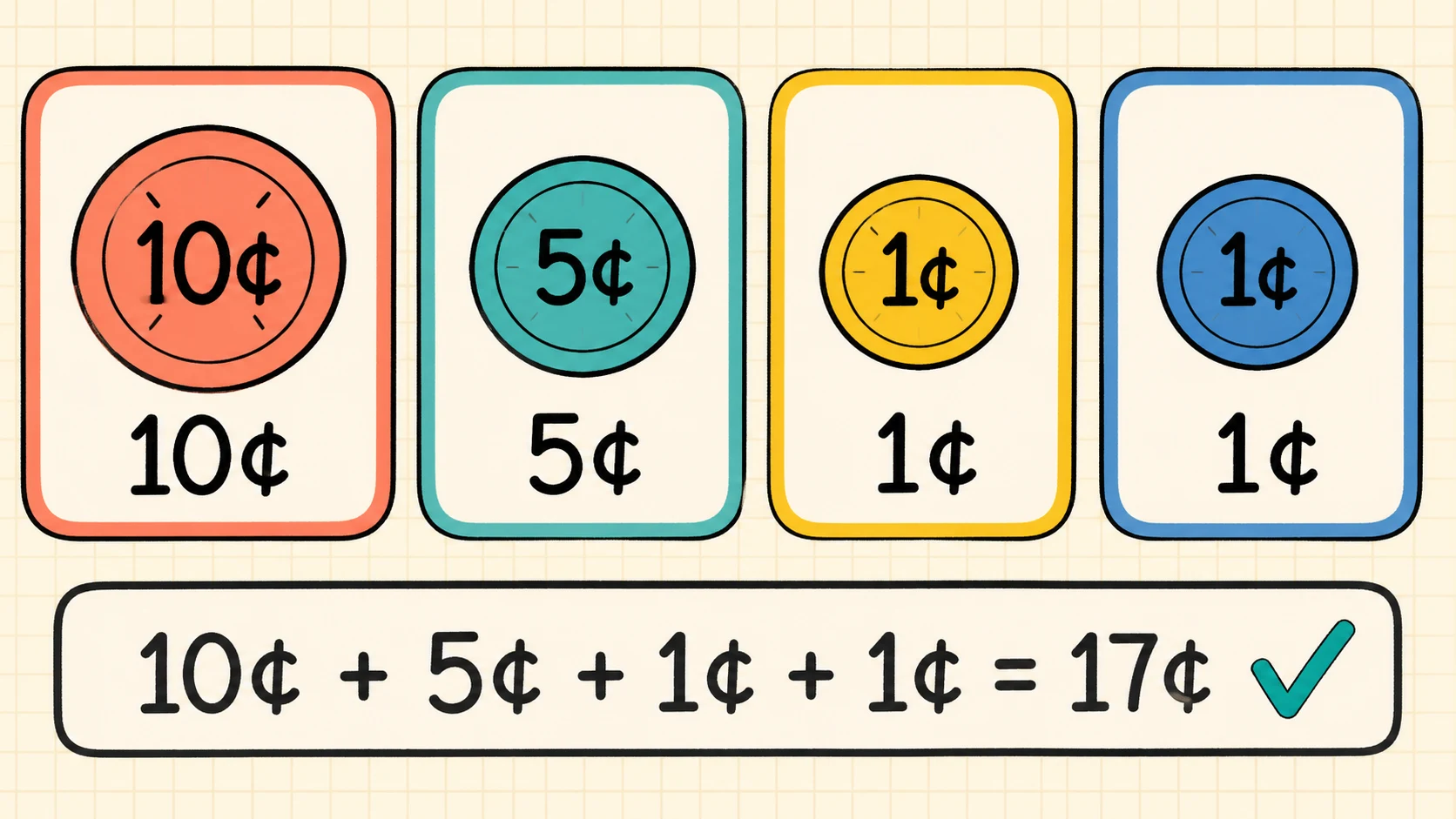
Name each coin, attach its value, count accurately, and record the unit.
The worked examples below are fully checked examples similar to the worksheet’s stated skills. They are not transcriptions of its 20 items.
Worked example 1: identify a coin value
Example: What is the value of one nickel?
A nickel has a value of 5 cents.
Answer: 5¢
Check: One nickel is worth the same amount as five pennies:
1¢ + 1¢ + 1¢ + 1¢ + 1¢ = 5¢
This check connects the coin name, its conventional value, and an equivalent amount.
Worked example 2: count like coins
Example: What is the total value of four dimes?
Each dime is worth 10 cents:
10¢ + 10¢ + 10¢ + 10¢ = 40¢
The same total can be found by skip-counting: 10, 20, 30, 40.
Answer: 40¢
Check: Four groups of 10 equal 40. Counting the coins again produces four dimes, not four cents.
Worked example 3: count a mixed collection
Example: Find the value of one quarter, one dime, one nickel, and two pennies.
Begin with the greatest-value coin and count on:
- Quarter:
25¢ - Add the dime:
25¢ + 10¢ = 35¢ - Add the nickel:
35¢ + 5¢ = 40¢ - Add two pennies:
40¢ + 1¢ + 1¢ = 42¢
Answer: 42¢
Check: Add the values in a different grouping:
(25¢ + 5¢) + (10¢ + 2¢) = 30¢ + 12¢ = 42¢
Both methods give 42 cents.
Worked example 4: add money amounts
Example: Mia has 12¢ and receives 5¢ more. How much does she have now?
“Receives more” indicates addition:
12¢ + 5¢ = 17¢
Answer: 17¢
Check: Count on five steps from 12: 13, 14, 15, 16, 17.
The cent symbol matters. 17¢ names a money amount; 17 alone is only a number unless the printed item already provides the unit.
Worked example 5: make change
Example: An item costs 16¢. The buyer pays 20¢. How much change is needed?
Count up from the price to the amount paid:
- Start at 16¢.
- Add 1¢ to reach 17¢.
- Add 1¢ to reach 18¢.
- Add 1¢ to reach 19¢.
- Add 1¢ to reach 20¢.
Four cents were added.
Answer: 4¢
Check: The cost plus the change must equal the payment:
16¢ + 4¢ = 20¢
Subtraction confirms the same result:
20¢ − 16¢ = 4¢
The count-up method is especially useful when a learner understands the situation but is not yet fluent with the corresponding subtraction fact.
Move from guided to independent practice
Guide without taking over
Choose the first visible item that appears accessible. Ask the learner to point, name, count, and write. If they hesitate, prompt the next action rather than providing the value:
- “Which coin will you count first?”
- “What is that coin worth?”
- “What number will you start from?”
- “What unit belongs with the answer?”
- “How could you check it?”
Then solve another item with less adult language. On a third item, wait quietly while the learner starts. This gradual reduction in prompting helps reveal whether the process has transferred.
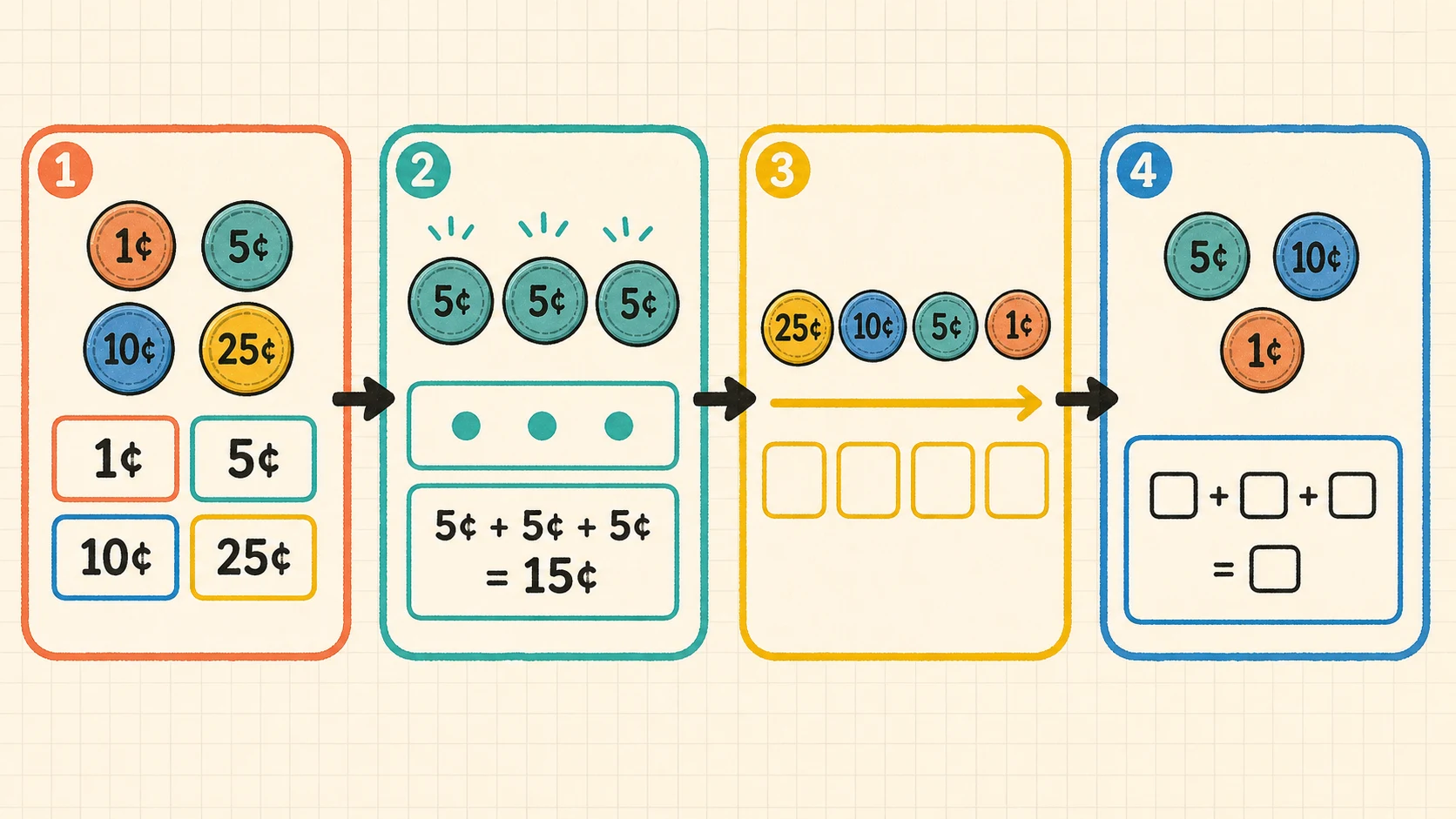
Reduce prompts as soon as the learner can name the task and carry out the next step.
The IES practice guide for assisting students struggling with mathematics offers high-level recommendations concerning systematic instruction, clear mathematical language, representations, and deliberate practice. It does not prescribe how this worksheet must be taught. A reasonable application here is to model a short routine, use coins or drawings to expose the quantities, and remove support in small steps.
Release a manageable item set
Do not assume all 20 items must be finished in one sitting. A learner who is accurate and composed may continue. A learner whose counting deteriorates after several items may benefit from stopping at a clear boundary and returning later.
During independent work, avoid correcting every hesitation immediately. Observe:
- whether coins are named correctly;
- whether each coin is counted exactly once;
- whether the learner starts with a helpful coin;
- whether skip-counting changes correctly between denominations;
- whether the operation fits the story;
- whether the answer includes the needed unit.
Those observations are more useful for planning than the total score alone.
Adapt support without changing the skill
Adaptation should make the same reasoning more accessible. It should not replace a counting-money problem with an unrelated easier activity.
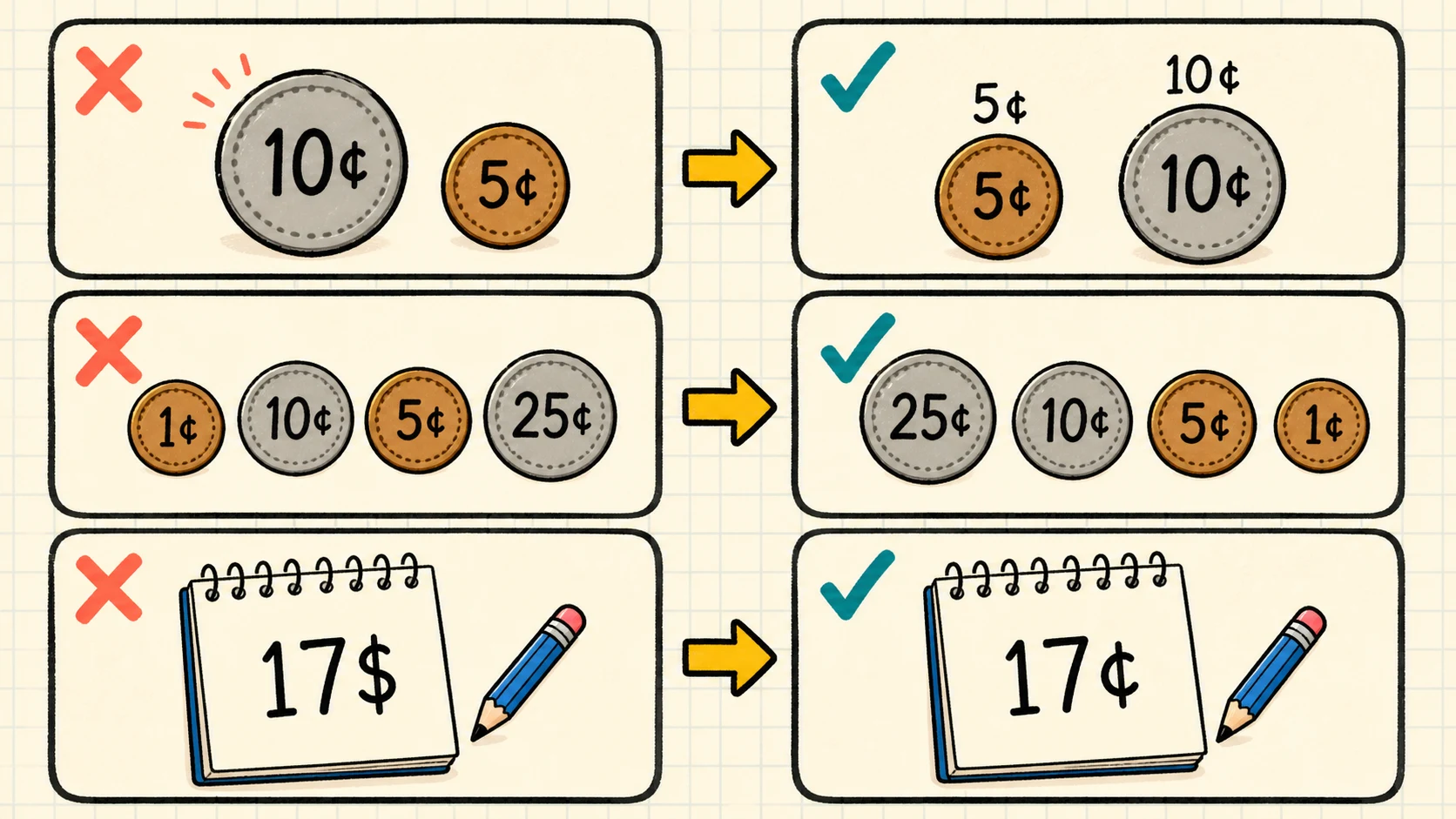
Adjust the representation, amount of work, or prompting while preserving the money task.
When coin identification is the barrier
Place matching physical coins over or beside the printed images. Let the learner turn a coin over, compare its design with the page, and use the value reference. Ask for the name and value before counting.
Keep the original item in view. The support is the match between picture and object; the learner still performs the stated money task.
When counting is the barrier
Arrange coins from greatest value to least value. Provide a number line or let the learner record intermediate totals:
25 → 35 → 40 → 41 → 42
Cover unrelated items with a blank sheet so the learner sees one problem at a time. If writing interrupts the counting sequence, the adult may write the running totals the learner says during guided practice. For independent evidence, the learner should eventually record the final answer.
When workload or attention is the barrier
Assign a small, clearly marked set rather than the full page. A practical option is four or five items, a brief pause, and then a decision based on observed accuracy. This is not a universal timing rule.
Do not remove every mixed-coin item simply because it is harder. Instead, provide organized coins, a value reference, or one completed model. The mathematical target remains identifying values and combining them.
When the work appears too easy
Ask for a second method or a short explanation: “Show the total by grouping the coins another way.” The learner might verify 42¢ as 25 + 10 + 5 + 2 and then as 30 + 12.
Another extension is to construct the same amount with different coins. For 20¢, examples include two dimes, four nickels, or one dime and two nickels. Confirm each combination explicitly. Avoid introducing dollars, decimal notation, or multi-step change unless the learner is ready and the next instructional goal calls for it.
Handle boundary cases carefully
Equal cost and payment
If an item costs 20¢ and the buyer pays 20¢, the change is 0¢.
Check: 20¢ + 0¢ = 20¢
A learner may think every purchase must return at least one coin. This case shows that change means the difference between payment and cost; sometimes that difference is zero.
Repeated coins versus repeated cents
Three nickels are not 3¢. They are three groups of 5¢:
5¢ + 5¢ + 5¢ = 15¢
The visible number of coins and the total value answer different questions. Ask, “How many coins?” and then, “How much money?” to separate the two quantities.
A smaller coin with a greater value
A dime may look smaller than a nickel, but its assigned value is greater:
10¢ > 5¢
The value must come from coin knowledge, not from physical size. If image scale differs between a printable and a real coin, continue using the coin’s name and value as the reliable information.
Totals that cross a skip-count pattern
Consider one dime, one nickel, and two pennies:
10, 15, 16, 17
The learner counts by tens for the dime, adds five for the nickel, and then counts by ones for the pennies. Continuing 10, 20, 30, 40 would count coins rather than values. Mixed collections require the counting increment to change with the denomination.
Interpret errors before correcting them
An incorrect answer does not identify its own cause. Reconstruct the learner’s steps.
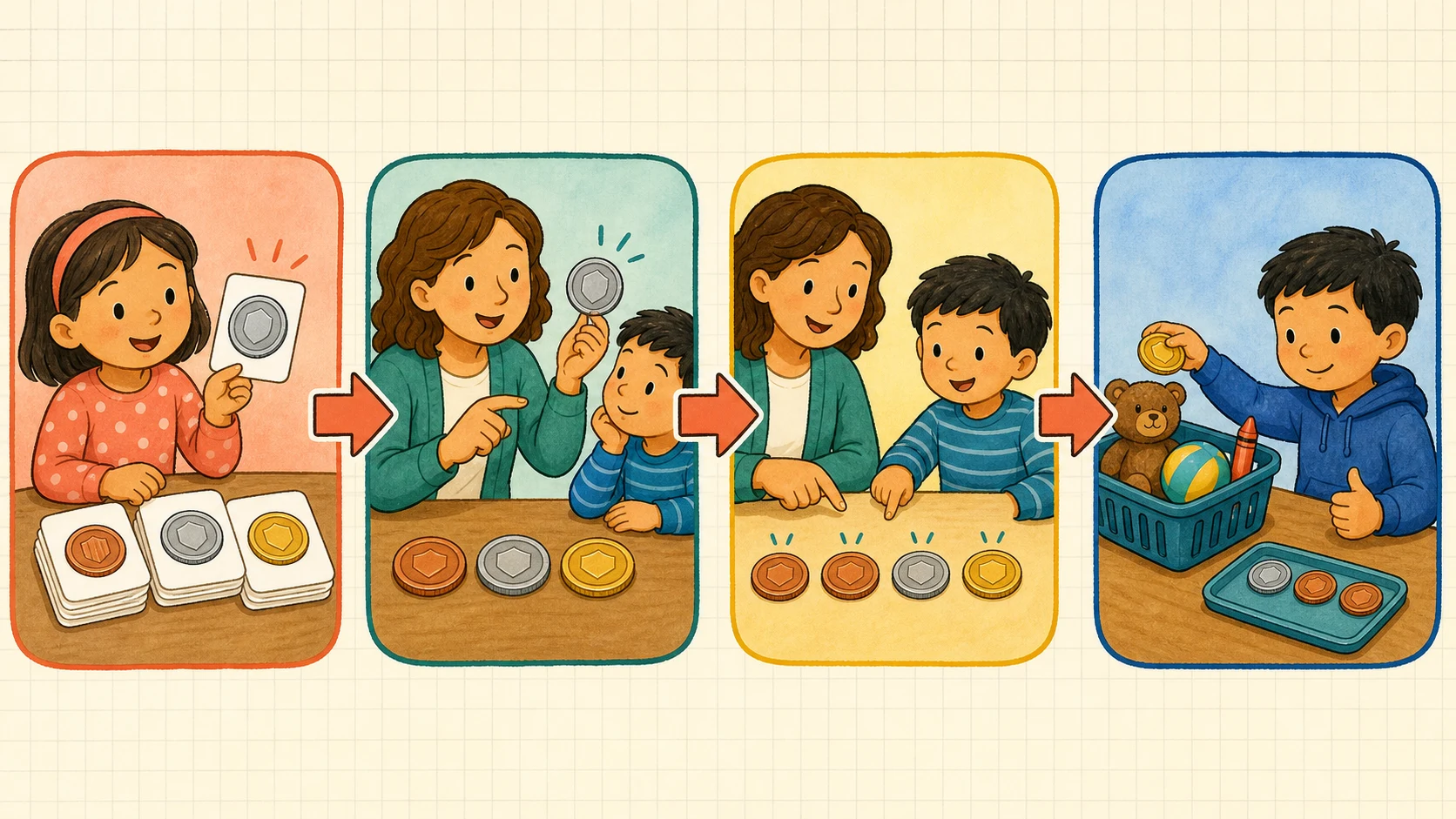
Trace the coin name, value, counting path, operation, and written unit before assigning more practice.
| Observed error | Possible interpretation | Immediate instructional response |
|---|---|---|
| Calls a nickel “5¢” correctly but later adds it as 1 | The coin name is known, but its value was not maintained during counting. | Place a 5¢ label beside the nickel and recount. |
| Reports four dimes as 4¢ | The learner counted objects rather than total value. | Contrast “four coins” with “40 cents” using four groups of 10. |
| Counts one coin twice | Tracking, rather than coin-value knowledge, may be the difficulty. | Move each physical coin into a counted area. |
| Counts mixed coins in a difficult order | The values may be known, but the counting sequence overloads the learner. | Arrange greatest value to least and record running totals. |
| Adds when change is requested | The situation or operation was misread. | Act out cost, payment, and the amount returned; then count up. |
Writes 25$ for twenty-five cents |
Symbol meaning or placement is unsettled. | Compare 25¢ with $25 without expanding into decimal notation. |
| Gives a correct answer but cannot reproduce it | The response may be a guess or an unsteady procedure. | Ask for a recount or a second representation. |
| Repeatedly misses only after several items | Endurance or attention may be affecting performance. | Pause and resume with a shorter set later. |
Do not diagnose a broad learning problem from this worksheet. It is one 20-item practice sample, not a clinical or comprehensive assessment. Record the specific behavior instead: “Counted every coin as one cent” is more actionable than “does not understand money.”
Use the answer key responsibly
The answer key is best used after the learner has completed a defined set of items. Compare one response at a time, but do not immediately replace every mismatch with the keyed answer.
Use this correction sequence:
- Mark the item for review without revealing the answer.
- Ask the learner to identify what the item requires.
- Rebuild the amount with coins or write the amounts separately.
- Recount or recompute.
- Compare the revised result with the key.
- Explain the repaired step in one sentence.
If the learner’s result still differs, the adult should independently verify the arithmetic. For example, if the learner and key differ on a collection worth 25¢ + 10¢ + 5¢ + 2¢, recompute it as 35¢ + 5¢ + 2¢ = 42¢. A key supports efficient checking, but responsible use still includes reading the printed item carefully and confirming the unit.
A score such as 16 out of 20 does not by itself show which skill needs attention. Four errors caused by cent-symbol placement call for a different response than four errors caused by unknown coin values. Group errors by type before choosing more practice.
Decide what to do after the worksheet
Use the learner’s process and error pattern to choose the next step.
Continue at the same level
Continue with similar practice if the learner is mostly accurate but still needs a value reference, occasional organization of mixed coins, or reminders to include the unit. Revisit only the problem types that remain unstable rather than immediately repeating all 20 items.
The 1st Grade Math hub can help place money work alongside other first-grade mathematics practice. Grade labels describe intended practice level, and local instructional sequences may introduce or revisit these ideas at different times.
Step back briefly
Return to coin identification and like-coin counting if the learner guesses values, treats every coin as one cent, or cannot count a single denomination consistently. Use real or play coins before returning to the missed worksheet items. That is a change in support and sequencing, not a conclusion that the learner cannot do the topic.
Move forward cautiously
If the learner solves the page accurately, explains the method, and later remembers it without extensive prompting, select the next skill from the Money topic guide. Possible directions within the catalogue’s broader progression include more mixed-coin counting, comparing amounts, or purchase problems. Consult the guide rather than assuming that one successful easy worksheet demonstrates mastery of every money skill.
The Common Core State Standards mathematics pages provide a public reference for grade-level mathematics expectations. Local standards and teaching sequences may differ, and this guide does not claim comprehensive standards alignment or certification for this exact worksheet.
Schedule retrieval instead of immediate repetition
Retrieval means asking the learner to solve a small amount again after some time has passed. The schedule below is an instructional suggestion, not a universal timetable or a promise of retention.
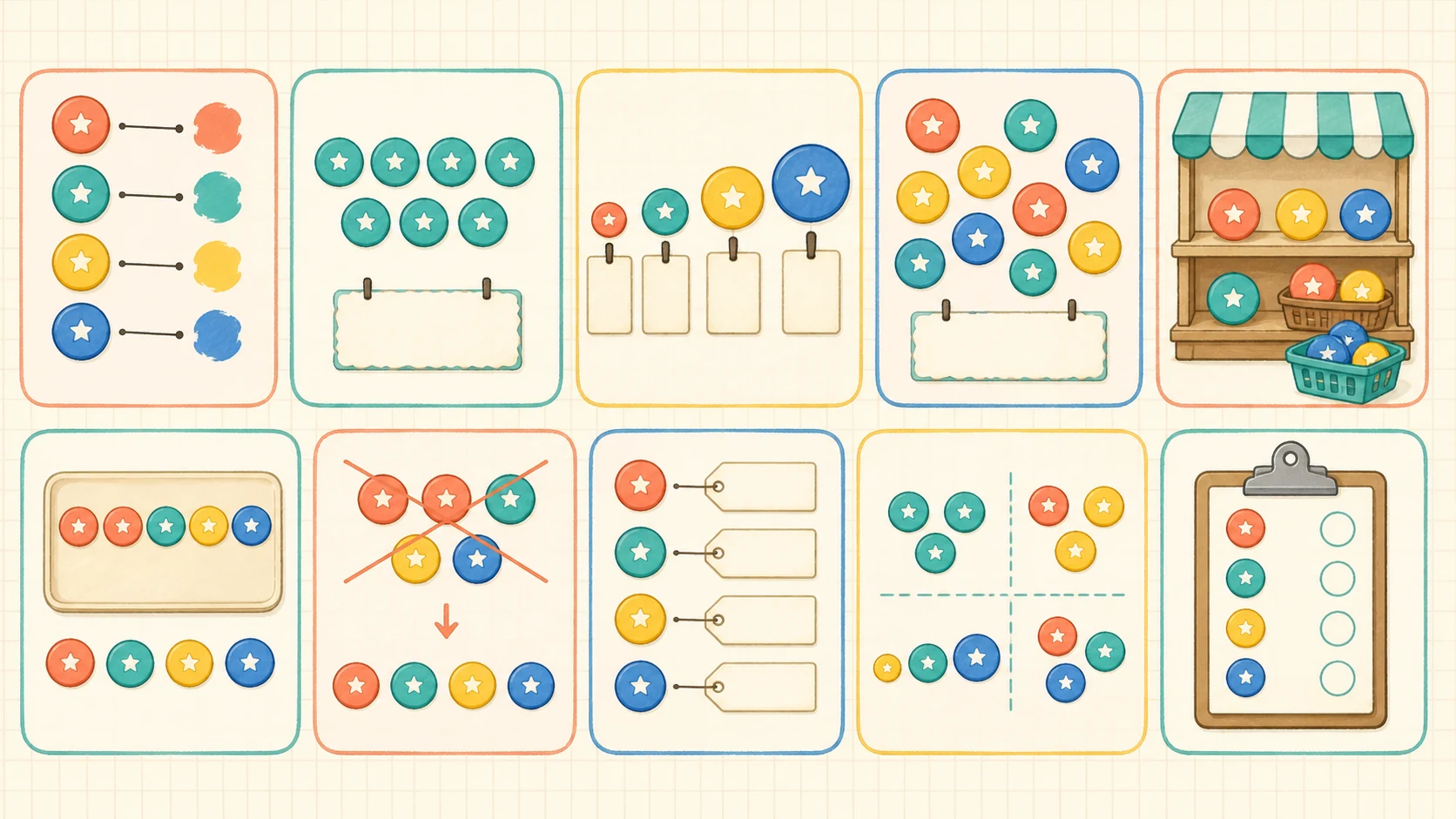
Revisit a few representative tasks after increasing delays, adjusting the plan when errors reappear.
| Suggested point | Review task | Decision |
|---|---|---|
| End of the lesson | Rework one corrected item without looking at the previous answer. | If the same error returns, model once more. |
| Next practice session | Solve two or three representative items or adult-created equivalents. | If coin values are recalled but counting slips, focus on organization. |
| Several days later | Count one like-coin set, one mixed set, and one operation or change example. | If all are explained accurately, widen the interval. |
| About one or two weeks later | Use a new printable or coin setup with the same core skills. | If performance remains stable, move toward the next topic-guide step. |
Do not preserve the interval when the evidence argues against it. If the learner forgets dime and nickel values at the next session, review sooner with concrete coins. If the learner recalls the method easily, reduce repetitive practice and move to a related application.
Limits of this printable
This worksheet offers 20 easy-level exercises and a separate answer key. Its catalogue scope includes counting money, coin values, money operations, and making change. It can provide useful written practice, but it cannot by itself show how a learner reasons across every money context.
A completed page does not establish comprehensive mastery, predict later performance, or certify standards attainment. The printable also cannot replace conversation and observation. An adult needs to notice whether the learner recognized the coins, selected an operation, maintained an accurate count, and understood the unit.
Use physical or realistic play coins when printed pictures alone are insufficient. Use short purchase scenarios when the learner needs the meaning behind “cost,” “pay,” and “change.” These are instructional supports, not claims that a particular material or schedule guarantees an outcome. Child-specific educational or medical decisions fall outside what this worksheet can determine.
The next useful action
Print the free 1st Grade Money worksheet, gather a small set of matching coins, and begin with one modeled example plus two guided items. Let the learner’s observed work determine how many of the remaining 20 items to assign.
After checking and correcting the page, choose the next practice from the broader Money guide. If several varied printables are needed, the 1st Grade Money Worksheet Pack contains 18 worksheets and is listed at $4.79. For customized follow-up practice, explore the free worksheet generators and create a small retrieval set based on the exact error pattern you observed.
Put it into practice
Use the guide with a real printable
Move from explanation to a short, observable practice task. Check the first item together, then adjust the next session from the learner's actual work.
See the 18-worksheet pack