Complete guide
How to teach and practise 1st grade fractions worksheets - standard theme (easy)
What this six-item worksheet is for
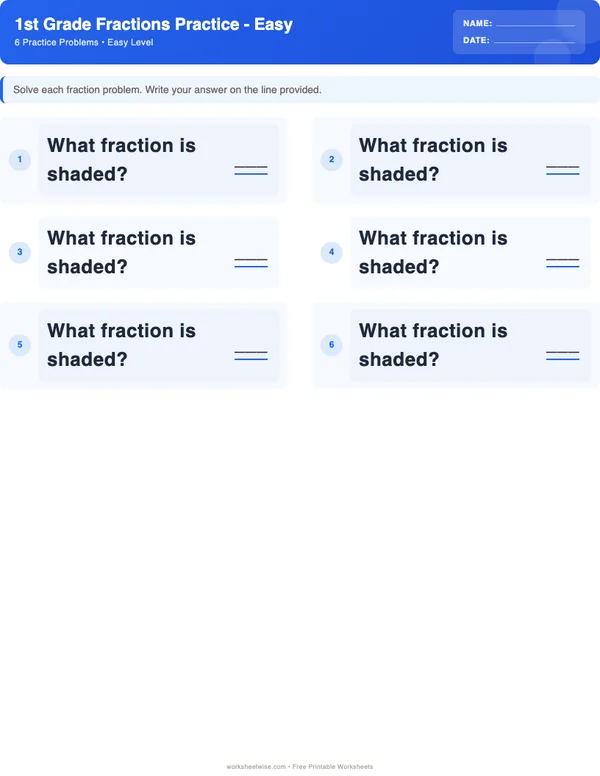
The free 1st Grade Fractions worksheet provides six easy-level exercises involving fractions, equivalent fractions, comparison, and fraction operations. Its printed direction is: “Solve each fraction problem. Write your answer on the line provided.” A separate printable answer key is included.
The short answer: use this worksheet as a focused check of how a learner interprets fraction tasks—not as a complete fractions lesson or a speed test. First preview all six items. Model one comparable problem that does not reveal an answer from the sheet. Complete one or two worksheet items together, then let the learner attempt the remaining items independently. Review errors by asking the learner to represent each whole and its equal parts before changing an answer.
Grade labels describe the intended practice level; they do not guarantee that every item matches a particular school’s current sequence. Local curricula and instructional sequences differ. The adult should therefore look at the actual problems before assigning the page and provide the necessary visual support without replacing the mathematical decision the learner is meant to make.
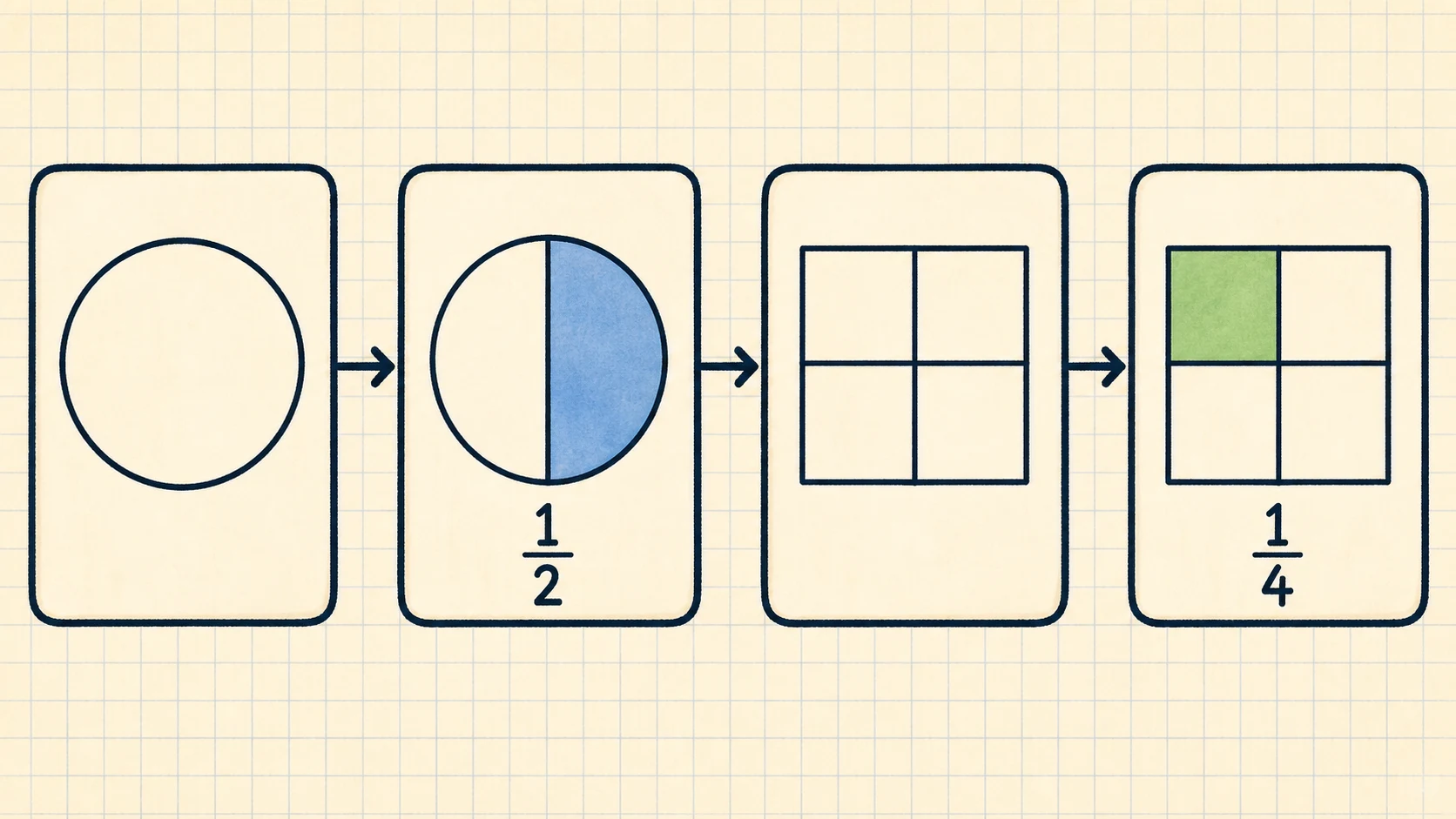
Preview, model, practice together, release responsibility, and review the evidence.
Prepare the worksheet before the learner begins
Print both the worksheet and its answer key, but keep the key out of the learner’s view during the first attempt. Have a pencil, two or three blank sheets of paper, and a few simple objects available. Folded paper strips, counters arranged in equal groups, or hand-drawn rectangles can make the fraction relationships visible.
Read all six problems yourself. The catalogue identifies four areas—fractions, equivalent fractions, comparing fractions, and fraction operations—but it does not specify which skill appears in each numbered item. Mark the skill each problem actually requires. For example:
- An item asking how much of a shape is selected requires identifying a fraction.
- An item showing two equal amounts divided differently may involve equivalence.
- An item asking which fraction is greater requires comparison.
- An item that joins or removes fractional parts requires an operation.
This preview matters because a learner might understand halves and fourths in pictures but not yet understand an operation written only with symbols. If several types appear on one page, announce the change in task: “This one asks us to name a part. The next one asks us to compare two parts.”
Do not teach every stage in the full fractions progression during this six-item session. For the wider sequence—from partitioning shapes to later work with number lines, equivalence, comparison, and operations—use the 1st Grade Fractions topic guide. The current page is better treated as a small practice sample within that larger path.
Use a short, observable lesson sequence
A calm lesson can take place in one sitting or be divided across two brief sessions. There is no universal timetable. Move according to the learner’s observed work: accuracy, explanations, use of equal parts, and ability to continue without prompts.
| Phase | Adult action | Learner action | Evidence to notice |
|---|---|---|---|
| Preview | Identify the demand in each of the six items | Listen and inspect the page | Recognizes that different items may ask different things |
| Launch | Establish “whole,” “equal parts,” and fraction language | Partition or inspect one simple model | Treats the whole as fixed and checks that parts are equal |
| Model | Solve a comparable example aloud | Watch, then explain the steps back | Connects the picture, words, and fraction notation |
| Guided practice | Complete one or two worksheet items together | Makes each mathematical choice with limited prompting | Can state what the denominator and numerator describe |
| Independent practice | Step back for the remaining items | Solves and records answers | Maintains the method without adult cues |
| Review | Compare reasoning with the answer key | Rechecks selected items and corrects in a different color | Can locate the step where an error began |
| Retrieval | Revisit a few related examples later | Solves without copying the earlier page | Recalls the idea after time has passed |
This structure is consistent with the broad instructional emphasis in the IES guide on teaching mathematics to young children: instruction can connect mathematical ideas with representations, language, and purposeful monitoring. That guidance did not evaluate WorksheetWise or this particular printable.
Launch with the meaning of equal parts
Before discussing symbols, draw a rectangle and call it one whole. Divide it into two equal sections. Shade one section and say, “The whole has two equal parts. One of those parts is shaded, so the shaded amount is one-half.”
Then draw another rectangle divided into two visibly unequal pieces. Ask whether either piece should be called one-half of the rectangle. The answer is no: two pieces alone do not make halves. They must be equal parts of the same whole.
This is a useful boundary case because young learners may count pieces without checking their size. Keep returning to three questions:
- What is the whole?
- Into how many equal parts was the whole divided?
- How many of those equal parts are being named, shaded, selected, joined, or removed?
The Common Core mathematics standards include an early geometry expectation involving circles and rectangles partitioned into equal shares and described with language such as halves and fourths. That is relevant high-level context for foundational fraction work. It does not establish comprehensive standards alignment for every item on this mixed-skill worksheet.
Connect words, pictures, and symbols
For a fraction such as , explain the notation in direct language:
- The denominator, 4, tells how many equal parts make the whole.
- The numerator, 3, tells how many of those parts are being considered.
- The fraction bar separates the two numbers and can be read as “out of” in an introductory visual example: three selected parts out of four equal parts.
Avoid teaching “top number” and “bottom number” as the entire explanation. Those location labels may help a learner point to the symbols, but they do not explain what the numbers mean.
If the worksheet uses pictures, ask the learner to trace the outline of the whole and touch each equal part. If it uses only symbols, permit a quick sketch. The sketch supports the same skill because the learner must still determine the fraction relationship.
Model the task without completing the page for the learner
Use an example similar in structure to the worksheet, not one copied from it. Say what you notice, what you need to decide, and how you will verify the result.
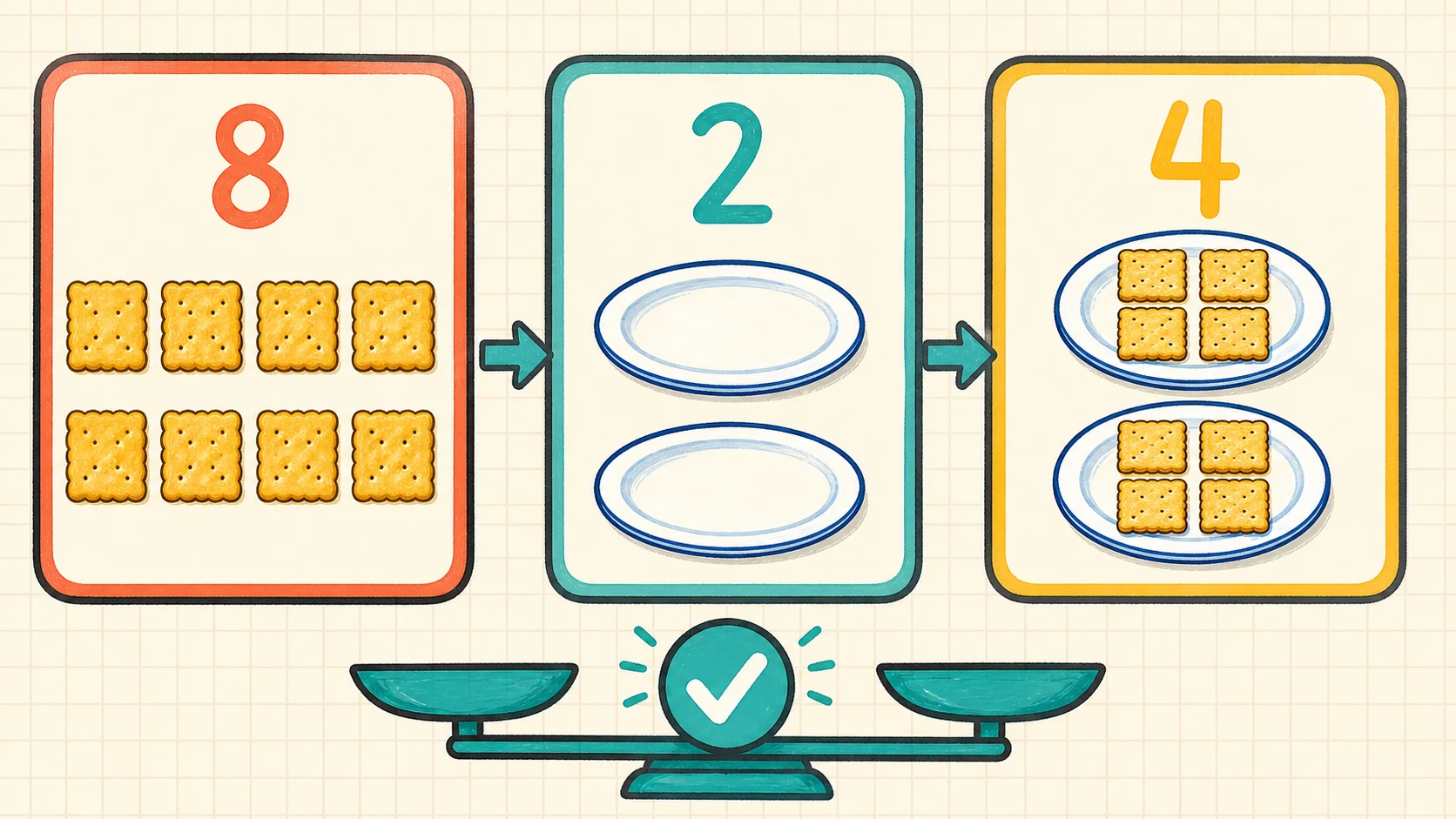
The model makes the whole, the equal parts, and the final notation explicit.
Worked example 1: identify a fraction
Draw a rectangle divided into four equal sections. Shade three sections.
Reason through it:
- The rectangle is the whole.
- It has 4 equal parts, so the denominator is 4.
- Exactly 3 parts are shaded, so the numerator is 3.
- The shaded fraction is .
Check the answer by counting the equal parts again: four altogether, three shaded. The answer is , not . The fraction would describe four one-fourth-sized parts, which is more than one whole; that is not what the drawing shows.
Worked example 2: recognize equivalent fractions
Draw two equal-length paper strips. Divide the first into two equal parts and shade one part. Divide the second into four equal parts and shade two parts.
The first strip shows . The second shows . The shaded lengths have the same starting and ending points, so the amounts are equal:
This conclusion depends on both strips representing equal-sized wholes. If one strip is longer, equal-looking counts do not establish equivalent fractions. Keeping the whole the same is an important boundary condition.
Worked example 3: compare fractions with the same whole
Draw two equal rectangles. Divide each into four equal parts. Shade one part of the first and three parts of the second.
The first amount is , and the second is . Because the wholes and the size of each fourth are the same, compare the number of selected fourths:
Read this as “one-fourth is less than three-fourths.” To check, point to the shaded area in each rectangle. Three equal fourths cover more of the same-sized whole than one fourth.
Worked example 4: combine like fractional parts
Draw a bar divided into four equal sections. Mark one section, then mark one more section.
One fourth plus one fourth makes two fourths:
The denominator stays 4 because the pieces are still fourths. The count of selected fourths changes from one to two. The visual also shows that covers the same amount as , although a learner should only be asked to rename the result if equivalence is part of the item.
Worked example 5: remove one equal part
Draw a circle split into two equal halves and shade both halves. The starting amount is , or one whole. Cross out one shaded half:
There is one half left. Again, the pieces remain halves, so the denominator does not change.
These examples are independently checkable, but they are not presented as the six exact worksheet answers.
Move from guided practice to independent work
Place the worksheet in front of the learner and read the printed direction together. Ask the learner to point to the first problem and say what kind of decision it requires. If reading the wording is a barrier, read it aloud accurately without supplying the mathematical answer.
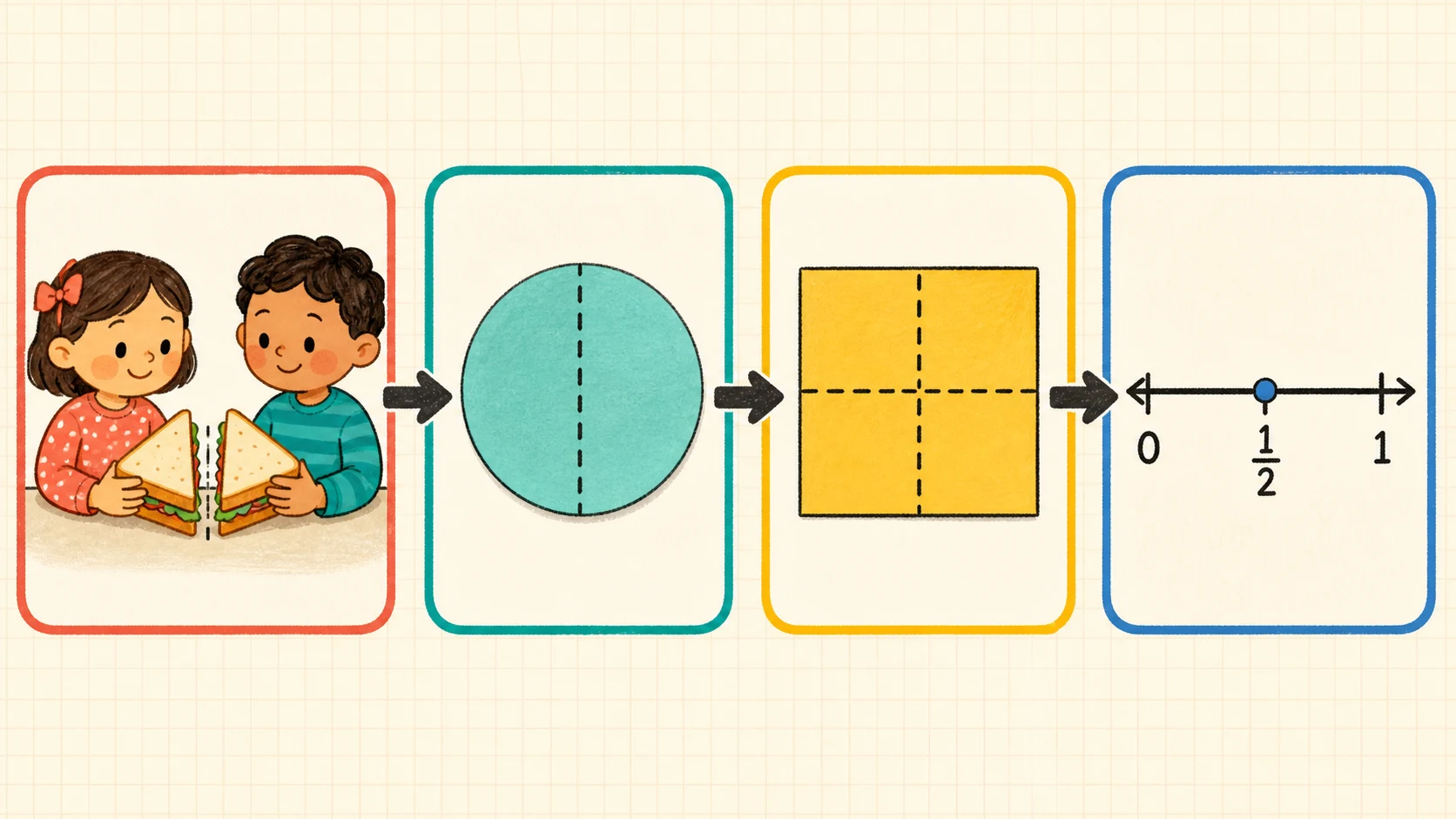
Guided practice supplies a process while leaving the key decision to the learner.
Run one guided item
For the first suitable item, use prompts in this order:
- “Show me the whole.”
- “Are the parts equal?”
- “How many equal parts make the whole?”
- “How many parts are involved?”
- “What answer will you write?”
- “How can you check it?”
Wait after each question. If the learner answers correctly, avoid adding another explanation merely to fill the silence. Ask for a brief reason, record what the learner can do, and continue.
If the learner cannot begin, return to a comparable drawing on blank paper. Do not mark the worksheet answer during the demonstration. After the model, cover it and invite the learner to try the worksheet item.
Release support gradually
On a second item, reduce the prompts to “What is the whole?” and “How will you check?” If those are enough, step back. Let the learner complete the remaining items independently.
Independent work means the learner chooses the method and answer. It does not require silent struggle. You may clarify a direction, provide a ruler for drawing a bar, or allow counters. Avoid pointing to the correct choice, changing the learner’s drawing, or saying “Look again” only when an answer is wrong; those cues can reveal correctness without showing what the learner understands.
For six items, record both the final answers and the level of assistance. An accurate response after several leading prompts is different evidence from an accurate response completed and explained independently.
Adapt support without changing the skill
Support should make the intended reasoning more accessible. It should not turn a comparison problem into guessing, remove the need to identify equal parts, or provide the answer through the prompt.
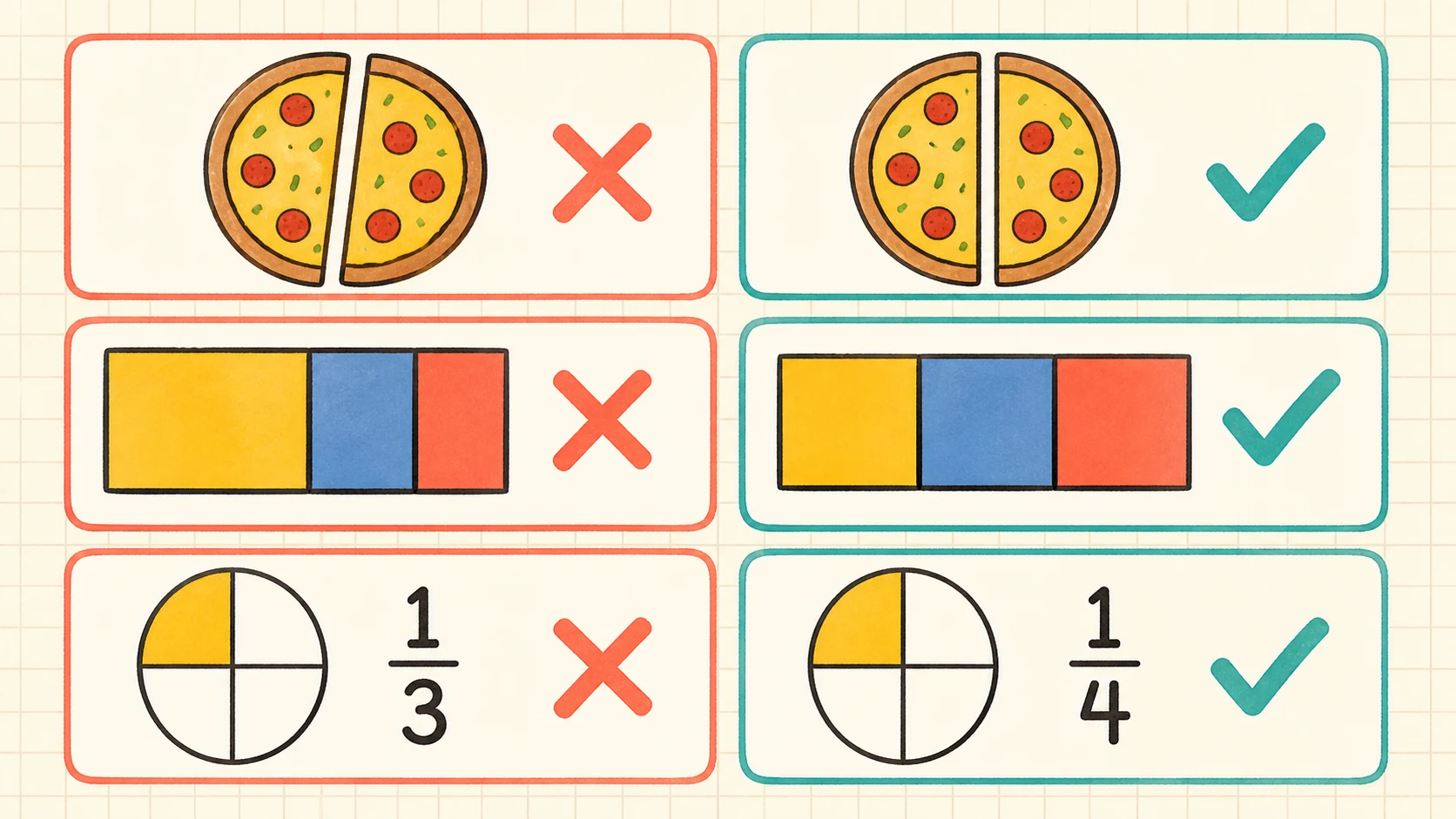
Adjust representation, language, or workload while preserving the mathematical decision.
Add concrete or visual support
If the learner is unsure what the symbols mean, recreate the problem with equal paper strips or simple bars. For and , align equal-length strips at the same starting point. For an operation involving fourths, draw a whole divided into four equal spaces and mark each part involved.
The learner should still state or write the fraction. Handling a model is preparation for the answer, not a substitute for naming the relationship.
Reduce language demands
Read the instructions aloud and replace a long prompt with a short accurate restatement, such as “Which amount is greater?” Keep the mathematical vocabulary visible. Pair “denominator” with “the number of equal parts in the whole” rather than removing the term entirely.
If handwriting is slowing the lesson, let the learner say the numerator and denominator before writing. You can draw a blank fraction bar, but the learner should choose both numbers.
Adjust the amount of practice
Because the printable has six items, a learner who tires or becomes disorganized may complete three items now and three later. This changes the session length, not the target skill. Mark where the first session stopped, and begin the second with one brief recall prompt.
A learner who completes all six accurately should explain two contrasting items rather than immediately receiving more of the same. One useful contrast is identifying in a picture and explaining why . Another is showing why and can name the same amount.
The IES practice guide for assisting students who struggle with mathematics offers broad framing around systematic instruction, mathematical language, representations, and monitoring progress. Use that source as general instructional guidance, not as a claim that it recommends this exact worksheet or a particular adaptation for an individual child.
Interpret errors before correcting them
A score alone cannot show whether an error came from unequal partitioning, reversed notation, comparison language, an operation, or simple recording. Ask the learner to reconstruct the reasoning.
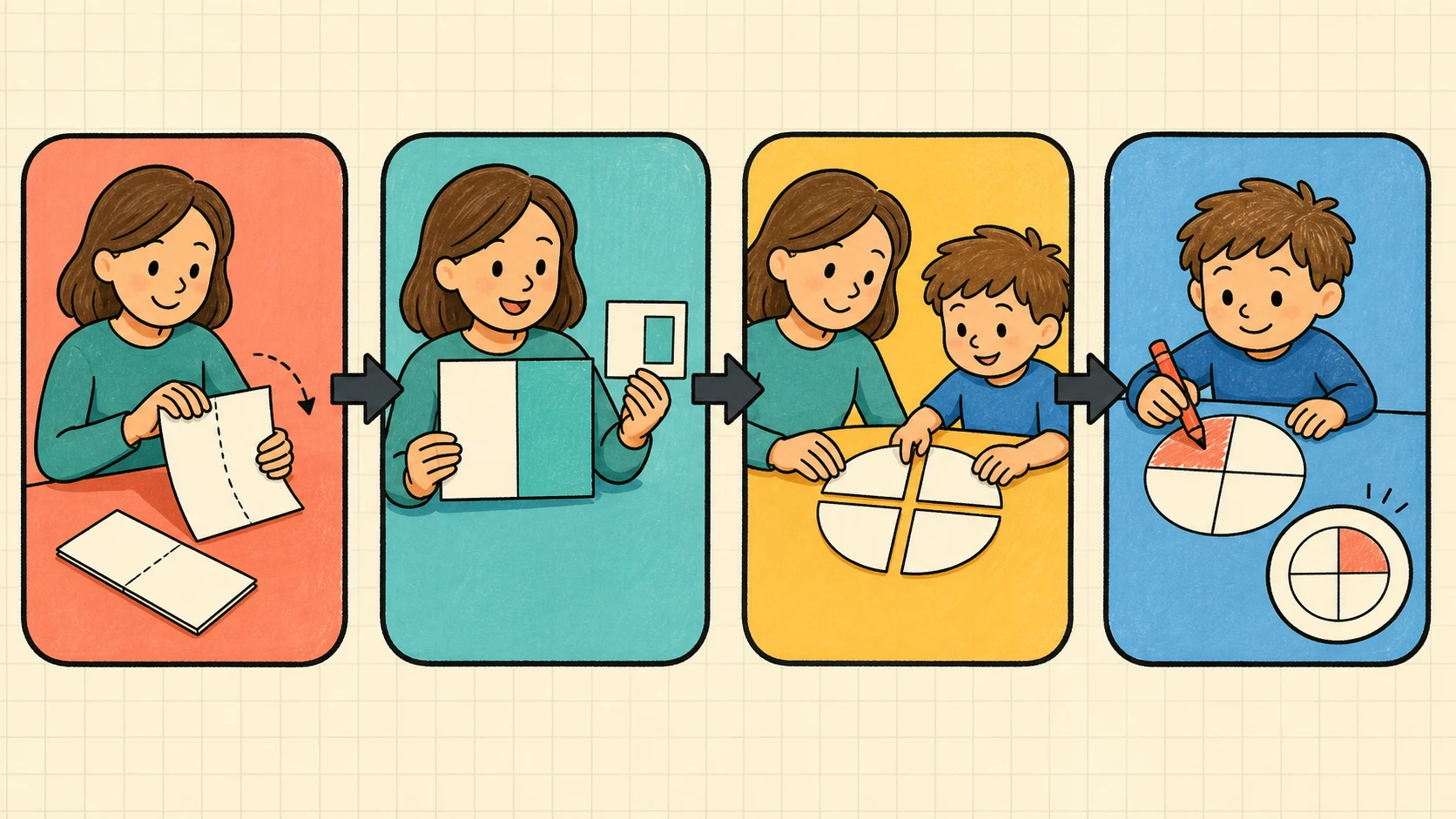
Locate the whole, check equal parts, name the quantities, and then reconsider the answer.
Unequal parts treated as fractions
A learner may divide a shape into two pieces of different sizes and call each piece one-half. Respond with two equal paper strips. Fold one exactly in half and divide the other unevenly. Ask which strip has two equal shares.
Instructional response: revisit equal partitioning before asking for fraction notation. The difficulty is not necessarily the symbols; it may be the meaning of equal shares.
Numerator and denominator reversed
A learner looking at three shaded parts in a four-part whole may write . Ask, “How many equal parts make the whole?” Write that number below a blank fraction bar. Then ask, “How many are shaded?” Write that number above it.
Instructional response: connect each number to its job. Repeating “top and bottom” is unlikely to resolve the conceptual reversal by itself.
More pieces assumed to mean a larger piece
A learner may say because 4 is greater than 2. Draw two equal-sized bars. Divide one into halves and the other into fourths. Compare one piece from each bar. When the same whole is cut into more equal parts, each individual part is smaller.
Boundary case: this comparison depends on the wholes being the same size. One-half of a small object need not be larger than one-fourth of a much larger object. Introductory worksheet comparisons generally need a shared or equal whole to support a direct visual conclusion.
Denominators added in a like-part operation
A learner may calculate as . Return to the four-part bar. Joining two fourth-sized pieces gives two fourths; it does not recut the whole into eighths.
Instructional response: name the unit repeatedly—“one fourth plus one fourth equals two fourths.” Do not introduce a general fraction-operation rule beyond what the item and learner’s current representation can support.
Correct answer with unclear reasoning
A correct answer may come from guessing or following a surface pattern. Ask for one drawing or a sentence such as “There are three shaded parts out of four equal parts.” If the explanation is sound, continue. If it is not, model a comparable example and revisit the item later without signaling its answer.
Check the answer key responsibly
Use the separate answer key after the learner has completed an honest attempt. Match each answer to the corresponding item carefully, especially if the worksheet includes different problem types.
First mark items as correct, incorrect, or not yet interpretable. Then add a brief note about the method:
- I: completed independently and explained
- P: completed with a neutral prompt
- M: completed after a model
- R: needs reteaching before another attempt
This record is more informative than writing only “5/6.” It distinguishes a recording slip from a misconception and an independent success from an answer produced through extensive support.
If the learner’s answer differs from the key, solve the item yourself using a visual model. Confirm that you read the operation, comparison symbol, selected region, and requested answer form correctly. Answer keys help adults check efficiently, but they should still be used thoughtfully. If the learner gives an equivalent form and the item’s directions do not make the expected form clear, compare the represented values before deciding how to discuss it.
Invite the learner to correct an error in a different color. Ask for the reason, not repeated copying: “I changed to because the whole has four equal parts and three are shaded.”
Do not show all key answers and then ask the learner to make the page match. That checks copying, not fraction understanding.
Decide what the learner needs next
Use the pattern across the six items, the explanations, and the amount of support—not one isolated mistake.
If the learner struggles to identify the whole or accept only equal partitions, pause mixed practice. Work with circles, rectangles, and paper strips divided into two and four equal shares. Return to symbols after the learner can explain the parts.
If identification is secure but comparison is weak, use equal-sized wholes and compare fractions with a shared denominator or familiar halves and fourths. Ask the learner to predict first, build or draw the amounts, and then verify.
If equivalence is uncertain, align equal paper strips showing examples such as and . Keep the wholes equal. The immediate goal is to notice that different partitions can cover the same amount, not to memorize a procedure for generating equivalent fractions.
If an operation is the difficulty, name the fractional unit and model what changes. In , the number of fourths changes while the unit remains fourths.
If all six items are accurate and independently explained, avoid treating one short page as proof of complete mastery. Change the representation or wording on a later day. The learner might identify a fraction from a shape, build it with a strip, compare it with another amount, or explain an equivalent pair. The 1st Grade math collection can help you select related practice without assuming that every available worksheet should be completed in order.
Schedule retrieval after the first attempt
A correct answer during instruction may reflect immediate support. A later attempt shows whether the learner can retrieve and apply the idea again. Space the review according to observed performance rather than following a rigid calendar.
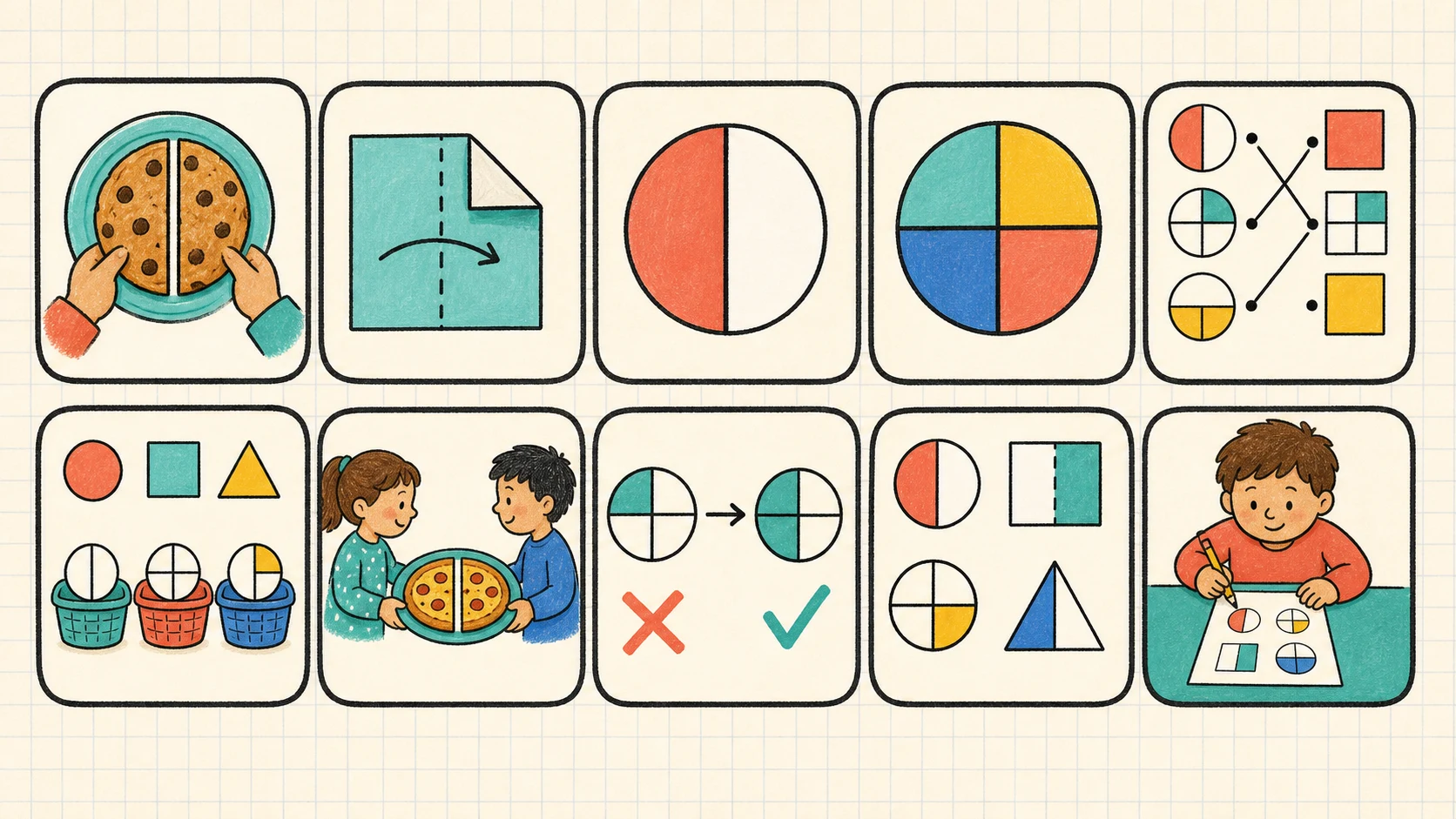
Revisit the idea after increasing gaps and adjust the interval when the evidence changes.
A practical schedule might look like this:
| Review point | Suggested task | What to observe |
|---|---|---|
| End of the lesson | Explain one completed item without looking at the key | Can the learner name the whole and equal parts? |
| A later day | Solve one new identification or comparison example | Is the method recalled without the original model? |
| Several days later | Complete two mixed examples in a different format | Does understanding transfer from pictures to words or symbols? |
| The following week | Revisit one earlier error and one successful skill | Is the correction retained? |
| Later as needed | Include a fraction item among other math practice | Can the learner recognize the skill without advance warning? |
These are instructional suggestions, not a sourced or universal timetable. Shorten the gap when the learner cannot reconstruct the idea. Lengthen it when the learner answers accurately, explains the reasoning, and uses little or no prompting.
Do not reuse all six items so frequently that the learner memorizes their positions. Change the numbers or pictures while preserving the underlying skill. For example, after identifying , ask for in a differently oriented rectangle. After comparing and , compare and to see whether the learner notices equality rather than assuming every pair must have a greater amount.
Keep the worksheet’s limits in view
This printable contains only six exercises. It can provide a useful snapshot, a short guided-practice opportunity, homework, or reinforcement, but it cannot sample every fraction representation or establish lasting mastery by itself.
The catalogue places identifying fractions, equivalent fractions, comparing fractions, and fraction operations on this page. Those skills cover more than one kind of reasoning. A learner’s overall result may therefore hide a clear strength in one area and a gap in another. Record performance item by item.
The “easy” label describes the worksheet’s catalogue difficulty. Difficulty still depends on prior instruction, vocabulary, familiarity with visual models, and the exact form of each problem. An adult may read directions, supply an equal-parts model, or split the page into two sessions without changing the skill. If the learner needs the answer disclosed, however, the resulting mark should not be treated as independent performance.
This guide offers instructional suggestions, not medical, diagnostic, or child-specific advice. It does not promise outcomes, certification, or comprehensive alignment with any standards system. Grade labels indicate intended practice level, and local sequences differ. The learner’s observed work should determine whether to review an earlier representation, repeat a comparable task, or move forward.
Continue with a focused next action
Print the free six-item worksheet, preview its problem types, and choose one comparable example from this guide to model before the learner starts. After checking the work, use the broader fractions topic guide to select the next skill based on the learner’s actual errors.
If the learner needs a longer run of related practice, consider the 1st Grade Fractions Worksheet Pack, which the catalogue lists as 18 worksheets for $4.79. If a specific representation or number choice needs to be revisited, use the free worksheet generators to create a fresh retrieval task instead of repeatedly rehearsing the same six answers.
Put it into practice
Use the guide with a real printable
Move from explanation to a short, observable practice task. Check the first item together, then adjust the next session from the learner's actual work.
See the 18-worksheet pack