Complete guide
How to teach and practise 1st grade counting worksheets - standard theme (easy)
What This 20-Item Counting Worksheet Is For
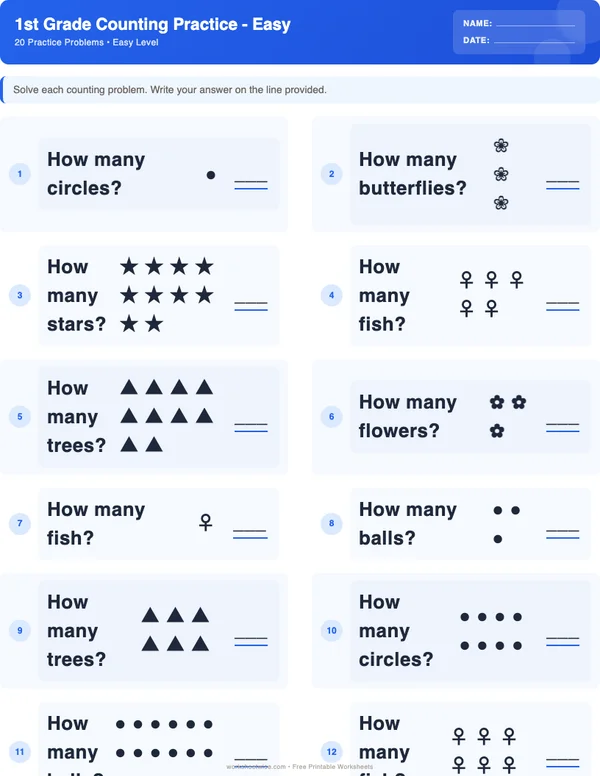
The free 1st Grade Counting worksheet gives a learner 20 easy-level exercises involving counting, number sequences, skip counting, number recognition, and number sense. The printed direction is simple: “Solve each counting problem. Write your answer on the line provided.” A separate printable answer key is included.
The most useful way to teach with this worksheet is to model one example, solve a small group together, let the learner complete a manageable section independently, and then study the work before deciding what comes next. Do not use speed as the main measure of success. Look for accurate counting, recognition of the sequence rule, and an ability to explain how an answer was found.
This printable can serve as classroom practice, homework, homeschool work, or focused reinforcement. It is not a complete counting curriculum or a complete assessment of number understanding. For the wider sequence of counting skills, examples, and related practice, use the 1st Grade Counting topic guide.
Grade labels describe the intended practice level; local school sequences and individual learners’ prior experience differ. Although the catalogue associates the broader counting topic with several kindergarten counting standards, that does not by itself establish comprehensive standards alignment for this particular worksheet. Adults who need to compare local expectations can consult the official Common Core State Standards for Mathematics and their own school or homeschool sequence.
A Practical Lesson Map
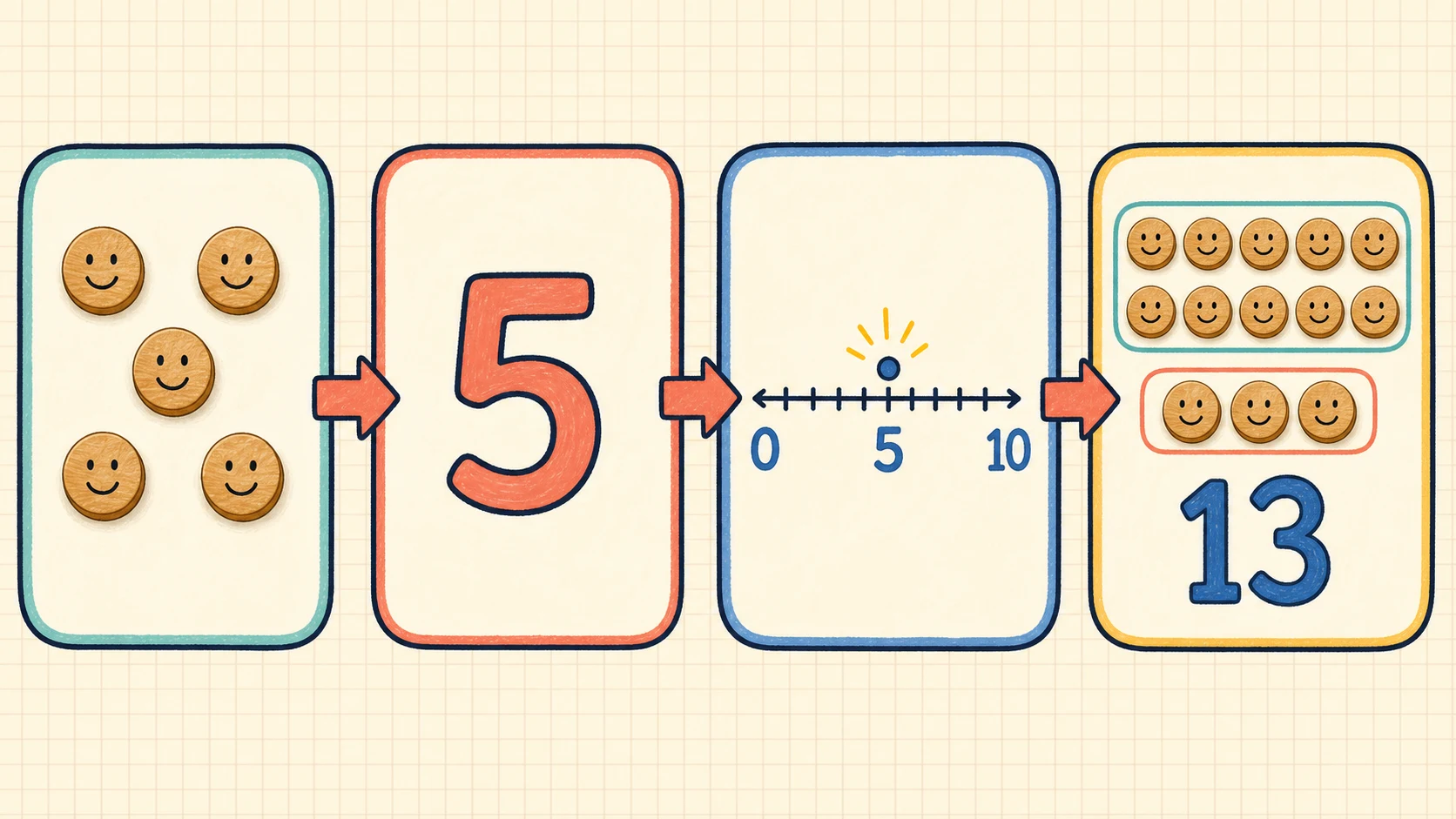
Move from a short launch to modeling, guided practice, independent work, and a careful review.
The table below is a suggested way to organize one use of the printable. It is an instructional option, not a universal timetable. The learner’s observed work should determine whether a phase is shortened, extended, or continued later.
| Lesson phase | Adult action | Learner action | Evidence to watch |
|---|---|---|---|
| Preview | Scan the 20 items and identify sequence, skip-counting, or recognition formats | Look over the page without solving everything | Notices that different items may use different counting rules |
| Launch | Read the printed direction and clarify what belongs on each answer line | Restate the task in simple words | Understands where and how to record an answer |
| Model | Think aloud through one similar example | Watch, listen, and identify the counting rule | Follows the relationship between neighboring numbers |
| Guided practice | Complete two or three selected items together | Say the sequence, point, or use a number aid | Uses a consistent method rather than guessing |
| Independent practice | Assign a small section or the remaining suitable items | Solve and write answers | Maintains accuracy without continuous prompting |
| Review | Compare reasoning and written answers with the key | Explain selected answers and correct errors | Can find and repair at least some mistakes |
| Retrieval | Revisit a few examples after a delay | Solve without copying prior work | Recalls the method with less support |
Before teaching, print both the worksheet and its answer key, but keep the key out of the learner’s immediate view. Check that all numbers and answer lines are readable. Have a pencil available. Optional supports include counters, linking cubes, a number line, or a hundred chart, but introduce only the aid that answers an observed need.
Launch the Exact Printable Clearly
Preview the task before asking for answers
Begin by showing the learner the whole page. State that it contains 20 counting problems and that the goal is to work out each missing or requested number and write it on the provided line. Because the catalogue identifies counting sequences, skip counting, and number recognition as worksheet skills, remind the learner to inspect each item rather than assume that every sequence changes by one.
A concise launch might be:
“This page has different kinds of counting practice. Before writing, look at the numbers that are already shown. Decide whether they go up by one or follow another repeated step. Then write the answer on the line.”
That language describes a usable process without supplying any particular worksheet answer.
Check readiness with a brief oral warm-up
Use two or three oral prompts that do not duplicate answers from the printable. For example:
- Count forward from 4 to 9.
- Say the number immediately after 12.
- Count by twos from 2 to 10.
Listen for what the learner actually does. A learner who counts forward accurately but hesitates when the step changes may need explicit skip-counting support. A learner who says the sequence correctly but writes a different numeral may need help separating counting from numeral formation or number recognition. Those are different observations and should lead to different support.
High-level guidance from the IES practice guide on teaching mathematics to young children supports purposeful instruction that helps young learners connect mathematical ideas, representations, and language. That source did not evaluate this WorksheetWise printable; it provides general instructional framing.
Model the Reasoning, Not Just the Answer
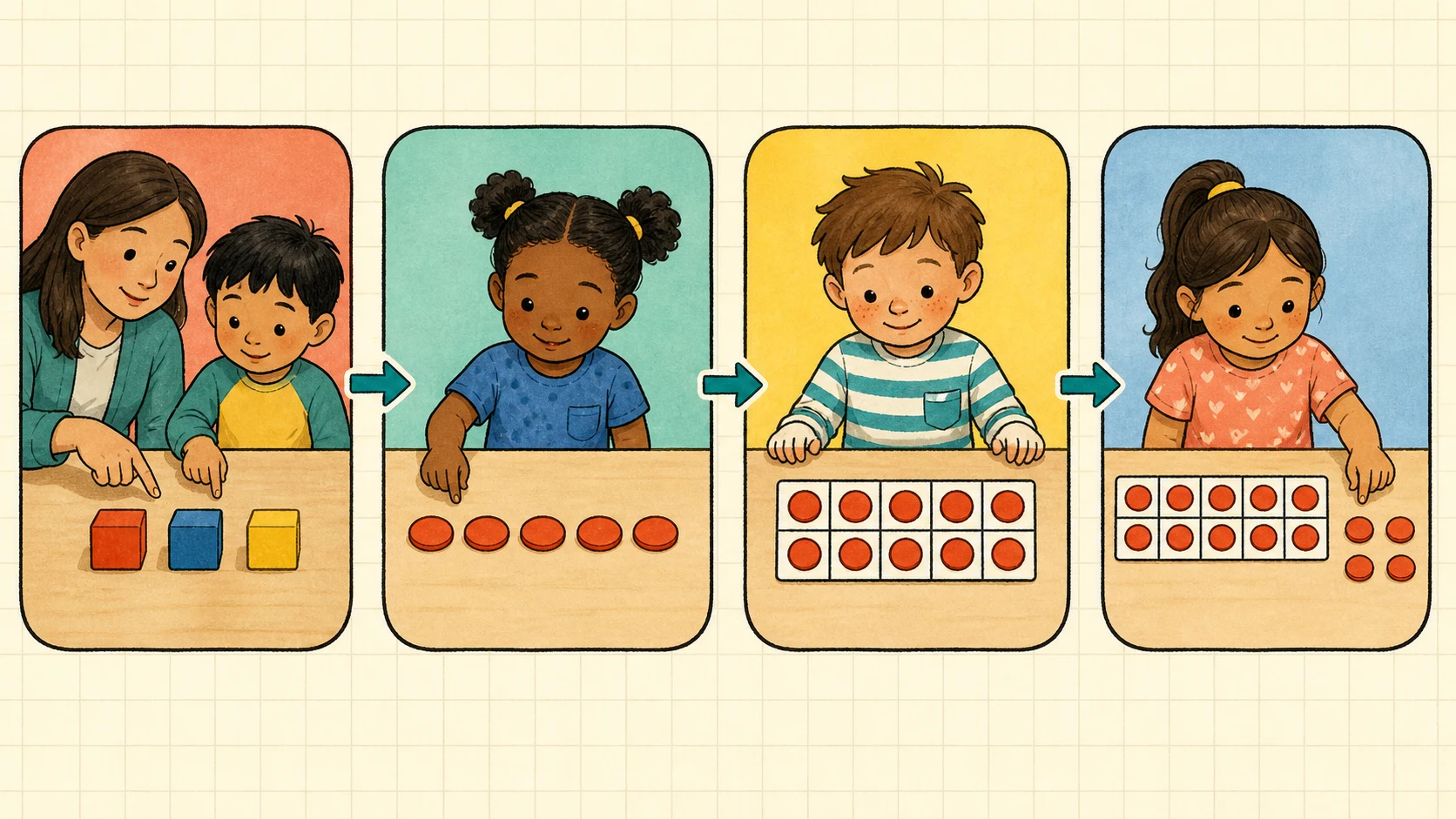
Show how to identify the counting step before asking the learner to continue alone.
Choose one worksheet item that represents the page without appearing unusually difficult. Cover the later items if the full page is distracting. Read the visible numbers aloud, compare neighboring entries, and name the repeated change.
A useful model has four parts:
- Read the numbers already provided.
- Compare one number with the next.
- State the rule in plain language.
- Apply the same rule and check it.
For a similar sequence such as 6, 7, 8, ___, say:
“Six to seven is one more. Seven to eight is also one more. The rule stays the same, so one more than eight is nine. I will write 9. Now I check by reading the completed sequence: six, seven, eight, nine.”
The learner needs to see that the answer comes from a relationship, not from an adult’s memory of the answer key. Keep the think-aloud short enough that the learner can imitate it.
Move from explanation to a prompt
On the next suitable problem, reduce the explanation and ask:
- “What changes each time?”
- “Are we counting by ones or making a different jump?”
- “What should come next?”
- “How can you check?”
If the learner answers correctly, ask for a brief reason and move on. Requiring a long explanation for every easy item can turn a straightforward practice page into an unnecessarily heavy language task. Use explanation strategically, especially when the pattern changes or an error appears.
Four Fully Checked Examples
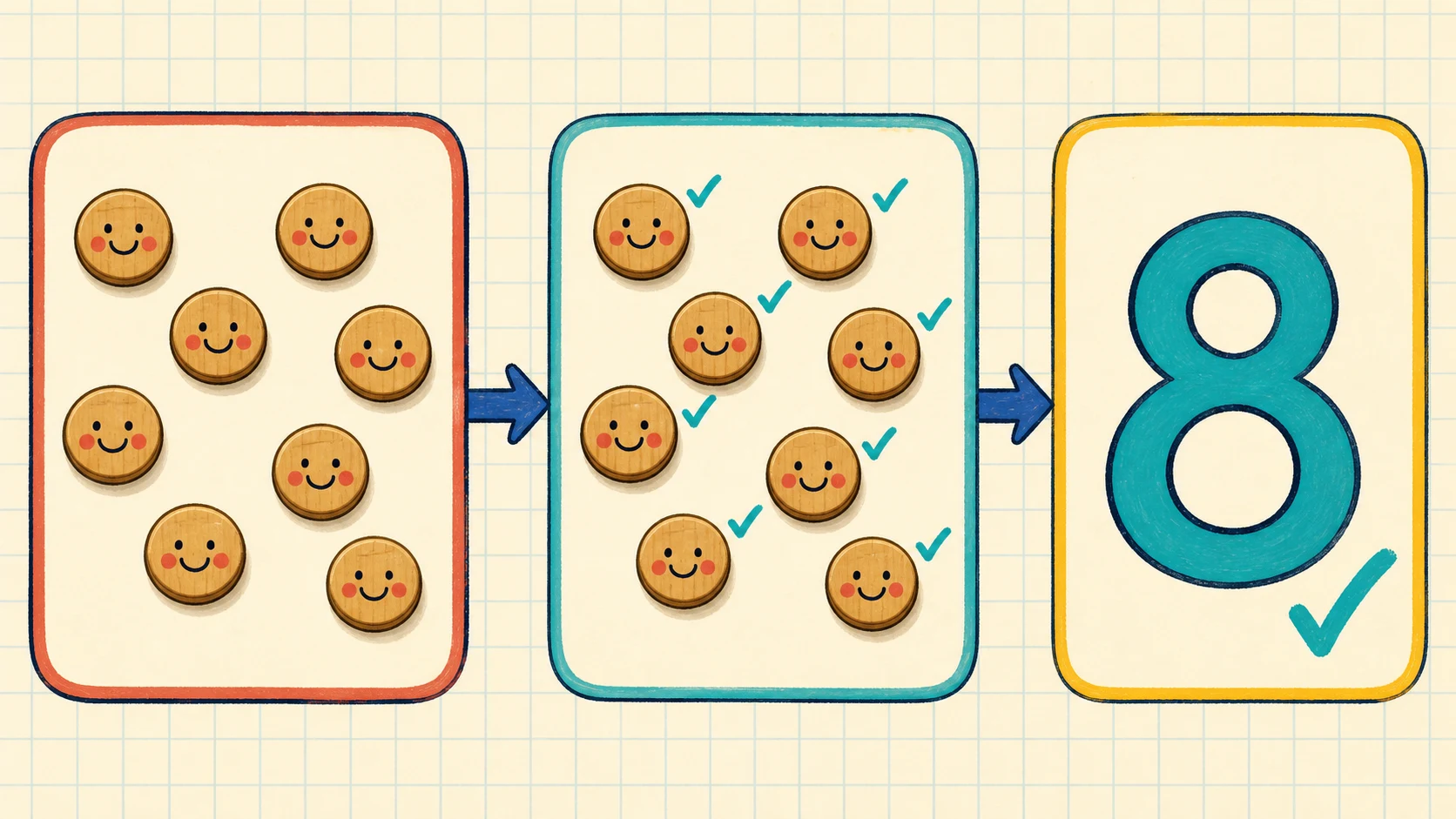
Each example identifies a rule, applies it, and checks the completed sequence.
These examples are verified demonstrations similar to the listed worksheet skills. They are not claims about the exact numbers printed in each of the 20 items.
Example 1: Count forward by ones
Problem: 14, 15, 16, ___
Compare consecutive numbers:
The repeated step is add 1. Therefore:
Answer: 17
Check: Read the complete sequence: 14, 15, 16, 17. Each number is one greater than the one before it.
Example 2: Find a missing number inside a sequence
Problem: 21, ___, 23, 24
This is not solved by looking only at 24 and counting forward. Use both sides of the blank.
The number after 21 is:
The number before 23 is also 22:
Both checks agree.
Answer: 22
Check: The completed sequence is 21, 22, 23, 24, with a difference of 1 between every pair.
Example 3: Skip count by twos
Problem: 4, 6, 8, ___
Compare the steps:
The rule is add 2, not add 1. Apply it again:
Answer: 10
Check: The complete sequence 4, 6, 8, 10 increases by two each time. Counting the jumps aloud—“plus two, plus two, plus two”—confirms the pattern.
Example 4: Skip count by fives
Problem: 5, 10, 15, ___
The differences are:
Continue the repeated step:
Answer: 20
Check: Count by fives from the beginning: 5, 10, 15, 20. The final number preserves the rule.
Example 5: Recognize the number before
Problem: “Write the number immediately before 30.”
Counting forward gives 28, 29, 30, so the number immediately before 30 is 29. Subtraction gives the same result:
Answer: 29
Check: Place the numbers in order: 29, 30. Because 29 comes directly before 30, the answer is correct.
This fifth example is useful because a learner can know how to continue a visible row yet still misread words such as “before” and “after.” In that case, the counting knowledge may be stronger than the response suggests.
Run Guided Practice Before Independent Work
Use a prompt ladder
Select two or three actual items for guided work. Give the least help that allows the learner to reason successfully. A practical prompt ladder is:
- “Read the numbers.”
- “What changes from one number to the next?”
- “Show the jump on a number line or with counters.”
- “Say the completed sequence.”
- Model one comparable example if the learner still cannot begin.
Start at the top of the ladder each time rather than automatically providing every support. If “Read the numbers” is enough, stop prompting and let the learner solve. If the learner cannot identify the change, make the relationship visible.
For a count-by-two pattern, two-color counters can show pairs. For a missing number in a count-by-one sequence, a number line can display the adjacent positions. These aids preserve the counting skill when they help the learner represent the same number relationship.
Release responsibility in small steps
After a correct guided response, ask the learner to try one similar item while narrating only the rule. Then ask for one without narration. Independent work begins when the learner chooses and uses a method without the adult supplying the next number.
The IES practice guide for assisting students struggling with mathematics offers high-level guidance on explicit, systematic instruction and the use of mathematical representations. Applied here as an instructional suggestion, that means making a counting relationship visible, practicing it with support, and then reducing that support. It does not mean the guide endorses this particular worksheet.
Adapt Support Without Replacing the Skill
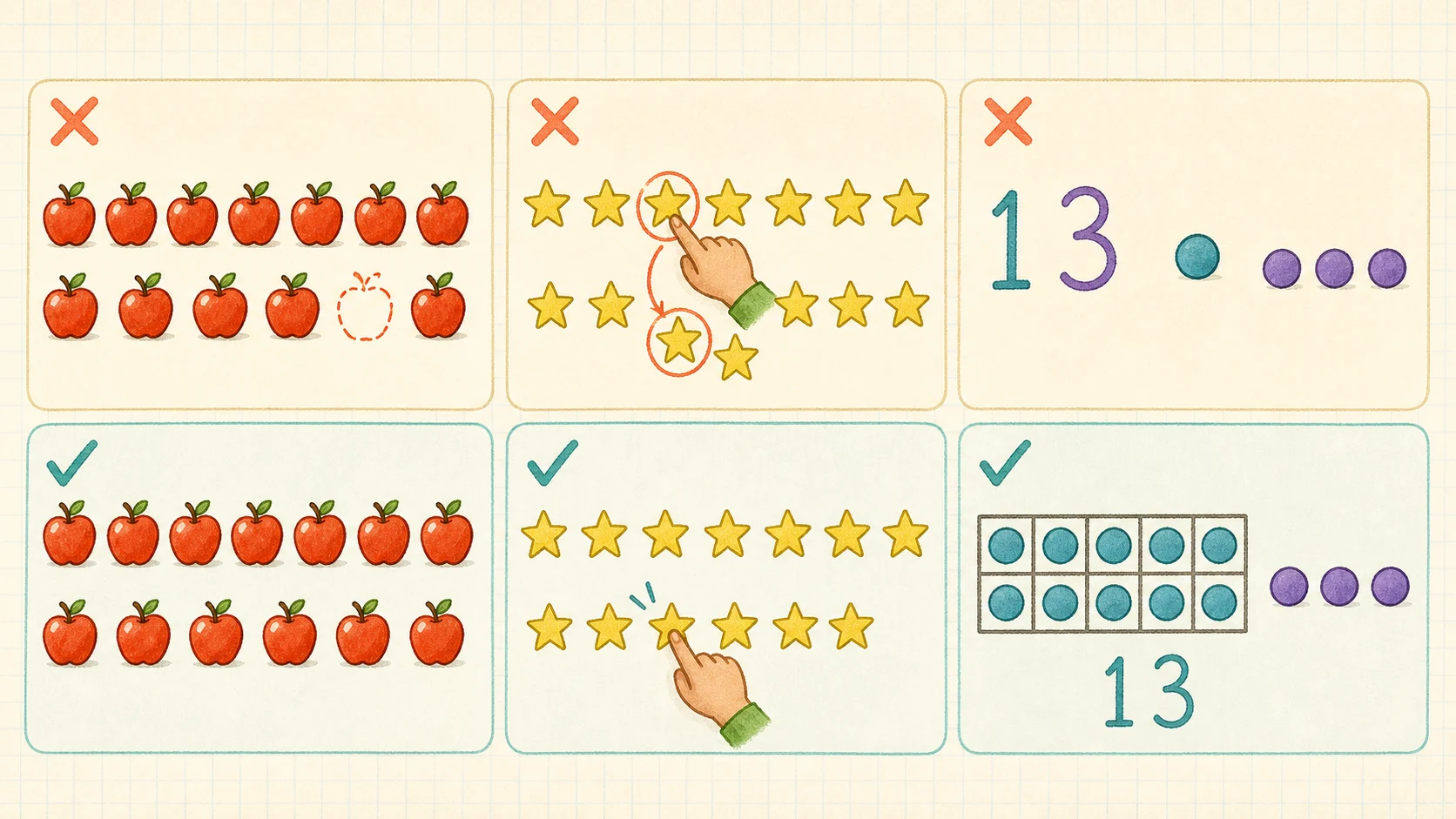
Adjust the amount of work, the representation, or the prompting while keeping the counting target intact.
Differentiation should respond to observed work. Avoid assigning a support because of a broad label alone. First identify what happened on a specific item.
When the learner loses one-to-one correspondence
If an item requires counting pictured objects and the learner recounts or skips objects, allow pointing, touching, or moving counters one at a time. A useful routine is “touch, say, move”: touch one object, say one number, and move or mark that object before continuing.
Keep the final question unchanged: the learner still determines how many objects are present. The support organizes the counting process; it does not supply the total.
For a scattered set, the learner can move each counted object into a separate group. If the objects cannot be moved, suggest a consistent scan from left to right or top to bottom. Do not insist on a single organization method if another method produces accurate one-to-one counting.
When the learner loses the number sequence
Provide a number line or hundred chart and ask the learner to locate the starting number. Have the learner trace each required step rather than copy the destination immediately.
If the sequence is 11, 12, 13, ___, the learner starts at 13 and moves one position forward. If the sequence increases by two, the learner makes equal two-space jumps. Continue to ask, “What is the step?” so the visual aid supports reasoning rather than becoming an answer-copying surface.
The catalogue’s broader counting guidance notes that teen numbers can require additional attention because their spoken names are less predictable than later tens-and-ones naming. When hesitation clusters around 11–19, slow down, say the numbers in order, and pair each spoken name with its written numeral.
When the full page is too much at once
Fold the paper, cover unused rows, or mark a stopping point after a small group of problems. The learner still completes counting tasks, but the visual and endurance demand is reduced.
A reasonable instructional choice might be five items followed by a check-in. That is not a required schedule. If five accurate items are easy, increase the independent section. If errors appear after two items, pause sooner and inspect the cause.
When the worksheet appears too easy
Do not add unrelated arithmetic merely to make the page harder. Ask the learner to state the rule, fill a blank placed in the middle rather than only at the end, or give the number immediately before and after an answer. For example, after finding 17, the learner might identify 16 and 18.
Another extension is to ask the learner to create a short sequence with the same rule. If the rule is “add two,” a valid created sequence could be 3, 5, 7, 9. Verify each difference:
These extensions deepen attention to the existing counting relationship without changing the lesson into a different topic.
Interpret Errors Before Correcting Them
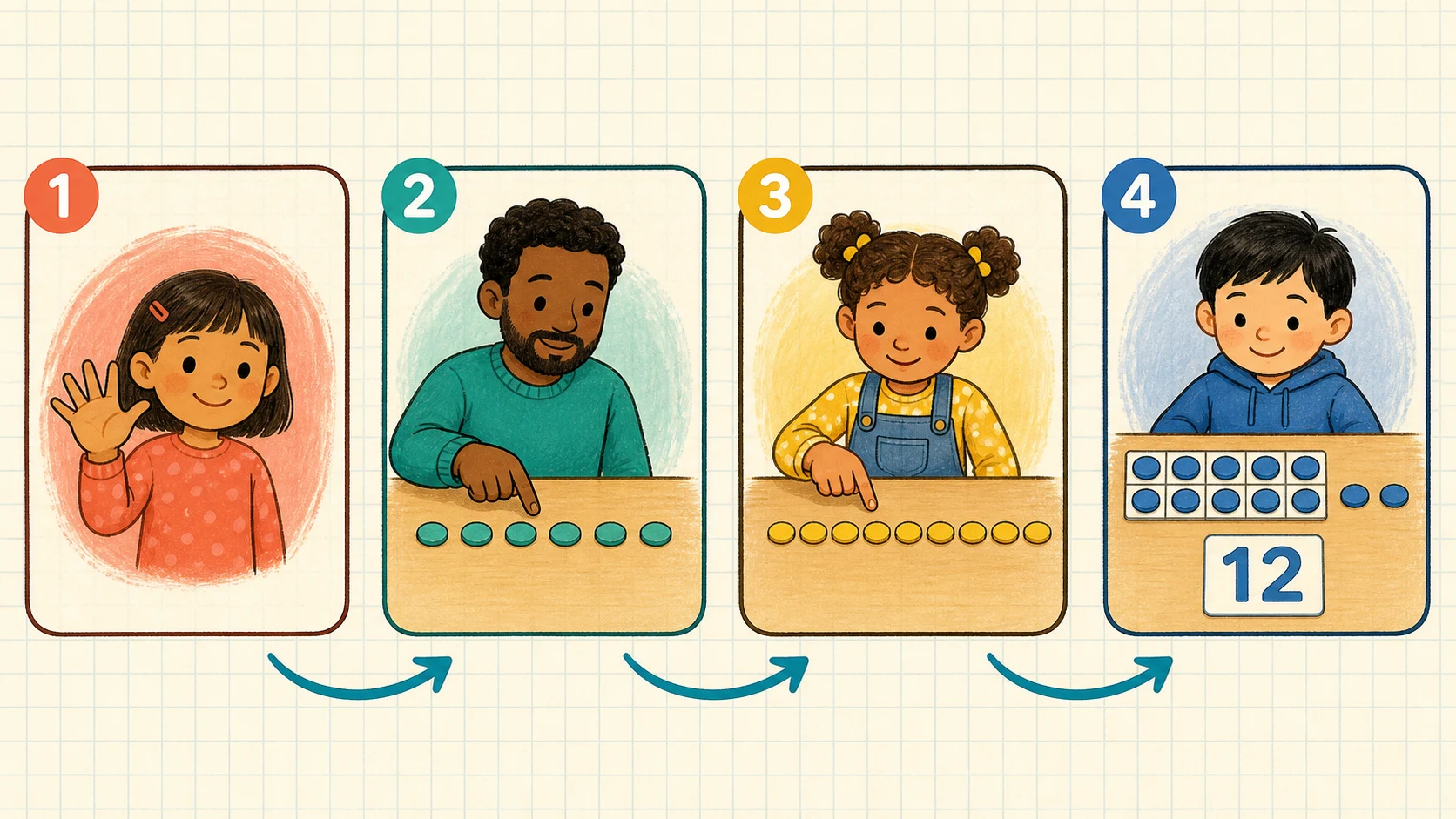
Read the item, identify the rule, recompute, and compare before changing an answer.
One wrong answer does not reveal its cause. Ask the learner to show or describe the method before deciding what support is needed.
| Observed work | Possible interpretation to check | Useful response |
|---|---|---|
| Says the correct next number but writes a different numeral | Oral counting may be intact; numeral recognition or recording may be the difficulty | Ask the learner to point to the intended number, then compare it with the written form |
Counts 2, 4, 6, 7 |
The learner may switch from a skip-counting rule to counting by ones | Mark or say each equal jump and restart from the last correct number |
| Gives the number after when asked for the number before | Directional language may have been misread | Place three consecutive numbers in order and identify left/before and right/after |
| Counts an object twice | The collection may not be organized for one-to-one counting | Move, cross off, or mark each object after counting it |
| Omits an object in a scattered group | The scan path may be inconsistent | Choose a starting point and a visible route through the set |
| Copies a nearby printed number into the blank | The learner may be responding visually without checking the rule | Ask for the change between every pair before accepting an answer |
| Makes several errors only near the end | Attention or task length may be affecting performance | Shorten the independent section and resume later |
| Produces different answers when recounting | The counting method may be unstable | Use touch-and-count or movable objects, then recount once systematically |
Treat these as hypotheses, not diagnoses. Check them against the learner’s explanation and a second, comparable example.
Use boundary cases to reveal the rule
Boundary cases are places where an otherwise familiar pattern can produce hesitation. Include them only when relevant to the learner’s work.
- Crossing from 9 to 10: In
8, 9, ___, the answer is 10 because . A learner who writes 0 may be focusing on the final digit rather than the whole number. - Crossing from 19 to 20: In
18, 19, ___, the answer is 20 because . Ask the learner to say the full sequence and locate 19 and 20 on a number line. - A blank at the beginning: In
___, 12, 13, the answer is 11. Check forward: 11, 12, 13. Also check backward from 12: . - A skip-counting jump across a ten: In
6, 8, ___, the answer is 10 because , not 9. - Zero as a legitimate number: If an item’s established rule leads to 0, do not treat the answer as an empty response. The written numeral 0 is distinct from leaving a line blank.
These examples show why “look for the rule” is more reliable than “write the number that seems close.”
Check the Answer Key Responsibly
The separate answer key is useful for efficient checking, but it should confirm reasoning rather than replace it. An adult can use this five-step routine:
- Let the learner finish the agreed section without seeing the key.
- Mark items that differ from the key without immediately writing the correct answer.
- Ask the learner to reread and recompute one marked item.
- Compare the revised answer with the key.
- Record the kind of error, if any pattern is visible.
For every mismatch, verify that the worksheet item and answer-key item have been matched correctly. Check the item number, printed sequence, and answer position. If a page was printed at an unusual scale or a mark is unclear, inspect the original before treating the response as wrong.
A corrected answer is useful evidence only when the learner can reproduce the reasoning. If the key says 20 and the learner replaces 19 with 20 simply because an adult pointed to it, the final mark is correct but independent understanding has not yet been demonstrated. Ask for the sequence rule or a comparable example.
Do not calculate a percentage and let it erase the pattern of work. Two errors caused by skipping pictured objects call for different instruction from two errors caused by switching a count-by-two sequence to count-by-one. The location, type, and repair of the errors are more instructionally useful than a score alone.
Decide What to Do Next
Use the completed page to choose among three next steps.
Continue at the same practice level
Stay with easy counting work when the learner is generally successful but still needs occasional prompts to find the rule, organize a set, or interpret “before” and “after.” Repractice the specific item type, not necessarily all 20 problems.
The 1st Grade Math worksheet hub can help an adult place counting practice alongside other first-grade math materials without assuming that the learner must move topics immediately.
Reduce support and confirm independence
When the learner completes the relevant items accurately and explains the rule, remove one aid at a time. For example, keep the number line nearby but do not point to it. Later, ask the learner to solve a comparable sequence without using it.
Do not equate fast work with secure work. A stronger sign is that the learner can solve a similar problem after a delay, explain a mistaken answer, or identify whether a sequence counts by ones, twos, fives, or another visible repeated step.
Return to a prerequisite counting action
If the learner cannot maintain one number word for each object, return briefly to concrete objects. If the learner can count objects but cannot identify written numerals, pair spoken numbers with numeral cards. If the learner recognizes numerals but misses the repeated change in a sequence, compare adjacent numbers and display equal jumps.
This return is not a punishment or a change of subject. It isolates the part of counting that needs clearer practice.
Schedule Retrieval Without Overloading the Learner
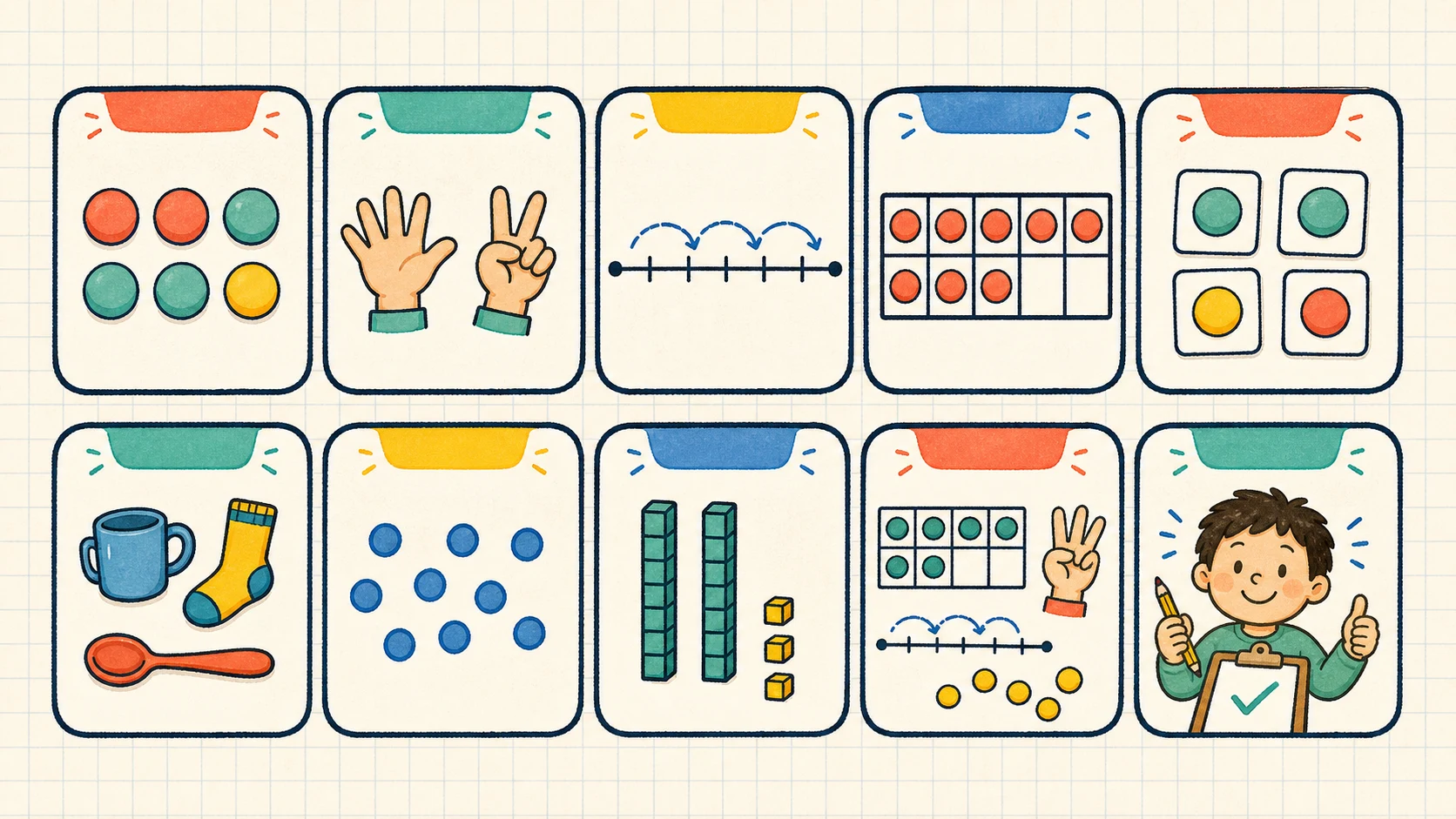
Revisit a small sample after delays and adjust the spacing according to the learner’s work.
Retrieval means solving again after some time has passed, without copying the earlier answer. The schedule below is a practical example rather than a universal prescription.
| Review point | Suggested task | What to observe |
|---|---|---|
| End of the first lesson | Rework one corrected item without looking at the correction | Can the learner state and apply the rule? |
| Next practice session | Solve three comparable examples: one count-by-one, one skip-counting, and one recognition item | Which method is retained without prompting? |
| Several days later | Revisit two previously difficult formats mixed with one secure format | Does the learner choose the correct rule when formats are mixed? |
| About a week later | Complete a short fresh set or selected related worksheet items | Is performance still accurate after a longer delay? |
If the learner succeeds easily, lengthen the interval or reduce the number of review items. If the same error returns, shorten the interval, model the troublesome step again, and use a concrete or visual representation. If performance varies, gather more examples before making a broad judgment.
Avoid asking the learner to memorize the positions or answers from the original page. Change the numbers while preserving the relationship. For instance, if 4, 6, 8, ___ was practiced, later use 3, 5, 7, ___. The answer is 9 because each step adds 2:
That checks retrieval of the method rather than recall of the earlier final number.
Limits of This Worksheet
This printable contains 20 easy-level exercises and focuses on counting, number sequence, skip counting, number recognition, and number sense. It can provide useful practice and observable work, but it cannot by itself show everything a learner understands about counting.
A written page may not reveal whether the learner can accurately count a scattered physical collection, explain why the last number counted tells how many objects are present, or transfer a sequence rule to a new representation. It also cannot determine the cause of persistent difficulty. Observe oral counting, use concrete objects when appropriate, and compare performance across more than one occasion.
The worksheet should not be represented as medically diagnostic, universally paced, certified, or guaranteed to produce a particular outcome. The listed grade is an intended practice level, not a rule that every first-grade learner must complete the page in the same way or at the same time.
The broader 1st Grade worksheet hub provides context across subjects, while the counting topic guide is the better place to review the larger counting progression. Linking to those resources avoids expecting one printable to carry an entire sequence of instruction.
A Useful Next Action
Print the free worksheet and answer key, choose one item to model, and mark a stopping point for the learner’s first independent section. After checking the work, record one secure skill and one item type to revisit.
If the learner needs more practice with the same topic, use the 1st Grade Counting Worksheet Pack, which contains 18 worksheets and is listed at $4.79. If you need fresh examples matched to an observed difficulty rather than another fixed page, use the free worksheet generators. Begin the next session with two short retrieval items, then let the learner’s accuracy and explanation determine whether to continue, reduce support, or return to a concrete counting model.
Put it into practice
Use the guide with a real printable
Move from explanation to a short, observable practice task. Check the first item together, then adjust the next session from the learner's actual work.
See the 18-worksheet pack