Complete guide
How to teach and practise 1st grade addition worksheets - standard theme (easy)
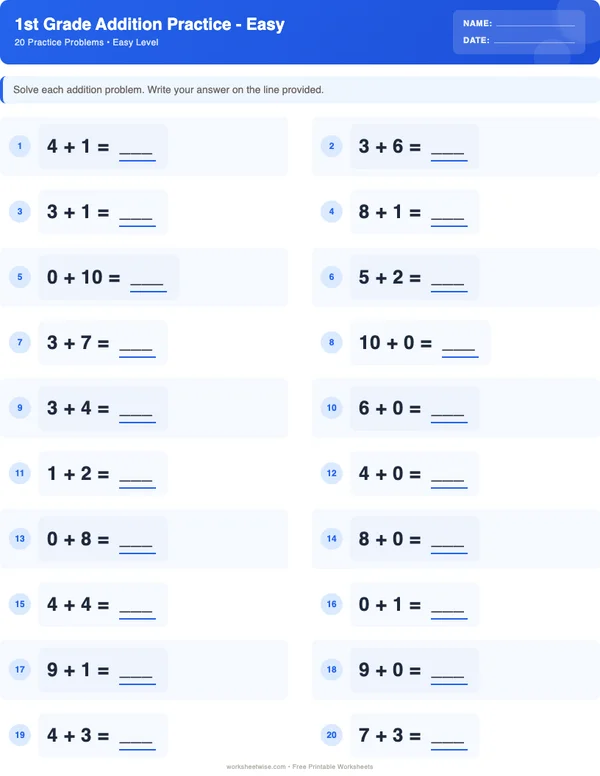
How to use this 20-item addition worksheet
The free 1st Grade Addition worksheet provides 20 easy-level exercises. The learner solves each addition problem and writes the answer on the line. A separate printable answer key is included.
For most learners, the best use is a short lesson rather than a one-sitting test: preview the page, model two or three similar problems, solve several items together, and then release the learner to work independently. Counters, drawings, or a ten frame may remain available if they help the learner explain the addition. Check the completed work for patterns, not merely a total score. Revisit one or two errors, stop before fatigue obscures understanding, and schedule a brief review on another day.
The worksheet practices addition facts, mental math, number sense, and place value. Its grade label describes the intended practice level; local school, district, state, and homeschool sequences differ. Use the learner’s observed work—not the label alone—to decide how much modeling, time, or follow-up is appropriate.
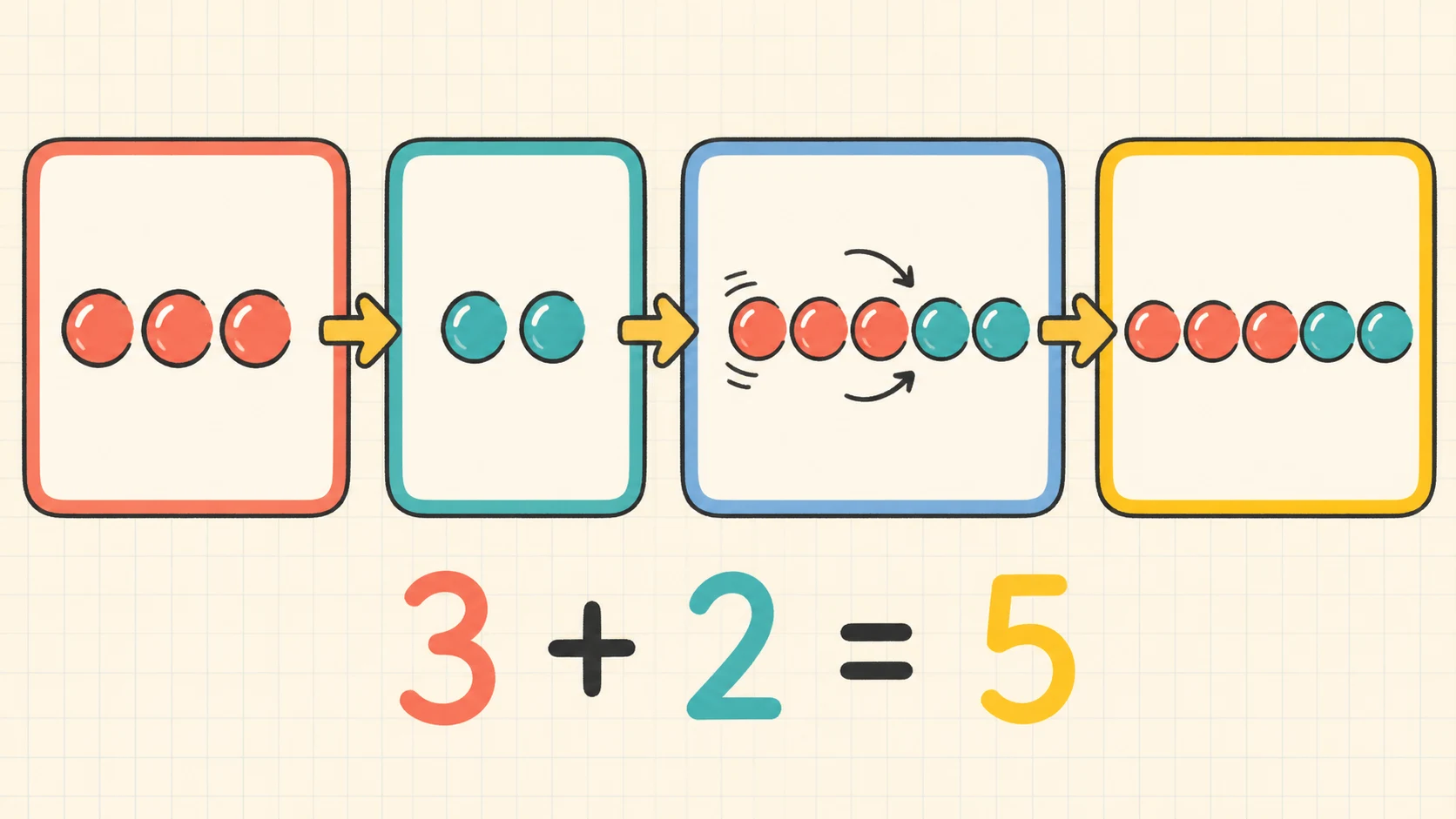
Preview, model, guide, release, check, and revisit.
What this printable does—and does not do
This worksheet offers a focused set of 20 addition exercises in a standard theme. It is suitable for classroom practice, homework, tutoring, or homeschool instruction. Because the difficulty is marked easy, it can serve as an introduction to written addition practice or as reinforcement for a learner who has already encountered the skill.
The printed direction is concise: “Solve each addition problem. Write your answer on the line provided.” That simplicity leaves the adult with an important instructional role. Before expecting independent work, establish what the plus sign asks the learner to do, how the two quantities combine, and where the answer belongs.
The worksheet’s stated skill list includes:
- Addition facts
- Mental math
- Number sense
- Place value
A single page cannot establish complete understanding of all four areas. It provides evidence from 20 written responses at one point in time. It does not, by itself, reveal whether a correct answer came from reasoning, memorization, counting every object, copying, or guessing. Conversation and observation supply that missing information.
The broader 1st Grade Addition topic guide covers the larger progression from concrete quantities and pictures toward number sentences and increasingly efficient strategies. Use that guide when the learner needs instruction beyond this printable rather than trying to turn one worksheet into the whole curriculum.
The IES guide on teaching mathematics to young children supports high-level practices such as building on children’s existing mathematical knowledge, using representations, and helping learners describe mathematical ideas. It did not evaluate this WorksheetWise page. Here, those principles justify asking the learner to show and explain how two quantities combine before emphasizing speed.
A practical lesson plan
A calm session can be brief, but it should have a clear instructional arc. The times below are flexible suggestions, not a universal timetable. A learner who is engaged and accurate may move quickly. A learner who becomes confused should receive more guided practice or stop and return later.
| Lesson phase | Suggested action | Evidence to watch |
|---|---|---|
| Prepare | Print the worksheet and answer key separately. Gather optional counters, scrap paper, and a pencil. | Can the learner attend to one problem without being distracted by the whole page? |
| Launch | Read the direction together and identify the plus sign and answer line. | Does the learner understand that the two numbers are being combined? |
| Model | Demonstrate two similar addition problems that are not copied from the worksheet. | Can the learner connect objects, a drawing, and the number sentence? |
| Guide | Complete two to four worksheet items together. Ask for an explanation before confirming the answer. | Does the learner count accurately and record the total in the correct place? |
| Release | Assign a manageable portion for independent work. | Is the learner choosing a workable strategy without continuous prompting? |
| Check | Compare responses with the answer key after the attempt is complete. | Are errors isolated, or do they form a repeated pattern? |
| Repair | Rework one representative error using objects or a drawing. | Can the learner explain what changed? |
| Retrieve | Revisit selected facts later without displaying the previous answers. | Is the strategy becoming more accurate or efficient over time? |
Before the learner begins
Print or open the worksheet while keeping the answer key out of sight. That separation helps preserve the page as a genuine practice opportunity. Have a small set of movable objects available—buttons, blocks, coins used only as counters, or pieces of paper. The objects need not be elaborate; they simply need to be easy to move and count.
Scan the worksheet yourself so you know where the learner will write. Do not preteach every item. Instead, decide on a stopping point, such as after five problems, where you will quietly check effort and understanding. Twenty exercises may be reasonable in one session for one learner and too much for another.
Launch language
Point to one problem and say, “This sign means we are adding. We are finding how many there are altogether.” Then ask the learner to show where each starting number appears and where the total should be written.
Avoid beginning with “Do you know this?” That wording can turn the first item into a confidence test. A more useful prompt is, “Show me how you would start.” The response tells you whether the learner recognizes the operation and has an available strategy.
If the learner immediately gives an answer, ask, “How did you figure it out?” Accept a clear explanation involving counting, counting on, a known fact, a drawing, or composing a number. The initial goal is observable reasoning, not sophisticated vocabulary.
Four fully checked examples to model
The examples below are similar to the worksheet’s addition practice, but they are instructional examples rather than claims about the exact printed items. Each calculation has been checked. Choose examples that demonstrate a strategy the learner can understand.
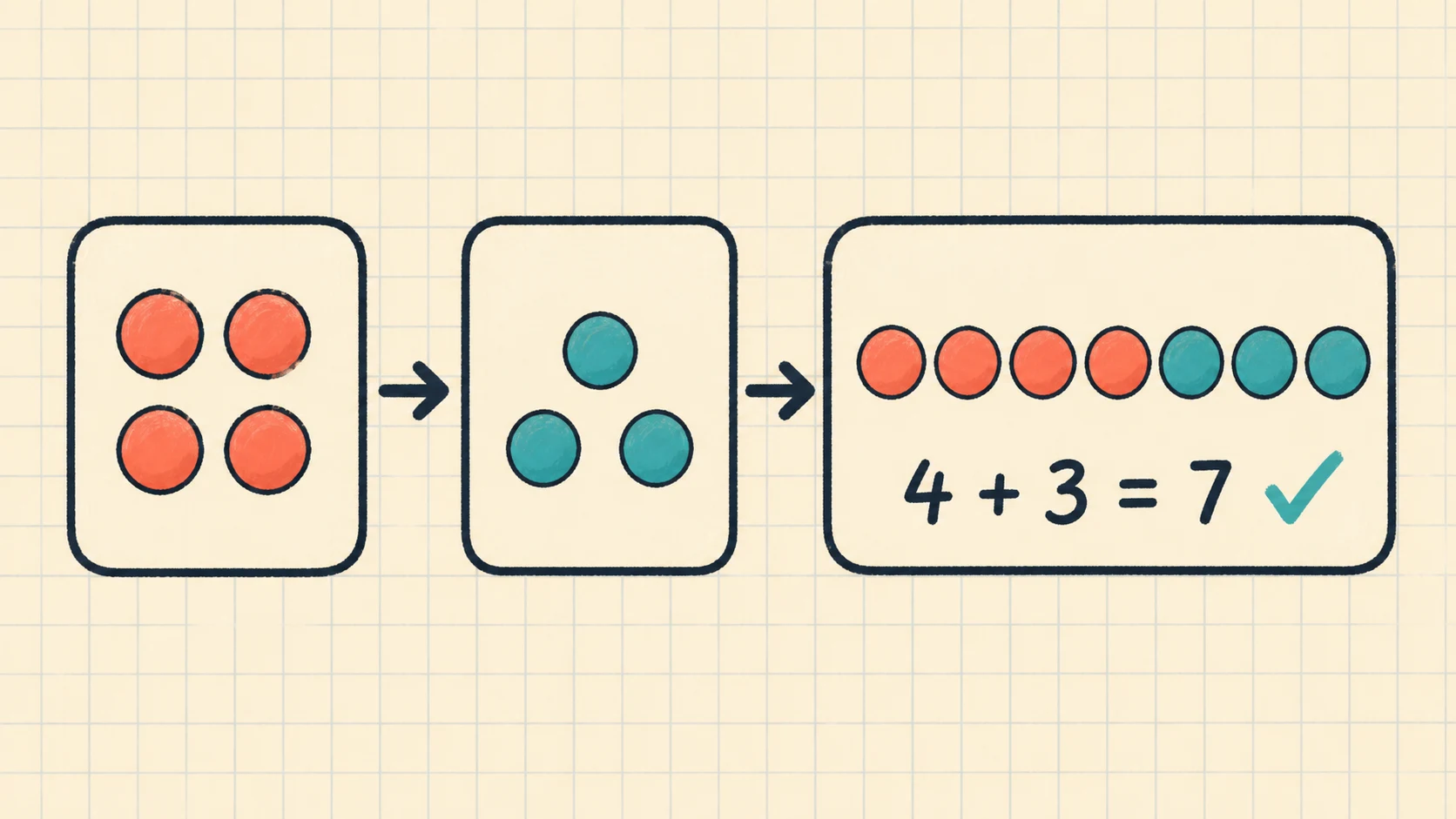
Connect the quantities, the action of combining, and the written equation.
Example 1: Combine two groups
Consider:
2 + 3 = ___
Place two counters in one group and three in another. Slide the groups together and count all the counters:
1, 2, 3, 4, 5
Therefore:
2 + 3 = 5
Check the calculation by counting the two groups again: two counters plus three counters make five counters. You can also reverse the addends:
3 + 2 = 5
The reversed equation is a useful check because the combined quantity has not changed. Do not require the learner to name this property. It is enough to notice that either group can be counted first.
Example 2: Count on from the larger number
Consider:
6 + 2 = ___
Starting at one and recounting all eight imagined objects would work, but counting on is more efficient. Hold 6 in mind, then make two counts:
- Start: 6
- One more: 7
- Two more: 8
Therefore:
6 + 2 = 8
Check with subtraction as an adult verification:
8 - 2 = 6
If subtraction is not yet comfortable for the learner, do not introduce it merely as a checking rule. Instead, draw six dots, add two more dots, and count eight. The instructional point is that 6 remains intact while 2 is added.
Example 3: Use a known double
Consider:
4 + 4 = ___
Make two equal rows of four:
● ● ● ●
● ● ● ●
Count the total: eight dots. Thus:
4 + 4 = 8
Check by grouping the dots into four pairs:
2 + 2 + 2 + 2 = 8
A learner may know “four plus four is eight” as a remembered double. That is useful, but ask for a representation if you need to confirm that the fact has meaning rather than being an unsupported guess.
Example 4: Make ten
Consider:
8 + 5 = ___
Show 8 in a ten frame or draw eight spaces filled. The 8 needs 2 more to make 10. Break 5 into 2 and 3:
5 = 2 + 3
Then calculate:
8 + 5
= 8 + 2 + 3
= 10 + 3
= 13
Therefore:
8 + 5 = 13
Check by counting on five steps from 8:
9, 10, 11, 12, 13
Both methods give 13. Making ten is particularly helpful because it organizes the total around a group of ten and remaining ones. That creates a place-value connection without requiring a formal multi-digit algorithm.
Boundary cases to discuss carefully
A boundary case tests whether the learner understands the operation beyond a familiar pattern. If a similar form appears in current or future practice, consider these cases:
- Adding zero:
7 + 0 = 7. No new objects are added, so the quantity remains seven. - Reversed addends:
2 + 6 = 8and6 + 2 = 8. The order changes, but the total does not. - A sum reaching ten:
6 + 4 = 10. This is a complete group of ten with zero ones left over. - A sum crossing ten:
9 + 3 = 12. The learner can make ten with one of the three, then add the remaining two. - Equal addends:
5 + 5 = 10. Equal groups can support a doubles strategy.
These are teaching examples, not a statement that each form appears among the worksheet’s 20 items. Use them only when they clarify a problem the learner is actually encountering.
Move from modeling to guided practice
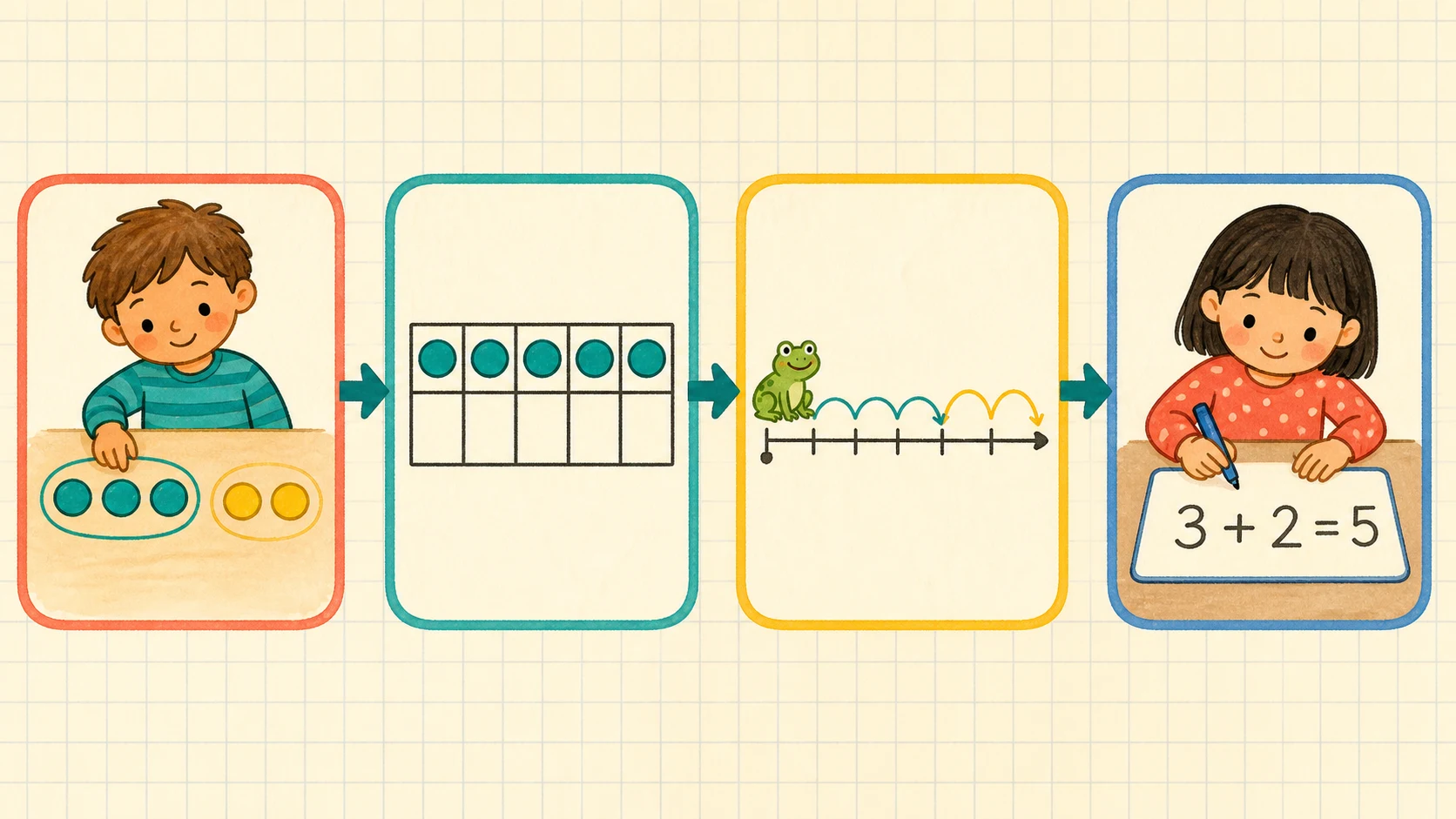
Reduce assistance gradually while keeping the mathematical thinking visible.
Use “I do, we do, you do”
During “I do,” solve one similar example while narrating only the essential decisions:
“I see addition. I will start with the larger number, 6. I need to add 2, so I count 7, 8. The sum is 8.”
During “we do,” let the learner control part of the process. Ask, “Which number will you start with?” or “How many counts do you need to make?” Move counters only when directed by the learner. This prevents the adult from completing the reasoning while the learner merely watches.
During “you do,” select one worksheet item and remain quiet long enough for the learner to begin. If help is needed, offer the smallest useful prompt:
- “What does the plus sign tell you?”
- “Which quantity could you start with?”
- “Can you show it with counters?”
- “How will you know when to stop counting?”
A prompt should restart thinking, not disclose the answer.
Decide when independent work is appropriate
Independent practice is reasonable when the learner can:
- Recognize the addition sign and the two addends
- Choose a strategy without being told every step
- Keep track of the count
- Record the total on the correct line
- Explain at least one answer in a way that matches the quantities
Do not require perfect fluency before independence. Some counting is expected during practice. However, if every item requires an adult to interpret the symbols, arrange the objects, track the count, and place the answer, the learner is not yet working independently on the intended task.
Consider dividing the page into groups of five items. After each group, observe posture, attention, strategy, and accuracy. A long pause can indicate thought, distraction, uncertainty, or fatigue; ask the learner to describe the next step before drawing a conclusion.
Adapt support without changing the skill
An adaptation should make addition more accessible while preserving the requirement to combine quantities and determine a sum. Reading the answer aloud, completing the arithmetic for the learner, or turning every item into a copying exercise changes what is being practiced.
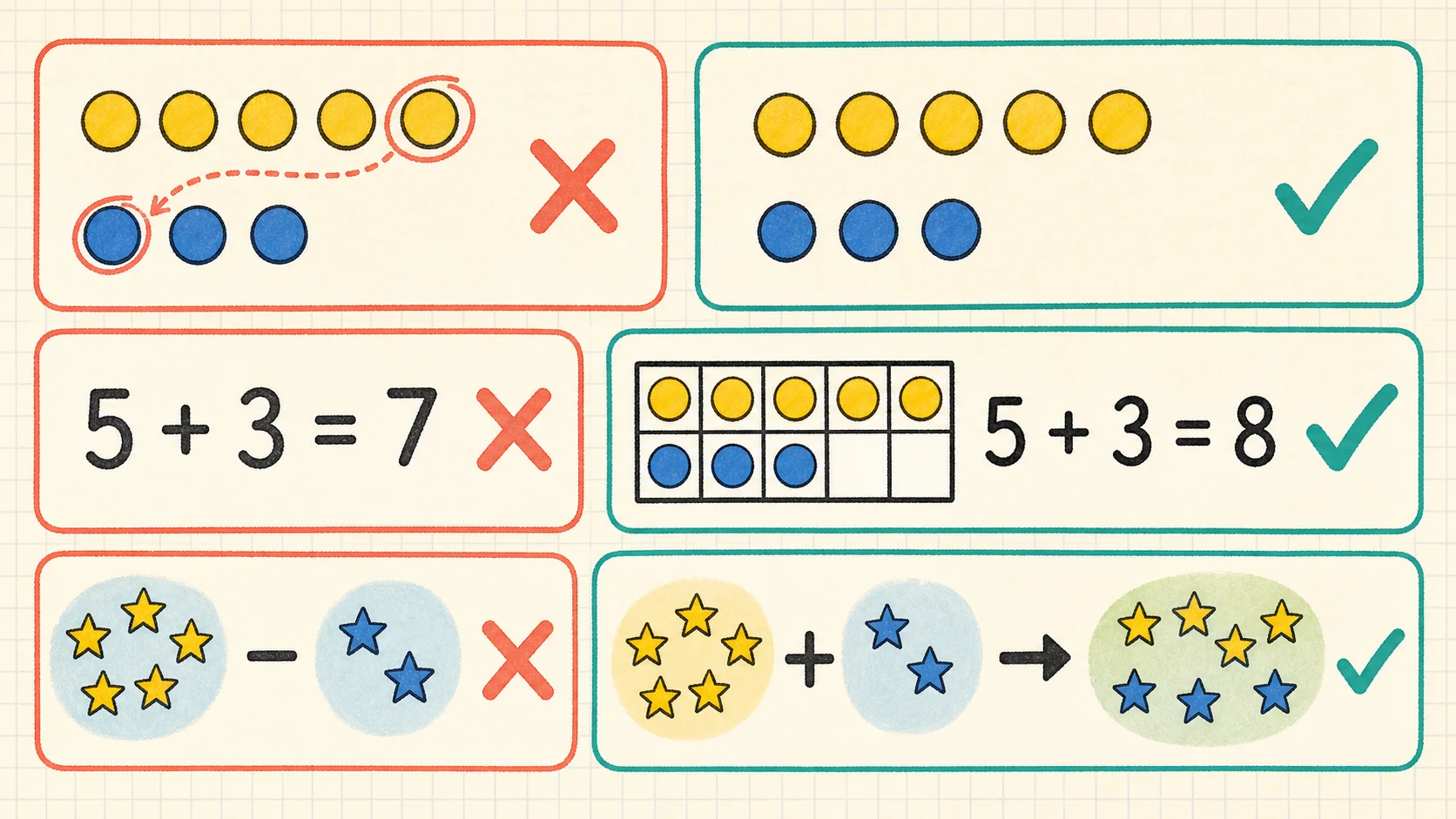
Adjust representation, workload, or prompting while retaining the same addition goal.
When the learner needs more concrete support
Provide counters for each addend. Ask the learner to build the first quantity, build the second, join the groups, and count the total. Then connect the actions back to the printed symbols:
- First group → first addend
- Second group → second addend
- Joined groups → addition
- Total counted → sum on the answer line
If loose counters are difficult to track, place them in rows or on a ten frame. The structure reduces accidental recounting while preserving the arithmetic. After several successful items, invite the learner to draw dots instead of moving objects. That is a change in representation, not a change in skill.
When the page feels visually or mentally crowded
Cover the unworked portion with a blank sheet of paper and expose one row or one problem at a time. The learner still solves the original exercise; the reduced visual field simply limits competing information.
You may also divide the 20 items across two sessions. Mark a neutral stopping point before the lesson rather than ending only after an error. Finishing ten attentive problems can provide better evidence than forcing twenty responses after concentration has deteriorated.
If writing is slow but the learner can calculate, allow an oral answer for one guided item while the adult points to the answer line. Return to written recording during independent practice so the printed task remains represented.
When the learner is accurate and ready for less support
Remove counters for a small group of items and ask for mental calculation. Follow one answer with, “What did you notice that helped?” The learner might describe counting on, using a double, or making ten.
Do not create difficulty merely by imposing speed. Instead, deepen the reasoning:
- Ask for a second way to solve one item.
- Ask which addend would be easier to start with.
- Ask the learner to draw a representation that proves the answer.
- Ask whether reversing the addends changes the sum.
- Present an incorrect sample answer and ask the learner to check it.
These extensions maintain the focus on addition while strengthening explanation and self-checking.
The IES guide for assisting students struggling with mathematics provides broad guidance on systematic instruction, clear mathematical language, representations, and deliberate practice. It does not prescribe a response for a particular child or certify this worksheet. Here, those ideas support using explicit steps and carefully reducing prompts according to the learner’s performance.
Interpret errors before correcting them
A wrong numeral is evidence to investigate, not a diagnosis. Ask the learner to reproduce the thinking with counters, a drawing, or spoken counting. One error may be a slip. Several errors with the same structure may reveal an instructional need.
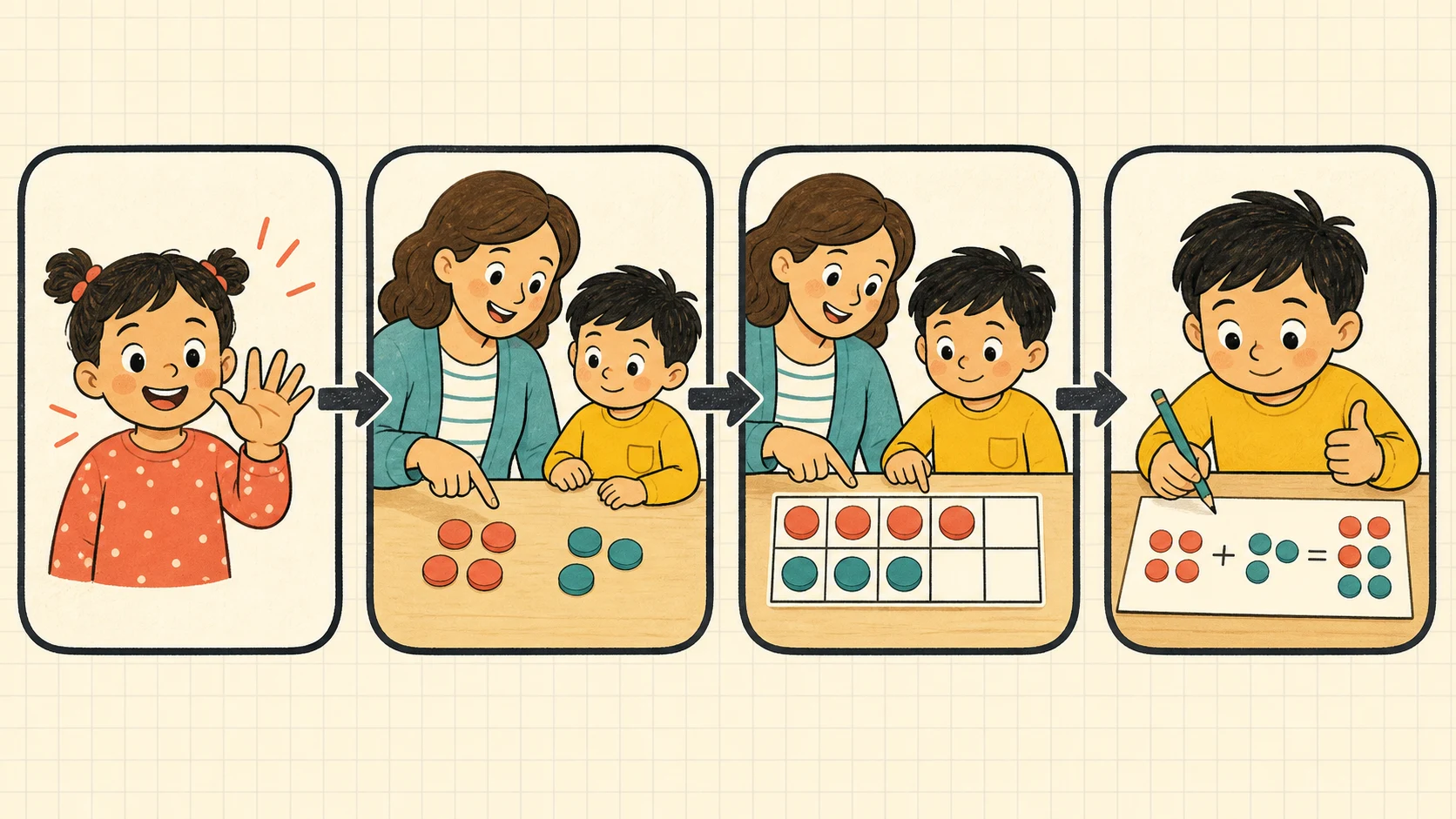
Read the equation, represent both addends, recompute, and compare.
Misreading the operation
Suppose a learner treats 5 + 2 as a request to count backward and answers 3. Ask the learner to point to the sign and describe its action. Then build five counters and add two more. The immediate goal is to reconnect the plus sign with combining or increasing a quantity.
Avoid saying only, “That is subtraction.” The label identifies the mistake but does not rebuild the intended meaning.
Recounting the starting number
For 6 + 2, a learner may say “6, 7” and answer 7. The learner has counted the starting number as the first added count. Model the distinction:
“Six is where we start. The first new count is seven; the second new count is eight.”
Use two counters as the added quantity and touch one counter for each spoken count. Then remove the counters and try a similar example.
Counting one too many
A learner may correctly start after the first addend but make too many counts. This is often a tracking problem rather than a misunderstanding of addition. Pair each count with one finger, one mark, or one moved counter. Ask, “How many counts were we supposed to add?” before beginning.
If the mistake disappears with tracking support, retain that support briefly and then fade it. If it persists, return to joining two visible groups.
Reversing or miscopying a numeral
An answer may reflect correct arithmetic but unclear numeral formation. Ask the learner to read the written answer aloud and show the same quantity with objects. If the stated and represented total is correct, distinguish the calculation from the recording issue. Have the learner rewrite the numeral once clearly without requiring repeated copying.
This guide cannot assess vision, motor development, attention, or a learning condition. Persistent concerns require appropriate discussion with the learner’s teacher or another qualified professional; a worksheet response alone cannot establish a cause.
Guessing from familiar patterns
A learner may answer quickly but be unable to explain, represent, or verify the total. Do not assume that speed proves fluency. Choose one response and ask for evidence: “Show me why that answer works.” If the representation conflicts with the answer, reteach with a concrete model.
Conversely, do not demand a full explanation after every correct item. Strategic sampling is enough to reveal whether the learner is reasoning consistently.
Check the answer key responsibly
The separate answer key is for verification after the learner has attempted the work. Keep it separate during initial practice. When checking, compare each printed equation and response carefully rather than scanning only the final digits.
A useful routine is:
- Mark correct responses neutrally.
- Circle or note items that need another look without writing the correct sum immediately.
- Ask the learner to choose one marked item and solve it again.
- If the second answer differs, compare the two strategies.
- Use the key to confirm the final calculation.
- Record the type of support that helped.
Recalculate a disputed problem independently. An answer key is a checking aid, not a substitute for mathematical verification. For example, if the learner believes 8 + 5 = 13, you can confirm it by decomposing 5 into 2 and 3: 8 + 2 + 3 = 10 + 3 = 13.
Avoid reducing the page to “18 out of 20” without examining the two missed items. Two unrelated slips may require only a brief correction. Two errors caused by counting the starting number may justify targeted practice. Likewise, a perfect page completed with constant adult direction does not show independent mastery.
Let the learner correct a small number of representative errors. Requiring the entire page to be erased and repeated can hide which adjustment actually improved the work. Keep the original response visible when practical so the learner can compare the first attempt with the correction.
Decide what to teach next
The next step should follow the learner’s observed strategy, accuracy, and independence.
If the learner is accurate and independent
Move to another easy addition page or use the 1st Grade Math collection to select related practice. Ask for occasional explanations so that practice does not become answer production without meaning.
When counting on is secure, introduce opportunities to use known facts, doubles, or making ten. The Common Core mathematics standards describe broad expectations involving addition, subtraction, strategies, and fluency across the early grades. Consult local requirements for the sequence actually being taught. This reference does not establish comprehensive standards alignment for this particular worksheet.
If the learner is correct but relies on counting every object
Do not remove the objects abruptly. Model counting on for one or two suitable examples, then let the learner choose between counters and counting on. Compare the amount of counting required:
For 7 + 2, counting all objects begins at 1 and continues to 9. Counting on keeps 7 intact and adds only two counts: 8, 9.
The correct answer shows that the learner understands the quantities. The instructional next step is efficiency, not a complete restart.
If errors cluster around sums near or beyond ten
Return to a ten frame or another representation of one group of ten. Practice composing ten before asking for repeated mental solutions. For example:
9 + 4 = 9 + 1 + 3 = 10 + 3 = 13
Keep the equation connected to the representation. The purpose is not to memorize a string of symbols but to see how one addend can be decomposed to complete ten.
If the learner needs extensive help on most items
Pause independent worksheet completion. Work with smaller concrete examples and a reduced set of problems. The broader Addition topic guide can help you locate the learner within the progression instead of repeatedly assigning pages at an unsuitable level.
Grade labels describe intended practice level, not a guarantee of readiness. Local sequences differ, and learners may show different levels of independence across representations or fact types.
Schedule retrieval instead of immediate repetition
Retrieval means solving again from memory or reasoning after some time has passed. It differs from copying a visible correction. A modest schedule can show whether the learning remains available without prescribing the same pace for everyone.
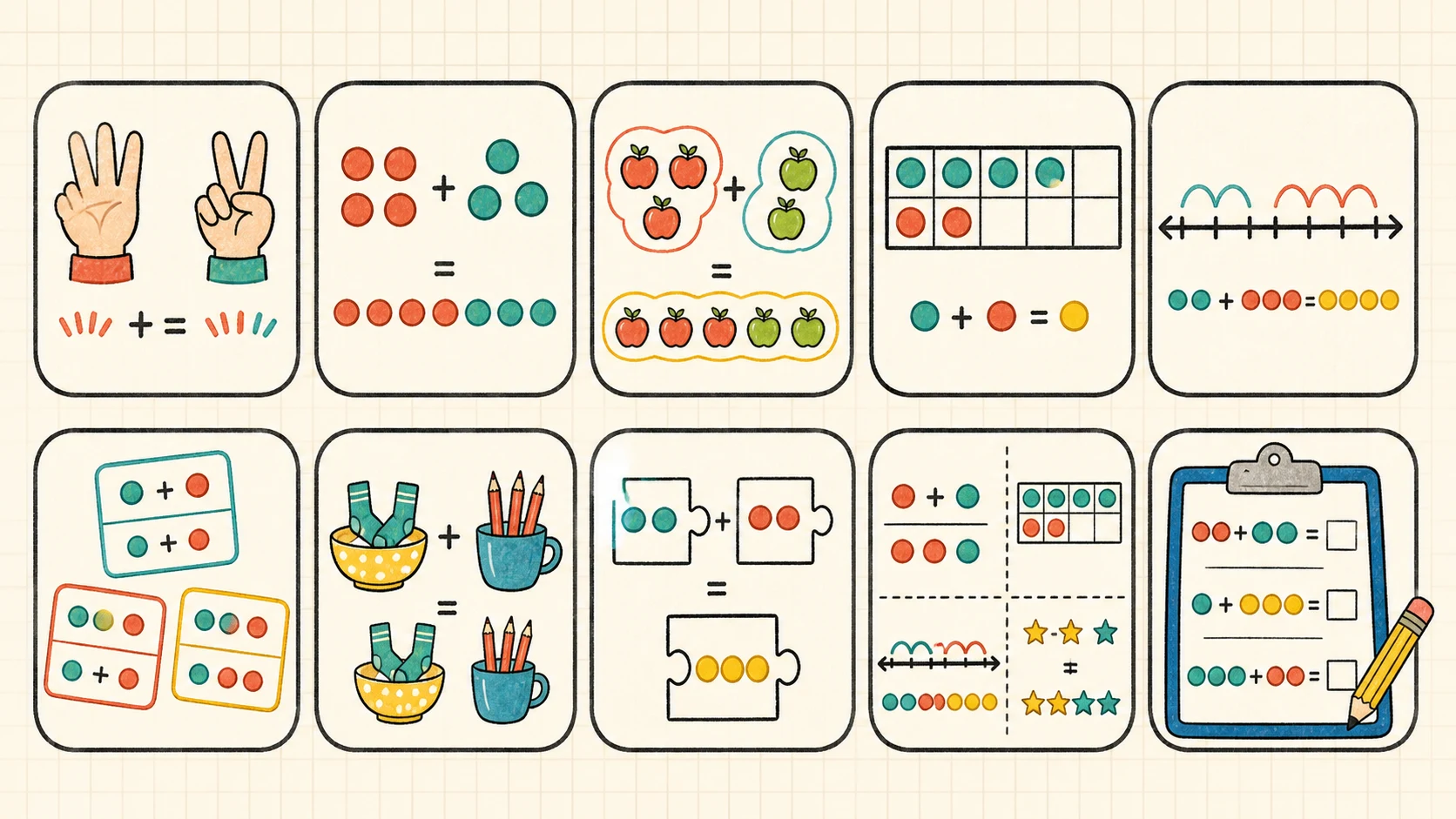
Revisit a small selection after increasing intervals and adjust from observed work.
Consider this flexible plan:
| Review point | Suggested activity | Decision |
|---|---|---|
| Later in the same session | Rework one corrected item without looking at the correction. | If the same error returns, restore the representation and model again. |
| Next learning session | Solve three to five selected facts or similar examples. | Continue support if accuracy depends on prompting. |
| Several days later | Mix a few reviewed facts with unfamiliar addition examples. | Look for retained strategy, not just remembered order. |
| The following week | Use a short mixed review or another free worksheet. | Move forward if reasoning is accurate and reasonably independent. |
This is an instructional suggestion, not a sourced or universal timetable. Shorten or lengthen the interval according to what the learner remembers. If performance drops sharply, return sooner with fewer examples and clearer representation. If performance remains accurate, space the next review farther apart.
Do not reuse the completed sheet with all answers visible and call that retrieval. Cover the responses, write selected equations on separate paper, or use fresh problems with the same structure. The learner should reconstruct the answer rather than recognize a familiar mark.
Limitations and an honest next action
This 20-item printable provides focused practice, not a complete addition program or a comprehensive assessment. It cannot establish why a learner made an error, guarantee fluency, measure understanding in every context, or determine readiness from a score alone. The answer key confirms expected responses, while adult observation reveals strategy, independence, and the kind of support that was effective.
Begin with the free 1st Grade Addition worksheet, model two similar examples, and let the learner attempt a manageable set. After checking the work, choose the next resource from the evidence: return to the topic guide for conceptual support, explore the 18-worksheet 1st Grade Addition pack for broader practice, or create a fresh review through the free worksheet generators.
Put it into practice
Use the guide with a real printable
Move from explanation to a short, observable practice task. Check the first item together, then adjust the next session from the learner's actual work.
See the 18-worksheet pack