Complete guide
How to teach and practise 1st grade sentence structure worksheets - standard theme (easy)
Quick answer: how to use this 12-item worksheet
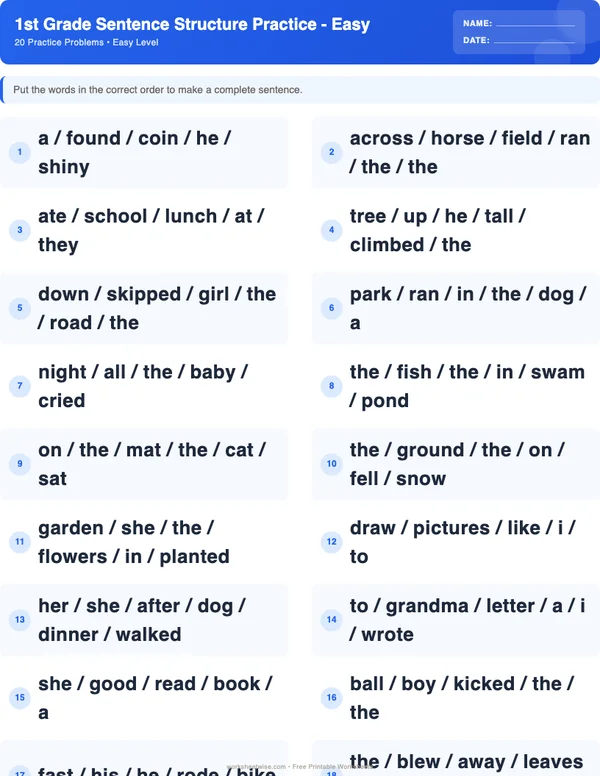
The free 1st Grade Sentence Structure worksheet gives learners 12 easy-level exercises in which they arrange words into the correct order to make a complete sentence. It practices word order, sentence formation, syntax, and grammar.
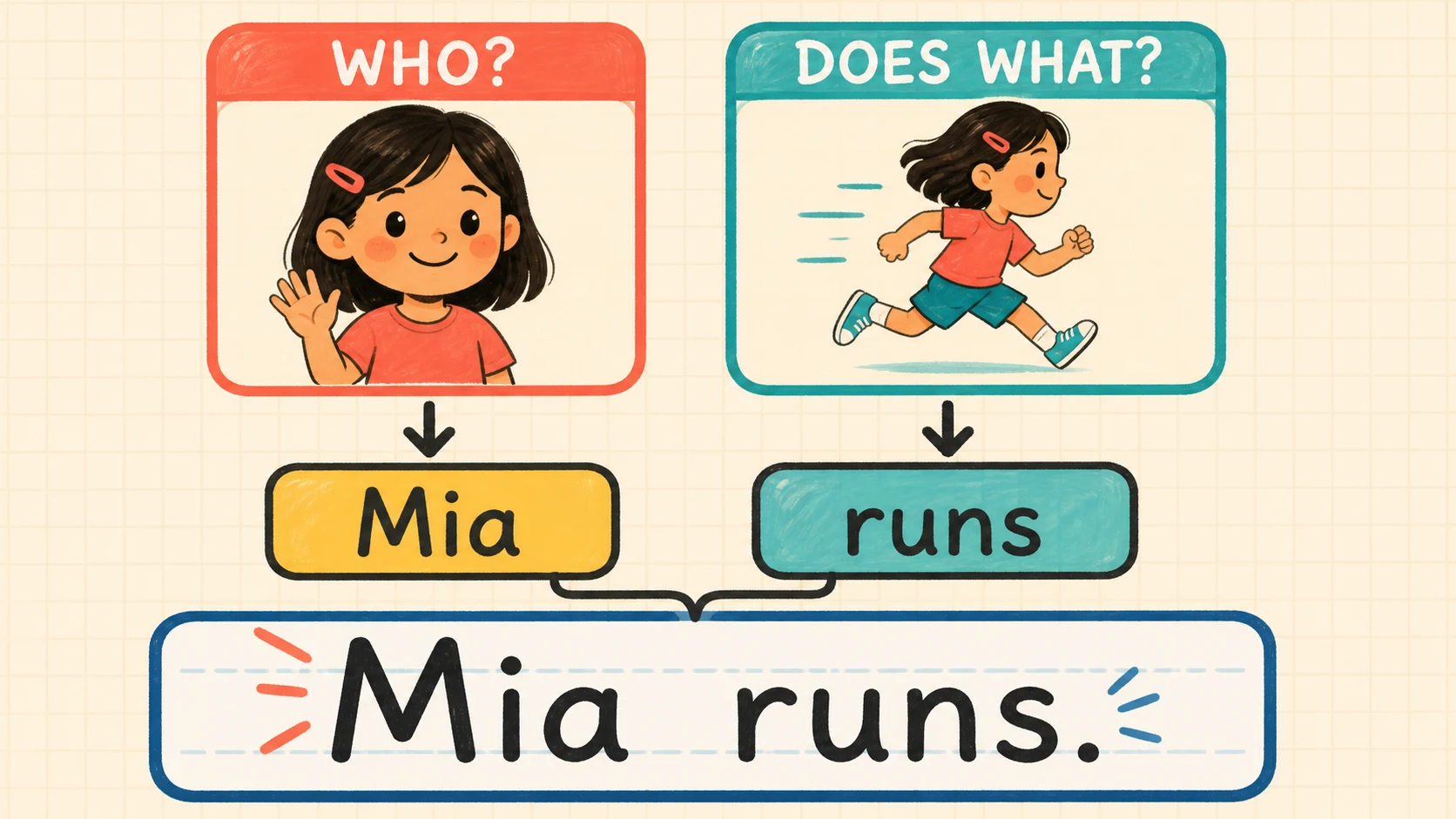
Use it as a short lesson rather than handing over all 12 items at once. First, model how to identify the naming part—who or what the sentence is about—and the action or describing part. Complete one item together, guide the learner through two or three more, and then release the remaining items in small groups. Ask the learner to read every finished sentence aloud. The learner’s observed work, not a fixed timer, should determine when you offer more support or move to independent practice.
Grade labels describe the intended practice level; local school, district, state, and homeschool sequences differ. An adult should therefore check whether this word-order task matches what the learner is currently studying.
Model one sentence, solve several together, observe independent work, and finish with a brief review.
What this worksheet teaches—and what it does not
The printed direction is precise: “Put the words in the correct order to make a complete sentence.” Each item asks the learner to reorganize a supplied group of words. The learner is not expected to invent a topic, plan a story, or compose a paragraph. That narrow focus is useful because it lets the adult observe whether the learner recognizes ordinary English sentence order.
At this level, a practical oral frame is:
- Who or what is the sentence about?
- What does that person, animal, place, or thing do or seem like?
For example, the words “jumps / The rabbit” can become “The rabbit jumps.” “The rabbit” names who the sentence is about, and “jumps” tells what it does.
This framework is an instructional suggestion for using the printable, not a claim that every English sentence can be fully analyzed with two questions. Commands, questions, sentences with linking verbs, and more complex constructions need additional explanation. The worksheet is described only as easy, 1st Grade practice in arranging words into complete sentences.
The activity also does not establish that a learner can independently compose sentences. Rearranging supplied words reduces demands such as idea generation, spelling, and vocabulary selection. A learner may succeed here but still need help writing an original sentence. Conversely, a learner who can express a clear thought orally might struggle with the visual or reading demands of scrambled words.
For a fuller sequence—from recognizing complete sentences through expanding and combining them—use the Sentence Structure topic guide rather than trying to make this single printable cover the entire topic.
Prepare the lesson before the learner begins
Print the worksheet and keep its separate answer key out of the learner’s immediate view. Have a pencil, an eraser, and a blank strip of paper available. The strip can cover later questions so that only one item is visible at a time.
Preview the page yourself. Confirm how capitalization and punctuation appear in the actual items. Do not assume that every first word is signaled by a capital letter or that punctuation is included as a separate clue. The catalogue identifies the task and skills, but it does not reproduce the 12 individual questions here.
Plan to demonstrate the thinking process with your own similar example before using a printed item. That preserves the worksheet questions for guided and independent practice.
Check the reading demand
Ask the learner to read the words in the first item without arranging them yet. If one word is unfamiliar, supply the word and continue with the sentence task. The goal is word order, not testing whether the learner can decode every printed word without help.
If many words cannot be read, pause the written lesson. You can read each word aloud while pointing to it, then ask the learner to arrange the words orally. That keeps the target skill—sentence formation—while reducing an unrelated decoding barrier.
The IES foundational reading practice guide provides broad instructional guidance for foundational reading in kindergarten through Grade 3. It can inform reading support, but it did not evaluate this WorksheetWise printable.
Set a clear purpose
Use one short explanation:
These words are mixed up. We will put them in an order that makes a complete thought and sounds right when we read it.
Then ask the learner to explain the job in their own words. Accept a plain response such as “Put the words in sentence order.” If the learner describes a different task—alphabetizing, copying, or matching—clarify before beginning.
Follow a model-to-independence lesson sequence
The following progression is flexible. Move forward when the learner shows readiness, and return to an earlier phase when errors reveal uncertainty.
| Lesson phase | Suggested items | Adult action | Learner action | Evidence to watch |
|---|---|---|---|---|
| Launch | Unnumbered example | Explain the task and read each word | Listen, repeat, and identify who or what | Understands that words must be reordered |
| Model | Unnumbered example | Think aloud and write a complete sentence | Follow the reasoning and reread the result | Notices meaningful order |
| Guided practice | 2–3 worksheet items | Prompt with questions; avoid giving the full order immediately | Arrange, explain, write, and read aloud | Can choose a likely beginning and connect the remaining words |
| Supported independence | 3–4 items | Observe quietly; prompt only after a productive pause | Solve each item and check it orally | Uses a repeatable checking routine |
| Independent practice | Remaining suitable items | Record error patterns without interrupting every response | Complete a small set independently | Maintains accuracy without continuous prompting |
| Review | 1–2 selected items | Discuss one success and one correction | Explain or repair an answer | Can describe why the revised order works |
| Retrieval | Later dates | Revisit a few items or analogous examples | Reconstruct sentences without copying | Retains the strategy after a delay |
This table is a practical lesson structure, not a universal timetable. Some learners may complete all 12 items comfortably in one sitting. Others may benefit from two or more brief sessions. Stop or reduce the set if fatigue begins to obscure what the learner understands.
Model the task with fully checked examples
Use examples similar to the worksheet without presenting them as actual worksheet questions. A complete demonstration should include arranging, reading, and checking—not merely announcing the answer.
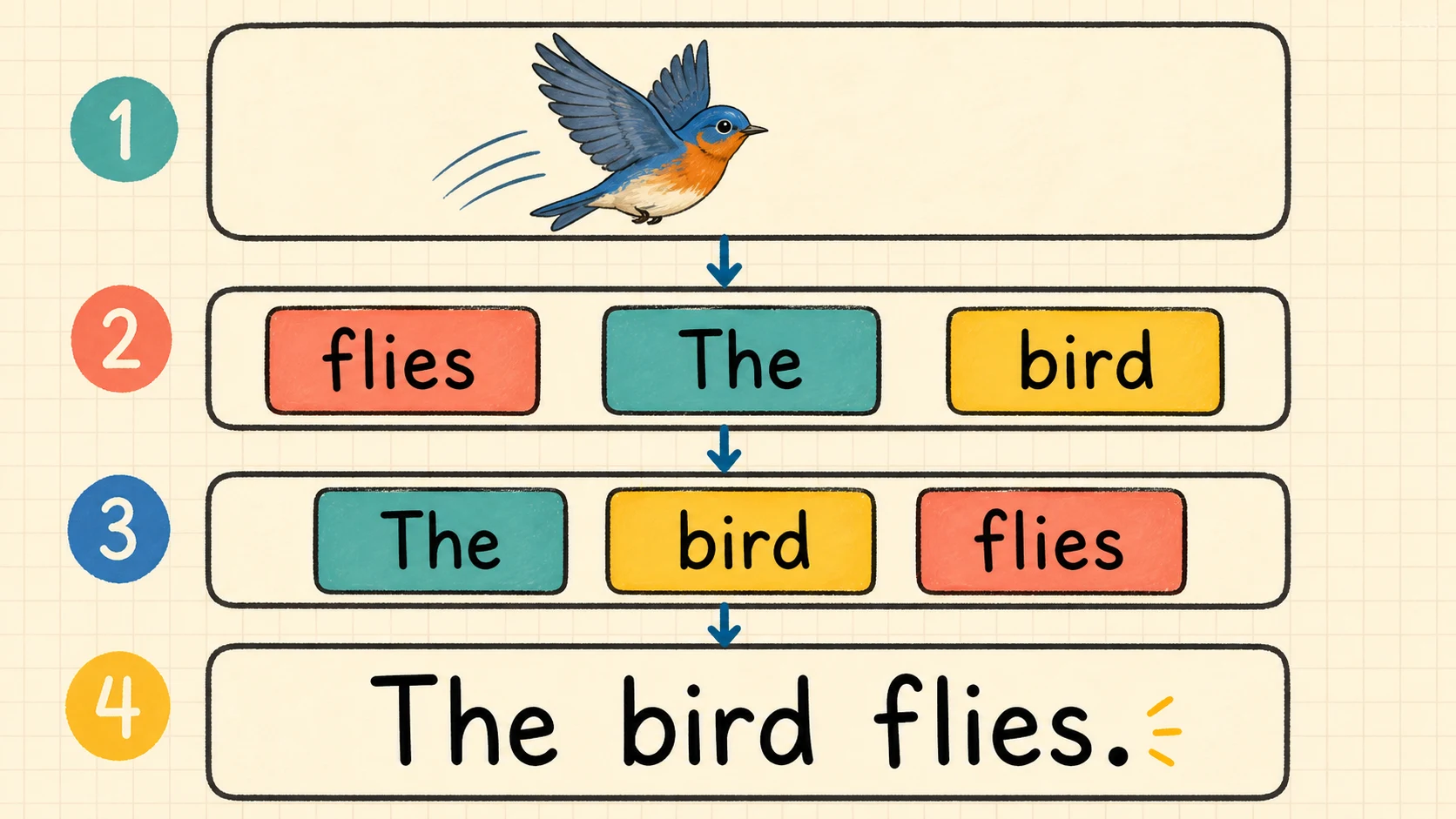
Find the naming part, connect the remaining words, and read the finished sentence as a complete thought.
Example 1: begin with who or what
Scrambled words: runs / The dog
Checked sentence: The dog runs.
Reasoning:
- “The dog” tells who the sentence is about.
- “Runs” tells what the dog does.
- “The dog runs” communicates a complete thought.
- The sentence begins with a capital letter and ends with a period in this written example.
The reverse order, “Runs the dog,” does not work as the intended simple statement. Read both versions aloud so the learner can compare them.
Example 2: keep a describing word beside its noun
Scrambled words: red / The / rolls / ball
Checked sentence: The red ball rolls.
“The” begins the naming group. “Red” describes “ball,” so those words stay together: “The red ball.” “Rolls” then tells what the ball does.
A common attempt is “The ball red rolls.” The learner may have found the subject and action but misplaced the describing word. Repair only that relationship: ask, “Which word tells what kind of ball?”
Example 3: place the action before its location
Scrambled words: in / swims / pond / the / A duck
Checked sentence: A duck swims in the pond.
“A duck” answers who. “Swims” gives the action. “In the pond” tells where. The sequence forms a clear statement:
A duck + swims + in the pond.
The wording “In the pond a duck swims” can be grammatical in other contexts, especially with appropriate capitalization and punctuation. That is a useful boundary case. However, an easy word-order exercise will usually target the most direct arrangement supported by its capitalization, punctuation, and answer key. Explain that more than one grammatical order can sometimes exist, even when the worksheet expects one conventional answer.
Example 4: preserve a multiword action
Scrambled words: is / Mia / singing
Checked sentence: Mia is singing.
“Mia” names who. “Is singing” works together as the action phrase. “Mia singing is” contains the same words but does not form the intended statement.
If the learner writes “Mia singing,” read it aloud and ask, “Do we still have a word that needs a place?” This prompt directs attention to the unused word without supplying the answer.
Example 5: distinguish a statement from a question
Scrambled words: the kite / Where / is
Checked sentence: Where is the kite?
This example is a question, so the ordinary “who plus did what” frame is not enough. “Where” signals that the speaker is asking for a location, and “is” comes before “the kite.” The question mark helps confirm the result.
Do not introduce this pattern unless the printed worksheet includes a comparable question or the learner is ready for an extension. The example illustrates why adults should inspect all available clues instead of forcing every item into one formula.
Run guided practice without solving every item aloud
Begin the printable after the learner has seen the separate model. For the first worksheet item, ask the learner to point rather than write immediately:
- “Which word or group might begin the sentence?”
- “Who or what is this about?”
- “What happens, or what is being said about it?”
- “Can you say the whole sentence before writing?”
- “Does every supplied word have a place?”
If the proposed order works, ask the learner to write it and read it once more. If it does not, resist rearranging all the words yourself. Repeat the attempt exactly as given and ask whether it sounds like a complete thought.
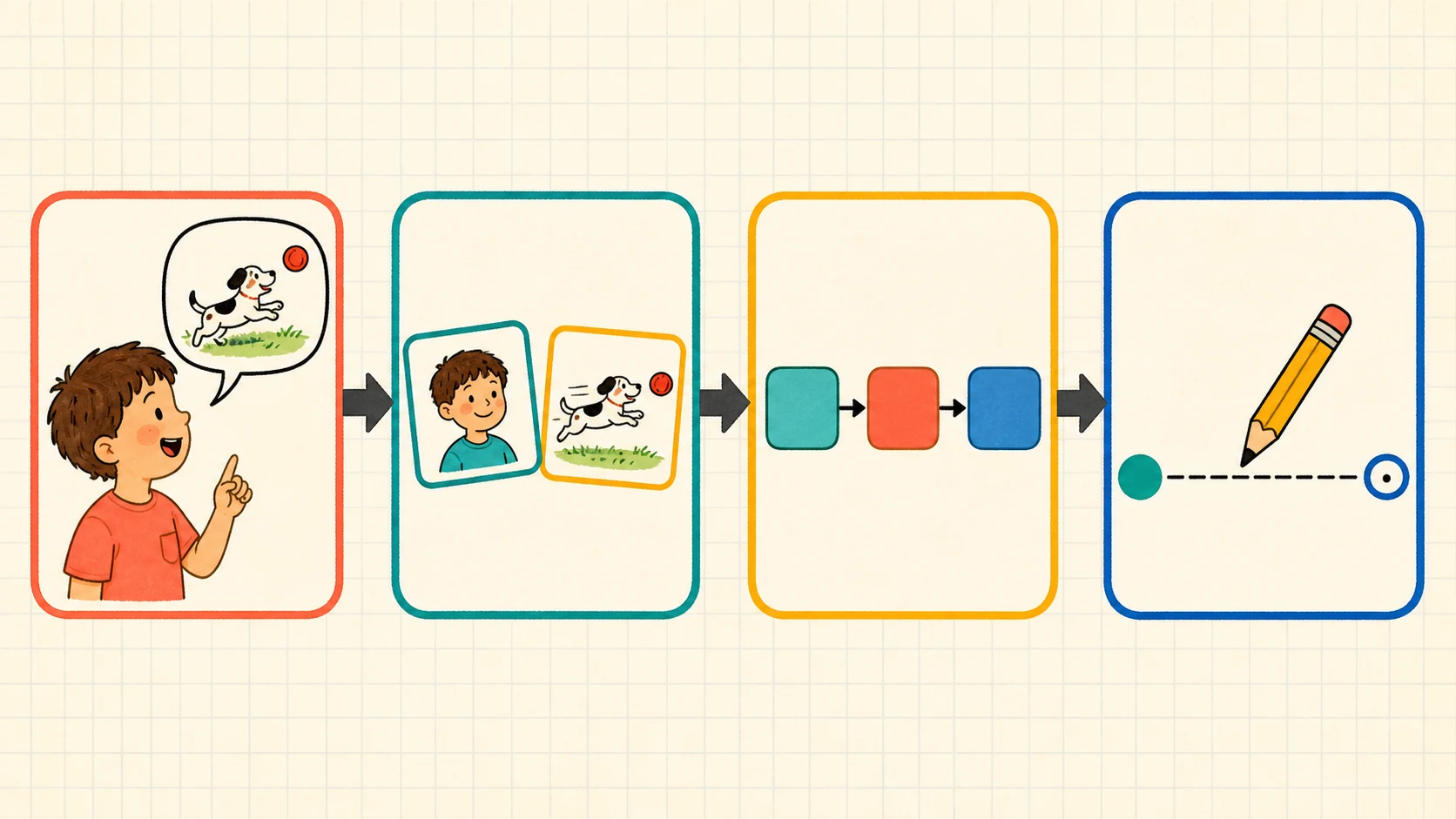
Guided practice uses brief prompts and learner explanations before the adult steps back.
Fade prompts deliberately
Support should become lighter as the learner gains control. A useful prompt sequence is:
- Full prompt: “Who or what is this sentence about? What does that subject do?”
- Short prompt: “Who? Does what?”
- Gesture: point to the scrambled words and then to the writing line.
- Independence: wait while the learner applies the routine.
Do not interpret speed alone as mastery. A quick response can be a guess, while a slower response may reflect careful checking. Ask for a brief explanation on at least one guided item: “How did you know that word came first?”
The IES elementary writing practice guide offers high-level recommendations for writing instruction, including explicit teaching and supported practice. It provides instructional context; it is not an endorsement or review of this particular worksheet.
Shift to independent work in small sets
Once the learner correctly arranges two or three guided items and can explain the checking routine, release a small set—perhaps three items—rather than automatically assigning everything remaining.
During independent work, observe without correcting each word as it is written. Note:
- whether the learner reads all the words before starting;
- whether every supplied word is used;
- whether words are copied accurately;
- whether the completed sentence is reread;
- whether the same kind of error repeats.
After the small set, check it before assigning more. If the learner is accurate and the process looks stable, continue. If two items show the same confusion, return to guided practice using one of those items or a fresh oral example.
A learner who finishes the 12 exercises accurately can demonstrate transfer by orally arranging a new example or writing one original simple sentence. Keep that extension brief. It should confirm the next instructional need, not turn the easy worksheet into a much harder composition assignment.
Adapt support without changing the sentence skill
Differentiation here should preserve the core demand: deciding how supplied words form a complete sentence. Avoid “help” that simply reveals the entire answer.
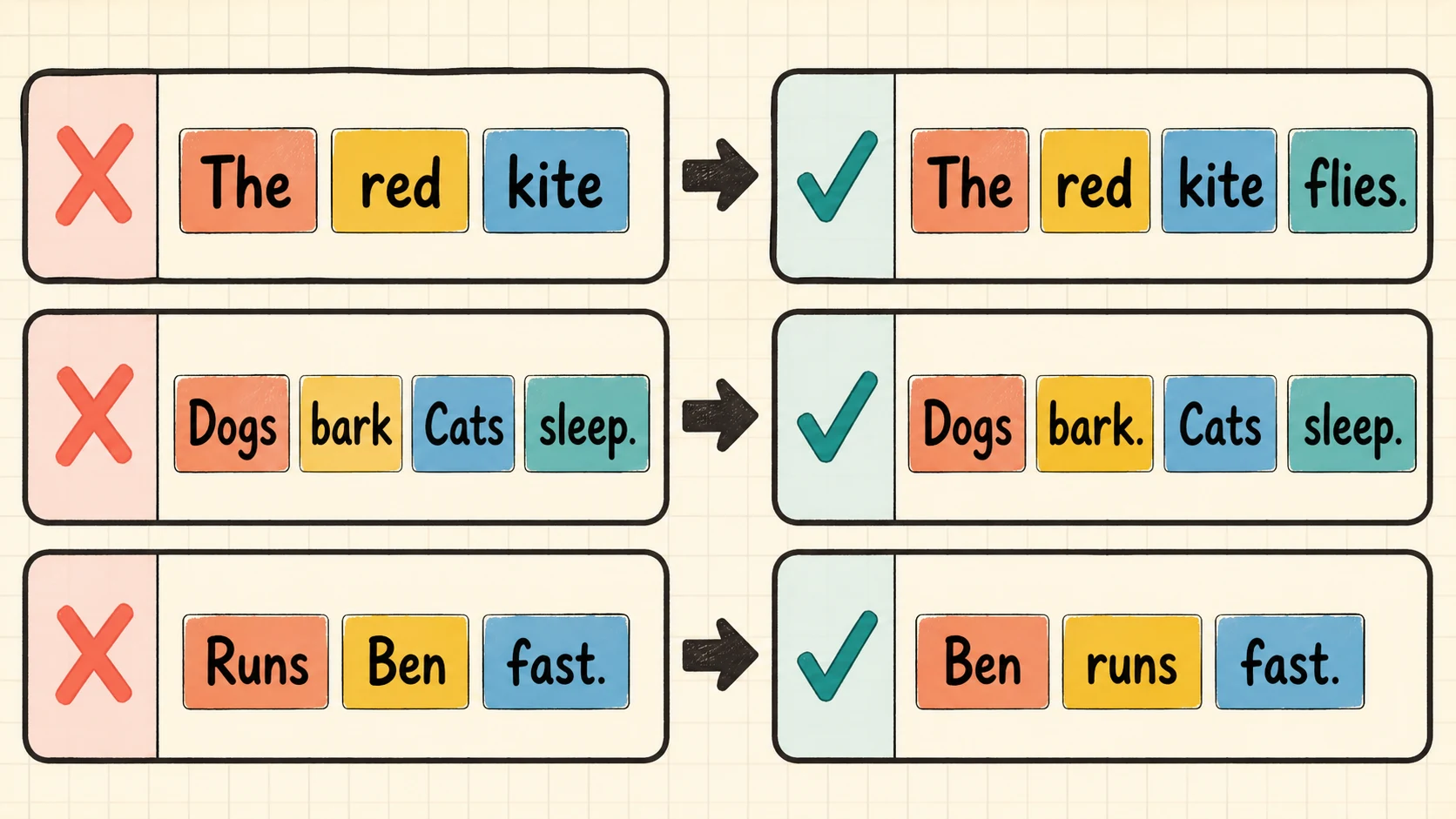
Reduce visual, reading, or writing demands while keeping word order as the decision the learner must make.
When the page feels visually crowded
Cover all but one item with blank paper. Reveal the next item only after the current sentence has been checked. You can also mark a clear starting point on the writing line without identifying the first word.
This adaptation changes the amount of information visible, not the sentence task.
When handwriting slows the lesson
Write each supplied word on a separate card and let the learner move the cards into order. Once the order is correct, ask the learner to read the sentence. The adult may record the final sentence if handwriting is not the skill being assessed.
Alternatively, let the learner dictate the ordered sentence while pointing to each printed word. Record that the response was oral or card-based so it is not confused with independent written performance.
When reading the words is difficult
Read the supplied words neutrally, in their printed scrambled order. Avoid using expression that discloses the sentence. The learner then decides how to arrange them.
If only one word is difficult, identify that word and continue. If most items require extensive reading help, the worksheet may currently measure decoding more than word order. Use fewer items and revisit when the text is more accessible.
When the learner needs more challenge
Ask for a reason after selected answers: “Why did you put these two words together?” Or invite the learner to expand one completed sentence orally with a describing word or a location.
Do not require added words in the worksheet answer itself unless you clearly label the activity as an extension. The original task is to arrange the words provided, and inserting new language can make a correct answer disagree with the key.
Interpret errors before choosing a correction
An incorrect answer is more useful when the adult identifies what kind of thinking produced it. Do not reduce every response to “careless” or “does not know sentences.”
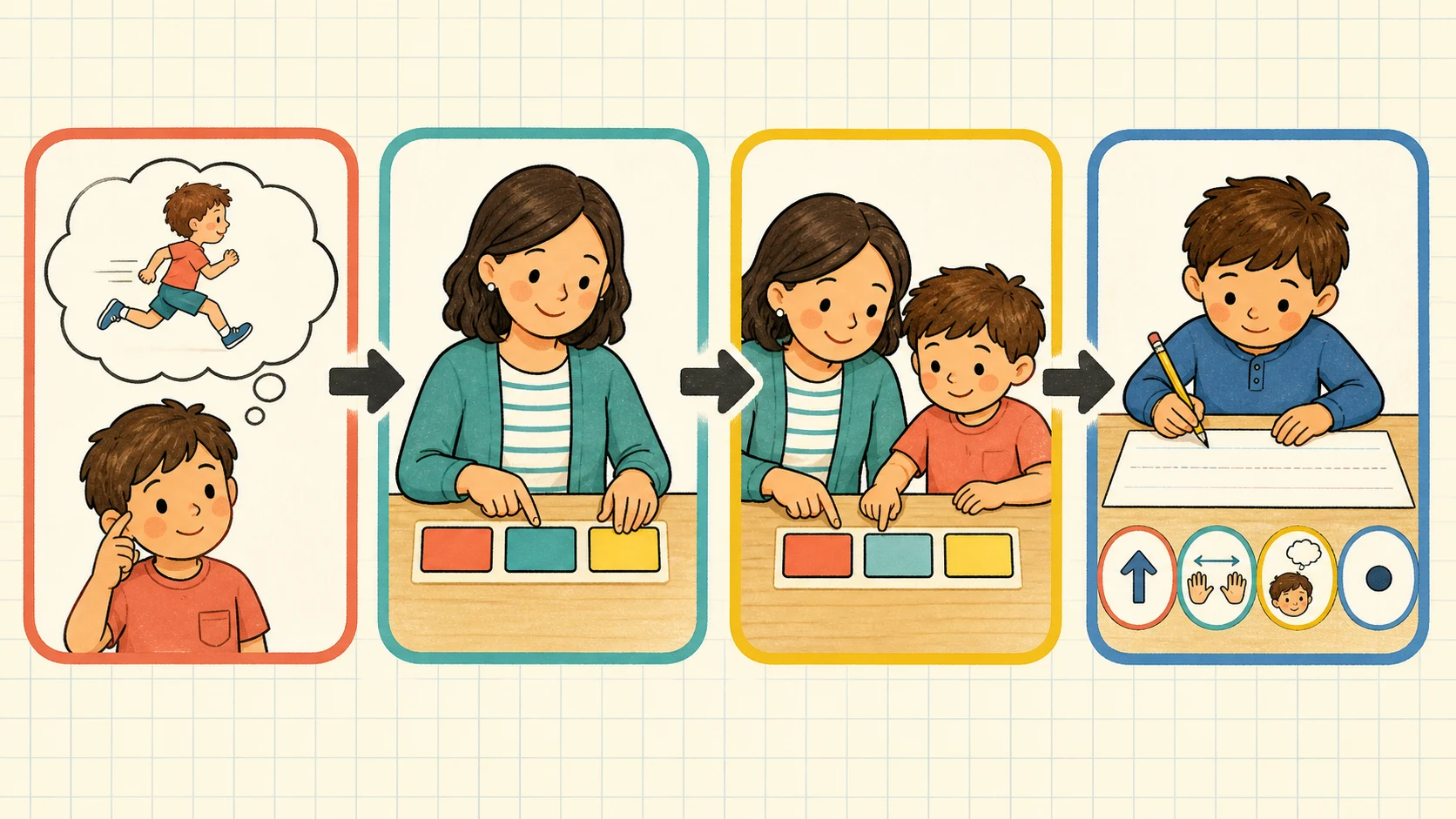
Read the response, locate the broken relationship, revise one part, and reread the whole sentence.
Words are copied in the printed order
The learner may not understand that the words are scrambled. Demonstrate one fresh example with movable cards. Physically exchange two cards and compare the result before returning to the page.
The subject and action are reversed
Example: “Runs the dog” for “The dog runs.”
The learner may recognize both important parts but not their conventional order in a simple statement. Ask, “Who is running?” Have the learner say that naming part first and then add what it does.
A describing word is separated from its noun
Example: “The ball red rolls.”
Ask which word tells more about the ball, then place “red” next to “ball.” This is more precise than restarting the entire item.
A small word is omitted
Words such as “a,” “the,” “is,” or “in” may be skipped because the learner focuses on the most meaningful nouns and verbs. Point to each supplied word while rereading the answer. Ask, “Which word has not been used?”
Repeated omissions may indicate that the learner needs fewer words at a time, clearer tracking, or more oral rehearsal. One omission does not establish a broad grammar difficulty.
The sentence sounds possible but differs from the key
Check the response as a sentence before marking it wrong. Some word sets can permit more than one grammatical arrangement. Consider capitalization, punctuation, intended meaning, and whether every supplied word was used.
For instance, “The cat sleeps on the mat” and “On the mat, the cat sleeps” can both be grammatical when capitalization and punctuation are adjusted appropriately. A beginner worksheet may intend the first, more direct order. Explain the intended pattern, but do not tell the learner that a genuinely grammatical alternative is meaningless.
Capitalization or punctuation is incorrect
Separate sentence order from written conventions in your record. A learner might arrange all words correctly but omit a period. Mark the word-order skill as successful and note the convention for correction.
The Common Core English Language Arts standards provide broad grade-level context for producing sentences and using writing conventions. Local implementation and instructional sequences vary, and this one worksheet should not be treated as proof of comprehensive standards alignment.
Use the answer key responsibly
The separate printable answer key is best used after the learner has attempted an item. It confirms the worksheet’s intended arrangement; it should not replace reading and evaluating the learner’s sentence.
Use this checking sequence:
- Read the learner’s sentence exactly as written.
- Confirm that every supplied word appears.
- Decide whether the order forms a complete, sensible sentence.
- Compare it with the answer key.
- If the responses differ, determine whether the learner’s version is ungrammatical, merely unconventional, or another valid arrangement.
- Ask the learner to repair one error and reread the sentence.
Avoid displaying the full key during independent practice. Copying can produce a perfect page without showing whether the learner understands word order.
Record useful evidence rather than only a total score. A note such as “9 of 12 correct; three items omitted small words; corrected two after pointing to unused words” guides the next lesson better than “75%.” At the same time, do not turn one brief worksheet into a diagnosis. Performance can be affected by reading difficulty, handwriting, attention, unfamiliar vocabulary, or fatigue.
Decide what to teach next from observed work
Use the learner’s pattern across the 12 items to choose the next step.
| Observed performance | Reasonable next action |
|---|---|
| Most items are accurate and independently reread | Try a new easy set or ask for one original simple sentence |
| Answers improve after “Who? Does what?” | Continue short guided practice and fade the verbal prompt |
| Word order is correct but punctuation is often missing | Keep sentence order practice brief and add a separate convention check |
| Small words are repeatedly omitted | Use word cards and require a touch-and-read check for every word |
| Many words cannot be read | Provide oral access now and coordinate future work with current reading instruction |
| Several answers are grammatical alternatives | Discuss ordinary versus less common order and inspect the clues in each item |
| Errors increase late on the page | Divide the 12 items into shorter sessions before increasing difficulty |
| The learner cannot arrange two- or three-part oral examples | Return to oral sentence building before assigning more written items |
Do not move to compound or complex sentences solely because the page is finished. Look for independent, repeatable control of simple word order. Likewise, do not demand repeated copies of the same sentence when the learner already understands it. The broader 1st Grade Grammar collection can help you choose adjacent practice without treating one result as a complete assessment.
Schedule brief retrieval instead of immediate repetition
A completed page should not be the final encounter with the skill. Revisit the ordering routine after a delay so the learner must retrieve it rather than imitate a just-completed example.
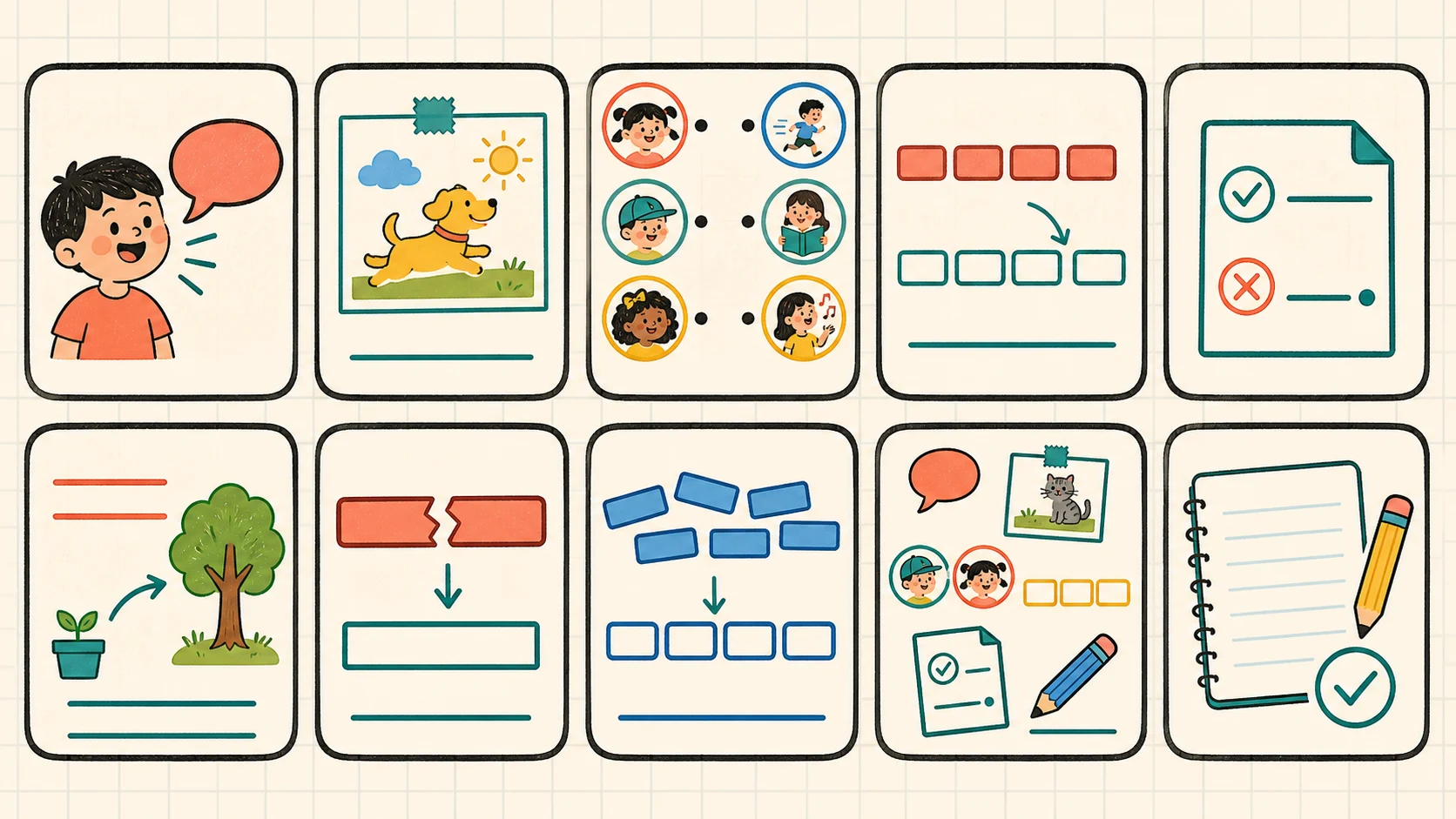
Return to a few sentences after increasing gaps, adjusting the schedule to the learner’s actual performance.
A practical, adjustable plan is:
| Review point | Activity | What to observe |
|---|---|---|
| End of the lesson | Repair one earlier error and explain the change | Can the learner identify why the new order works? |
| Next learning session | Rearrange two previously difficult items without viewing old answers | Is the strategy remembered after a delay? |
| Several days later | Solve two fresh oral or card-based examples | Does the skill transfer beyond the original page? |
| About one week later | Complete a few related sentence-order items | Is support still needed, and if so, what kind? |
| Later review | Write or arrange one sentence during ordinary grammar work | Does the learner use sensible order in a new context? |
These intervals are an instructional suggestion, not a sourced or universal schedule. Shorten the gap when the strategy is forgotten. Lengthen it when recall is accurate and independent. The learner’s observed work should drive pacing.
Keep the worksheet’s limitations in view
This printable provides 12 focused opportunities to arrange words. That is enough for a compact lesson and an initial look at performance, but not enough to establish comprehensive sentence mastery.
It does not, by itself, show whether the learner can:
- generate an original idea;
- select vocabulary independently;
- spell a self-composed sentence;
- write different sentence types;
- expand a sentence with meaningful details;
- combine ideas;
- recognize every fragment or run-on;
- transfer the skill into sustained writing.
The “easy” label describes the catalogue difficulty, not a promise that every learner will find the page easy. The 1st Grade label describes intended practice level, while local curricula and individual learning sequences differ. Adults should avoid making medical, developmental, or diagnostic conclusions from the result.
The most honest use of the page is narrow and practical: teach a word-order routine, observe how the learner applies it, respond to specific errors, and gather enough evidence to choose the next piece of instruction.
Continue with the next useful step
After the delayed review, choose the next resource from the evidence. If the learner still needs direct word-order practice, revisit the free 1st Grade Sentence Structure worksheet in shorter sets or use a fresh easy worksheet. If the learner is consistently accurate, follow the Sentence Structure topic guide to select the next appropriate skill rather than skipping ahead automatically.
For more sustained practice, the 1st Grade Sentence Structure Worksheet Pack contains 18 worksheets. If you need new material tailored to the learner’s current word-order pattern, explore the free worksheet generators and create a small retrieval set for the next session.
Put it into practice
Use the guide with a real printable
Move from explanation to a short, observable practice task. Check the first item together, then adjust the next session from the learner's actual work.
See the 18-worksheet pack