Complete guide
How to teach and practise 1st grade punctuation worksheets - standard theme (easy)
A focused lesson for this 12-item worksheet
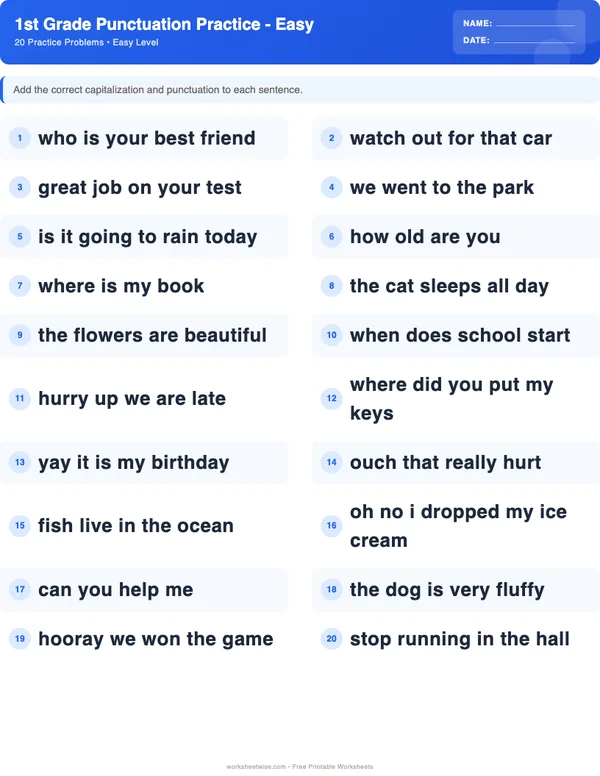
The free 1st Grade Punctuation worksheet gives a learner 12 easy-level sentences to correct. The task is specific: add correct capitalization and ending punctuation, choosing among periods, question marks, and exclamation marks.
The most useful way to teach it is to model one sentence, solve two or three together, let the learner complete a short independent set, and then examine the reasoning behind any errors. Success means more than matching the answer key. The learner should be able to explain that a sentence begins with a capital letter and that its meaning helps determine the ending mark.
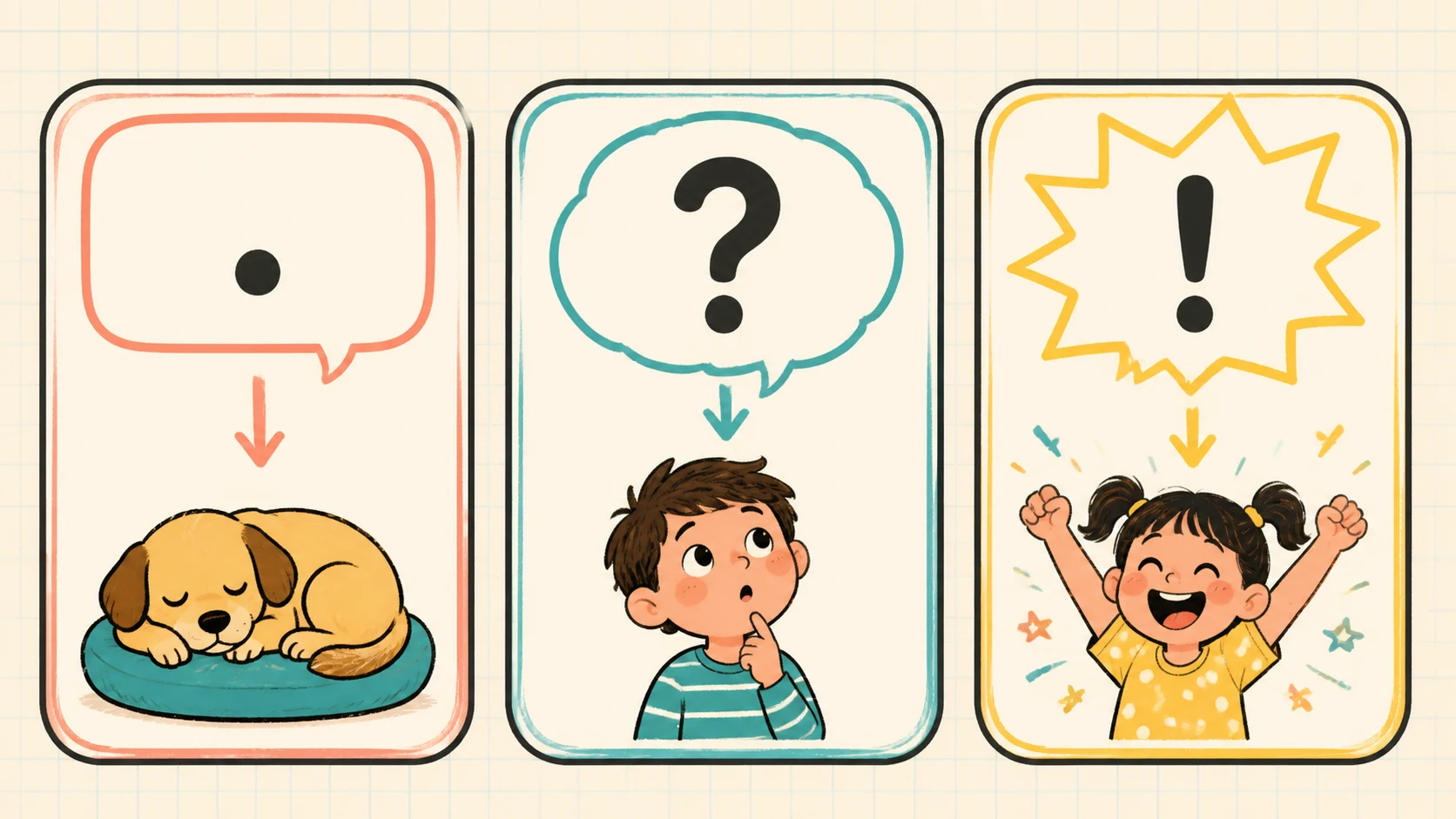
Move from a brief launch to modeling, guided practice, independent work, feedback, and later review.
This printable practices four listed skills:
- Capitalizing the beginning of a sentence
- Ending a statement with a period
- Ending a direct question with a question mark
- Using an exclamation mark for a strongly expressed sentence
Grade labels describe the intended practice level; they do not guarantee that every learner has met the same prior lessons. Local school and homeschool sequences differ. Use the learner’s observed work—not the label alone—to choose the amount of modeling, the number of items completed at once, and the next activity.
What this worksheet does and does not cover
This is a short mechanics exercise, not a complete punctuation course. It concentrates on sentence beginnings and three forms of end punctuation. Its easy designation and straightforward format make it suitable for an initial check, guided practice, homework after instruction, or reinforcement.
It does not, according to the catalogue facts supplied here, teach commas, apostrophes, quotation marks, colons, or semicolons. It also should not replace authentic reading and writing. The broader punctuation topic guide is the better place to see how end punctuation connects with later punctuation work.
The Common Core State Standards for English Language Arts provide a broader reference point for language conventions, including first-grade capitalization and end punctuation. That source did not evaluate this WorksheetWise printable, and the worksheet should not be described as comprehensive standards coverage. It is one bounded practice activity.
The skill underneath the directions
The printed instruction says, “Add the correct capitalization and punctuation to each sentence.” The learner therefore has to make at least two decisions for every item:
- Which letter must become a capital?
- Which mark belongs at the end?
Those decisions are related but distinct. A learner may capitalize correctly and still choose the wrong mark. Another may identify the sentence type correctly but overlook the lowercase opening letter. Score and discuss the two decisions separately so that one mistake does not hide what the learner understands.
A reasonable readiness check
Before handing over all 12 items, say three short sentences aloud:
- “The bird is blue.”
- “Can the bird fly?”
- “What a fast bird!”
Ask the learner to tell whether each sentence is telling, asking, or strongly expressing something. The learner does not need formal grammatical terminology if the meaning is clear. If all three categories are unfamiliar, teach them orally before expecting written corrections.
Prepare the lesson without overexplaining
Print or open the worksheet and keep the separate answer key out of the learner’s sight. Have a pencil and, if useful, two colored pencils available. One color can show the opening capital; the other can show the ending mark. Color is an instructional support, not a new requirement of the skill.
A complete first use can be brief, but no universal duration fits every learner. Stop or divide the work if attention fades, handwriting effort starts to obscure punctuation knowledge, or the same unexplained error repeats.
Use a simple lesson sequence
| Phase | Adult action | Learner action | Evidence to notice |
|---|---|---|---|
| Launch | State the two jobs: fix the beginning and choose the ending | Repeat or point to the two jobs | Understands that every sentence needs both checks |
| Model | Think aloud through one similar example | Watches and explains the final choice | Connects meaning with punctuation |
| Guided practice | Solve two or three items together | Supplies decisions before writing | Can distinguish telling, asking, and strong expression |
| Independent practice | Assign a manageable group of items | Corrects without immediate prompting | Applies both skills consistently |
| Check | Compare with the key after reasoning | Explains matches and revisions | Treats correction as part of learning |
| Retrieve | Revisit selected sentence types later | Corrects or writes fresh examples | Recalls the skill after a delay |
This sequence is an instructional suggestion for using the printable. It is not a claim that one fixed routine has been tested on this exact worksheet.
Give one compact launch
Try this language:
Every sentence begins with a capital letter. Then we read the whole sentence to decide how it ends. A telling sentence usually takes a period. A sentence that asks something takes a question mark. A sentence that shows strong excitement or feeling may take an exclamation mark.
Keep the explanation tied to the available choices. Avoid introducing commas or other marks during the launch unless the learner asks about them. Those marks are outside this worksheet’s stated skill set.
The IES guide on teaching elementary students to be effective writers offers broader instructional framing for elementary writing. This worksheet can serve as a small conventions activity within that larger work, but the guide does not review or endorse this printable.
Model one complete decision
Use an invented sentence similar to the task rather than reading an actual worksheet item aloud for the learner. Write:
where is my red hat
Then make the reasoning visible.
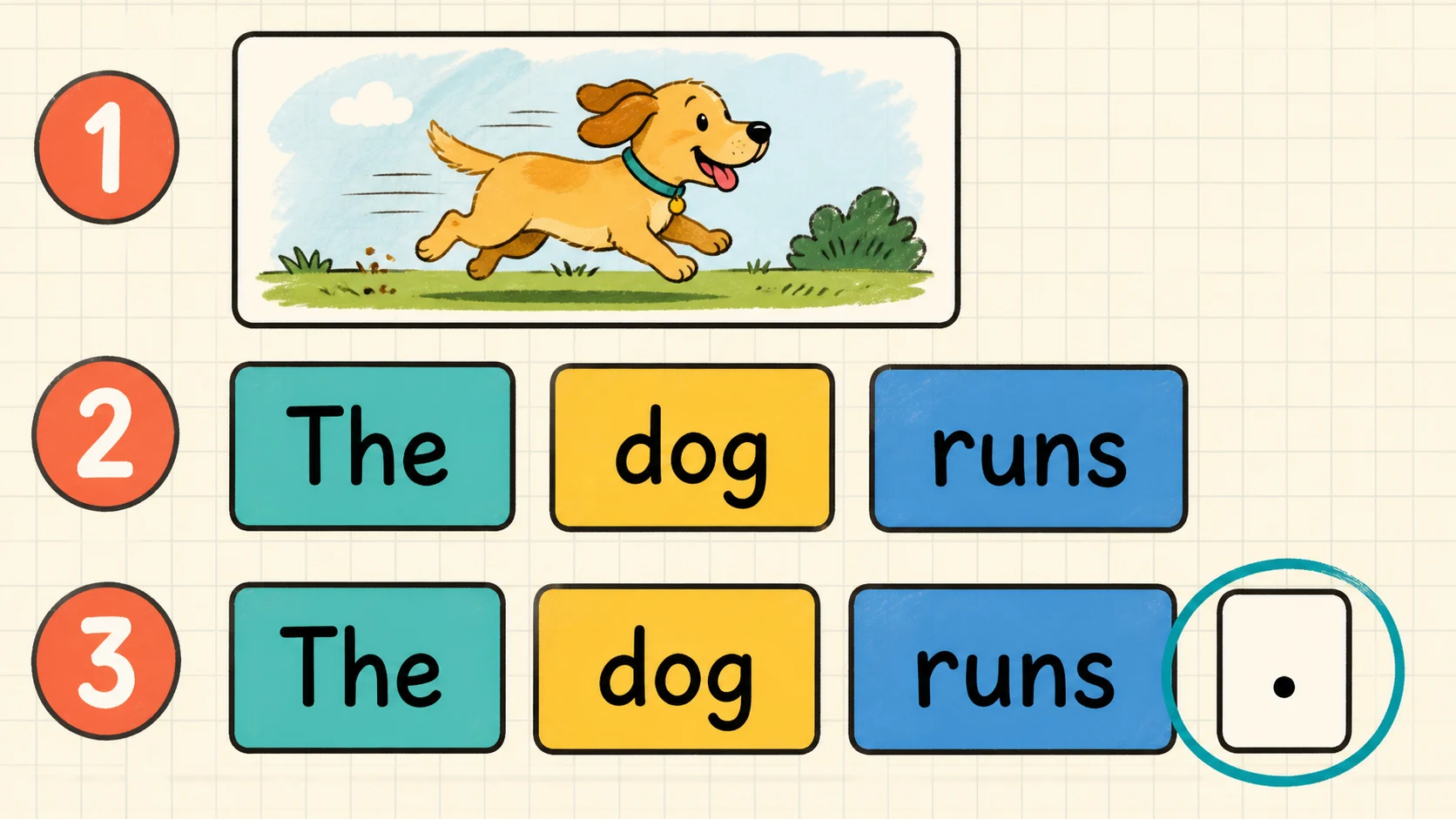
Check the opening letter, read for meaning, choose the ending mark, and reread the completed sentence.
Think aloud in a fixed order
Say:
- “I look at the first word. The sentence begins with a lowercase w, so I change it to uppercase W.”
- “I read the whole sentence: ‘Where is my red hat?’”
- “It asks for information, so it needs a question mark.”
- “I reread it with the correction: ‘Where is my red hat?’”
The checked answer is:
Where is my red hat?
It has a capital W and a question mark because it directly asks where the hat is.
Do not rely only on a rising voice. Spoken intonation can help a beginner notice a question, but the words and meaning provide stronger evidence. “Where is my red hat” asks something even if an adult reads it in a flat voice.
Work through fully checked examples
The examples below are newly written teaching examples. They illustrate the same listed skills but are not presented as items taken from the printable.
Example 1: A statement
Uncorrected:
the dog naps on the rug
Checked answer:
The dog naps on the rug.
Why it is correct:
- the becomes The because it begins the sentence.
- The sentence tells what the dog does.
- It does not ask anything or show a clearly strong expression.
- A period completes the statement.
A useful prompt is, “Is the writer telling us something, asking us something, or strongly expressing something?”
Example 2: A direct question
Uncorrected:
can we feed the ducks
Checked answer:
Can we feed the ducks?
Why it is correct:
- can becomes Can at the beginning.
- The speaker is asking whether feeding the ducks is possible or allowed.
- The answer could be yes or no.
- A question mark belongs at the end.
The word can is a clue, but the learner should still read the whole sentence. Individual words do not determine punctuation without context.
Example 3: A strong expression
Uncorrected:
what a huge pumpkin
Checked answer:
What a huge pumpkin!
Why it is correct:
- what becomes What because it opens the sentence.
- In this form, the sentence expresses a strong reaction to the pumpkin.
- It is not asking, “What is the pumpkin?”
- An exclamation mark communicates the strong expression.
This example matters because what often begins a question but does not always do so. Meaning and sentence structure must guide the choice.
Example 4: Another statement
Uncorrected:
my boots are by the door
Checked answer:
My boots are by the door.
Why it is correct:
- my becomes My.
- The sentence provides information about the boots.
- There is no direct request for an answer and no clearly marked strong reaction.
- A period is the restrained, appropriate ending.
Example 5: An excited sentence
Uncorrected:
we won the game
Possible lesson answer in a context of celebration:
We won the game!
Why it can be correct:
- we becomes We.
- If the speaker is celebrating, the sentence strongly expresses excitement.
- The exclamation mark fits that intended tone.
However, We won the game. is also grammatically possible when the writer is reporting the result calmly. This is a boundary case, not a reason to tell the learner that punctuation is arbitrary. Context determines the tone. On the worksheet, use the sentence wording and answer key to infer the intended easy-level classification.
Move from guided practice to independent work
Guided practice is not the adult supplying each answer. It is a short bridge in which the learner makes decisions while the adult keeps the reasoning orderly.
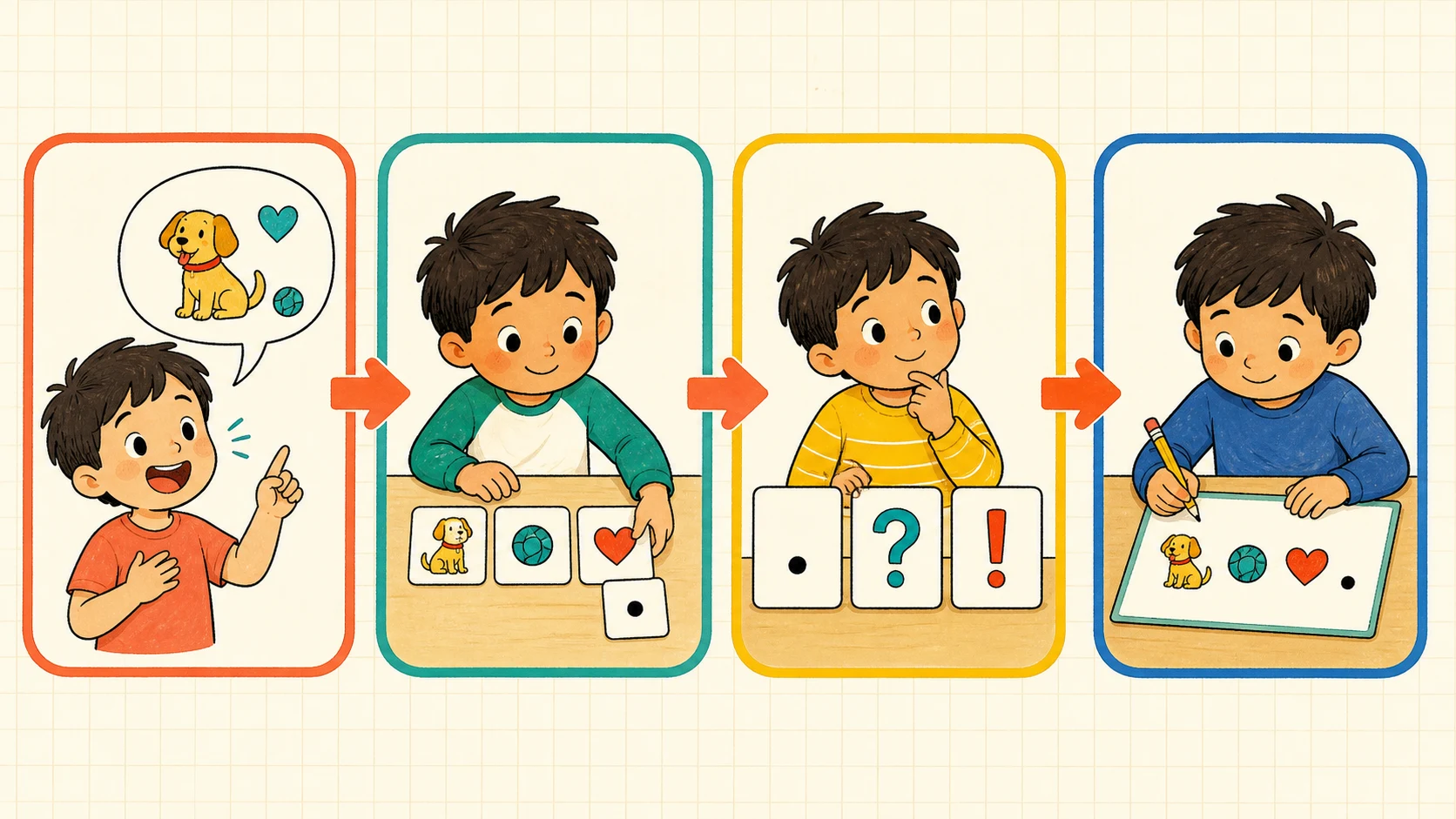
Prompt for the decision process, then reduce help as the learner becomes accurate.
Guide the first few items
For the first item, ask both prompts:
- “What must happen at the beginning?”
- “Is the sentence telling, asking, or strongly expressing?”
For the next item, shorten the support:
- “Check the beginning and the ending.”
For the third, point silently to the first letter and then the end. If the learner handles that successfully, allow independent work.
This fading sequence is a practical teaching method, not a sourced prescription or fixed timetable. Some learners will need one model; others will need several. Continue support only as long as it helps the learner make the decision.
Divide the 12 items when needed
The printable contains 12 exercises, but the learner does not have to complete all 12 in one sitting. Possible arrangements include:
- Three groups of four items
- Two groups of six
- A modeled item, three guided items, and the remaining items independently
- Six items now and six after a break
Keep the original punctuation decision intact. Dividing the page reduces the amount visible or completed at once; it does not simplify the rule.
Protect independent evidence
During independent practice, avoid saying “That one is a question” or tapping the correct punctuation symbol. Those cues reveal the answer. Instead, use neutral prompts:
- “Read the whole sentence.”
- “Check both jobs.”
- “Tell me what the sentence is doing.”
- “Reread your completed sentence.”
If the learner asks whether an answer is right, say, “Show me why you chose it.” The explanation gives more useful evidence than an immediate yes or no.
Adapt support without changing the skill
A helpful adaptation changes access, amount, or prompting while preserving the same target: capitalize the sentence beginning and choose the appropriate ending punctuation.
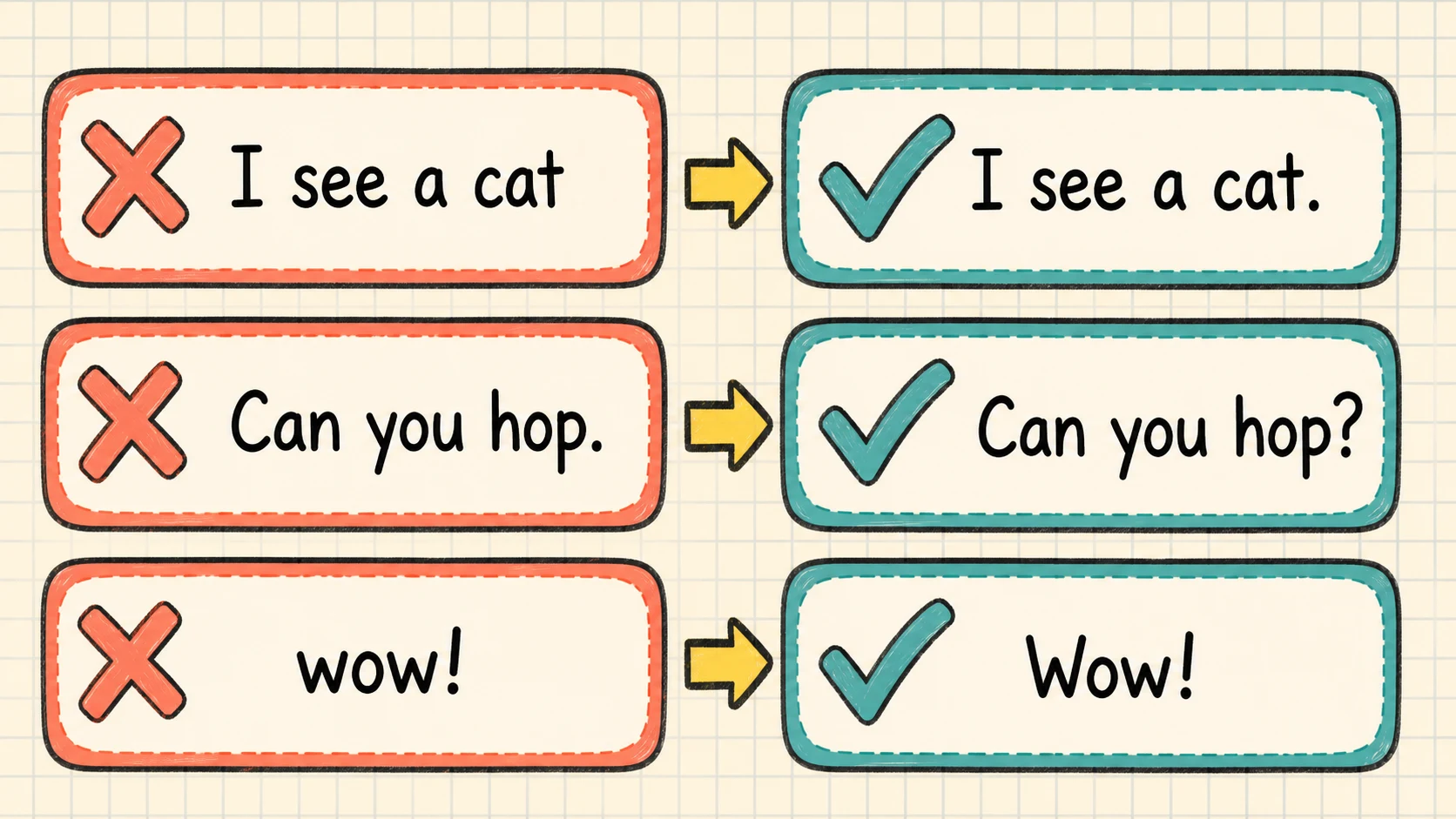
Adjust how much the learner sees, hears, or writes while keeping the punctuation decision unchanged.
When reading effort hides punctuation knowledge
Read the sentence aloud exactly as written, without exaggerating the ending. Then ask the learner to identify its purpose and add the punctuation. This separates decoding load from punctuation reasoning.
That choice is especially useful when the learner can discuss telling and asking sentences orally but struggles to read the printed words. It does not prove a reading difficulty or call for a diagnosis. It simply helps the adult observe the target skill more directly.
The IES foundational reading practice guide addresses broader reading instruction from kindergarten through third grade. It can inform the larger literacy context, but it does not prescribe how to administer this particular punctuation sheet.
When handwriting effort is high
Let the learner mark only the opening letter and ending punctuation instead of rewriting the full sentence. If capitalization requires changing a lowercase letter, the learner can write the capital above it or circle and replace it.
The knowledge target remains unchanged. The adaptation merely reduces copying. If later work requires sentence rewriting, practice that separately rather than treating slow copying as a punctuation error.
When the full page feels crowded
Cover all but one item with a blank sheet of paper. Reveal the next item after the current one is complete. Another option is to fold the page so that only a small group is visible.
Do not remove all question or exclamation items to make the page easier. That would narrow the skill being assessed. Reduce visual quantity while preserving the range of ending marks.
When the learner answers quickly but carelessly
Require a two-point check beside each item:
- Mark or point to the opening capital.
- Circle or name the ending punctuation.
Ask for a quiet reread before moving on. The goal is not to slow every learner indefinitely. It is to make both required decisions visible until the learner performs them consistently.
When the worksheet is too easy
Do not add unrelated advanced punctuation to the same task. Instead, ask the learner to explain two answers or write one original example of each practiced sentence type. For example:
- Statement: The frog is green.
- Question: Can the frog swim?
- Strong expression: What a tiny frog!
This extends application while retaining capitalization and the three listed ending marks.
Handle boundary cases and common misconceptions
Easy punctuation practice can still contain decisions that depend on meaning. Adults should distinguish a genuine rule error from a reasonable interpretation.
A sentence can be excited without an exclamation mark
A sentence about an exciting event does not automatically require an exclamation mark. Compare:
- We are going to the zoo.
- We are going to the zoo!
Both are possible. The first reports information; the second presents it with strong excitement. If an isolated worksheet sentence could reasonably take either mark, consult the provided key to identify the intended answer, then acknowledge that a different context could support the other mark.
A question word does not guarantee a question mark
Compare:
- What is in the box?
- What a big box!
Both begin with What, but they perform different jobs. The first asks for information. The second expresses a reaction. Encourage the learner to read beyond the first word.
A question mark is not used for every uncertain idea
The sentence I wonder where the cat is. expresses uncertainty, but it does not directly ask the reader a question. It is a statement and takes a period. By contrast, Where is the cat? directly asks and takes a question mark.
This boundary may be more complex than the worksheet’s easy-level items. Use it only if the learner assumes that words such as wonder always require a question mark.
Capitalization and punctuation are not one combined score
Consider:
can the bird sing?
The question mark is correct, but the opening capitalization is not. Record that as one correct decision and one correction needed. Conversely:
Can the bird sing.
The capital is correct, but the ending mark is not. Separating the observations tells you what to reteach.
Interpret errors before assigning more work
A wrong mark is evidence to investigate, not a complete explanation of what happened.
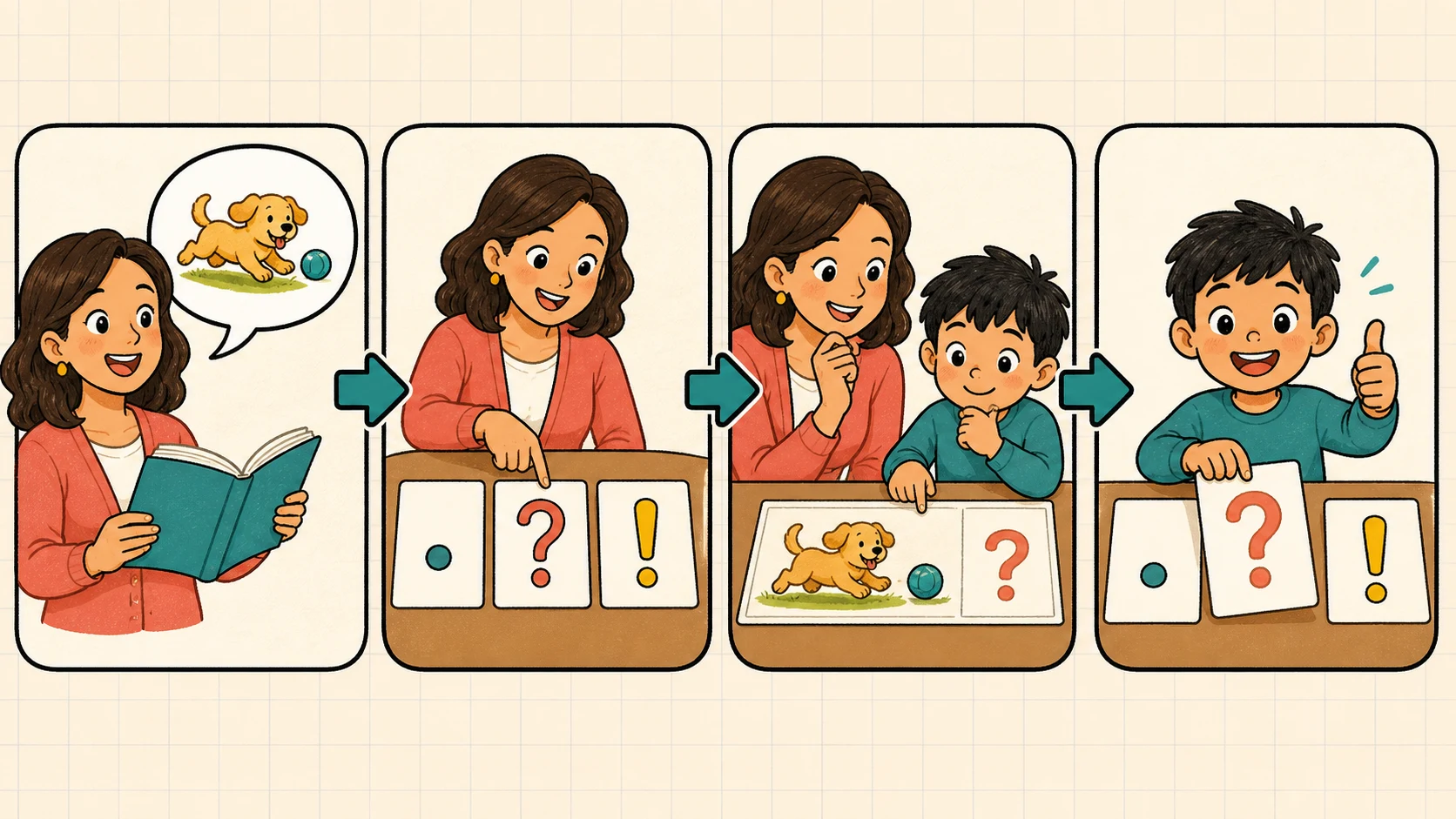
Classify the error, ask for the learner’s reasoning, correct it, and test the same idea with a fresh sentence.
Use the learner’s words and corrections to identify the likely instructional need.
| Observed pattern | Check before concluding | Useful response |
|---|---|---|
| Opening letters remain lowercase | Ask the learner to point to where the sentence begins | Model one capitalization correction, then try a new sentence |
| Every item gets a period | Ask the learner to sort examples as telling, asking, or strong expression | Contrast one statement with one direct question |
| Every item gets an exclamation mark | Ask what makes each sentence strongly expressive | Compare a calm report with an excited version |
| Question words trigger question marks every time | Have the learner read the entire sentence | Contrast “What is it?” with “What a surprise!” |
| Correct oral answers but incorrect written marks | Ask the learner to name and draw each symbol | Practice matching the names to ., ?, and ! |
| Mixed errors late on the page | Recheck a few early and late items orally | Consider fatigue, page load, or lost attention before reteaching the rule |
| Correct answers with no explanation | Ask for reasoning on two selected items | Confirm understanding without requiring an explanation for all 12 |
Avoid inferring a medical, developmental, or learning condition from this page. One worksheet cannot establish such a conclusion. It shows only how the learner handled these 12 items under the conditions in which they were completed.
Use the answer key responsibly
The separate printable answer key supports checking, but it should come after the learner has made and explained choices.
Check in two passes
First, check capitalization. For every item, look at the first letter independently of the ending mark.
Second, check ending punctuation. Compare the learner’s mark with the key, then ask for reasoning when there is a mismatch. A practical notation is:
- C for capitalization
- P for punctuation
An item can therefore be correct for C but need revision for P, or the reverse. This is more informative than treating the whole sentence as simply right or wrong.
Resolve a disagreement with evidence
If the learner’s answer differs from the key:
- Read the sentence as printed.
- Ask what the sentence is doing.
- Compare the learner’s explanation with the likely intended meaning.
- Check whether more than one punctuation mark could work under different tones.
- Teach the expected answer while acknowledging a defensible alternative, if one exists.
Do not alter a clear question into an exclamation merely because it sounds energetic. Did we win? remains a question, while We won! is a strong expression.
The key is useful for consistency, but it does not replace interpretation. Its purpose is to confirm the intended responses for this printable, not to prove that every isolated sentence has only one possible tone in every context.
Decide what to do next from the pattern
A total score alone is not enough. Look for which of the two recurring jobs—the opening capital or the ending mark—caused difficulty.
If capitalization is the main problem
Use three fresh sentences with the correct ending marks already supplied. Ask the learner only to fix each opening letter:
the sun is warm.→ The sun is warm.can I play?→ Can I play?what a tall tree!→ What a tall tree!
Then return to one or two missed worksheet items. This isolates capitalization briefly before recombining the skills.
If question marks are the main problem
Contrast a statement and a direct question:
- The rabbit is under the chair.
- Is the rabbit under the chair?
Ask which sentence expects an answer. Once the learner identifies that feature, revisit a missed question item without supplying the mark.
If periods and exclamation marks are confused
Read two versions with different intended tones:
- I found my shoe.
- I found my shoe!
Explain that a period gives a calm finish, while an exclamation mark shows a stronger expression. Then present a fresh sentence and supply a brief context before the learner chooses.
If the learner is consistently accurate
Move from correction to production. Ask for one original statement, one question, and one strongly expressed sentence. Check the same two features: capital beginning and appropriate ending mark.
For broader first-grade language practice, use the 1st Grade Grammar hub. If repeated practice with this same topic is useful, the 1st Grade Punctuation Worksheet Pack contains 18 worksheets. Choose additional material because the observed error pattern calls for it, not simply because another page is available.
Schedule retrieval without imposing a universal timetable
Immediate accuracy does not show whether the learner will remember the choices later. Revisit a small sample after time has passed.

Use short, delayed checks and adjust the spacing according to what the learner remembers.
The following is a practical schedule suggestion, not a universal or source-mandated timetable:
| Time | Retrieval task | What to record |
|---|---|---|
| Later the same day or next lesson | Correct one statement and one question | Whether both beginning and ending are checked |
| A few days later | Correct three fresh sentences using all three ending marks | Which sentence type still needs a prompt |
| About a week later | Write or correct one example of each type | Whether the learner remembers without a rule card |
| During later writing | Check one authentic sentence for capitalization and punctuation | Whether the skill transfers beyond the worksheet |
If the learner recalls the skill easily, lengthen the interval or apply it in original writing. If the same misconception returns, shorten the interval and use a direct contrast before another independent attempt. Pacing should follow observed work.
Do not repeatedly administer all 12 original items as though memorizing their answers proves mastery. Fresh examples reveal whether the learner can apply the rule.
Keep the worksheet’s limits visible
This printable gives a narrow sample of performance. It cannot show the full quality of a learner’s writing, reading comprehension, oral language, attention, or knowledge of punctuation beyond the four listed skills.
Its limitations include:
- Only 12 exercises
- An easy intended practice level
- Practice limited to capitalization, periods, question marks, and exclamation marks
- Sentence correction rather than extended composition
- No stated coverage of commas, apostrophes, quotation marks, or other later punctuation
- No universal indication of how much help a learner should receive
- No basis for medical, developmental, or diagnostic conclusions
The worksheet is useful when adults keep those boundaries clear. It can reveal whether a learner notices sentence beginnings, interprets simple sentence purposes, and applies an ending mark under a particular set of conditions. It cannot by itself demonstrate complete mastery or comprehensive standards alignment.
A practical next action
Use the worksheet once with the model–guide–independent sequence, mark capitalization and punctuation separately, and save two missed or uncertain sentence types for delayed review. Then visit the broader 1st Grade punctuation guide to select the next practice from the learner’s actual error pattern.
If all three ending marks are secure, create fresh transfer examples with the free worksheet generators. If the learner still confuses one pair of marks, repeat that contrast with only two or three new sentences before assigning another full page.
Put it into practice
Use the guide with a real printable
Move from explanation to a short, observable practice task. Check the first item together, then adjust the next session from the learner's actual work.
See the 18-worksheet pack