Complete guide
How to teach and practise 1st grade parts of speech worksheets - standard theme (easy)
What this worksheet teaches and how to use it
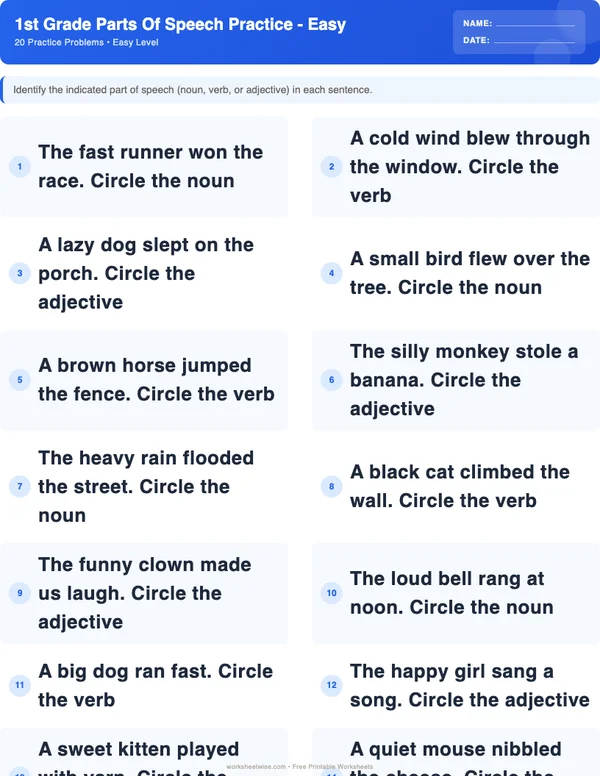
The free 1st Grade Parts of Speech worksheet provides 12 easy-level items. In each sentence, the learner identifies the indicated part of speech: a noun, verb, or adjective. The printable practices four connected skills: recognizing nouns, recognizing verbs, recognizing adjectives, and analyzing a word within a sentence. A separate printable answer key is included.
The short answer is: model one item aloud, complete two or three items together, let the learner attempt the remaining items with limited prompting, and then review errors by returning to the sentence—not by merely supplying the answer. Use the learner’s observed work to decide the pace. A learner who explains choices accurately may be ready for independent practice quickly. A learner who guesses, labels every “interesting” word, or confuses actions with describing words needs more guided examples first.
This worksheet is intentionally narrower than the complete subject of parts of speech. It covers nouns, verbs, and adjectives rather than all eight traditional categories. For the broader sequence—including pronouns, adverbs, prepositions, conjunctions, and interjections—use the Parts of Speech topic guide.
Grade labels describe the intended practice level, not a promise that every learner of the same age is at the same point. Local school, homeschool, and tutoring sequences differ. Select support according to the learner’s current responses.
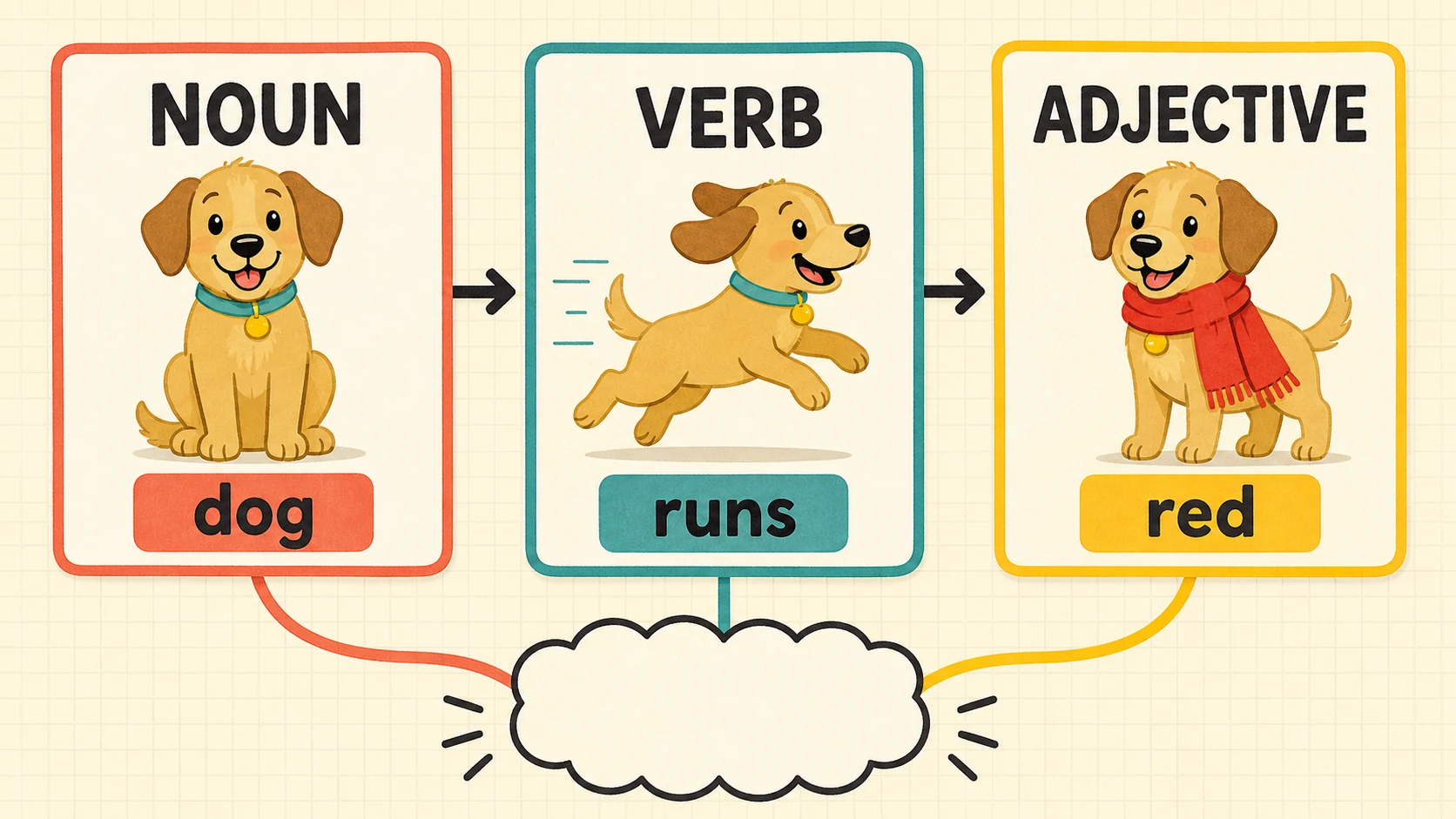
Use the map to move from a brief review through modeling, guided practice, independent work, and later retrieval.
A practical lesson plan for the 12 items
The full lesson can be brief, but it should not be rushed. The times below are instructional suggestions, not a universal timetable. Pause, shorten, or extend a stage based on what the learner demonstrates.
| Lesson stage | Suggested use | What the adult watches for |
|---|---|---|
| Review the three categories | 2–4 minutes | Can the learner explain noun, verb, and adjective in simple language? |
| Model one parallel example | 2–3 minutes | Does the learner attend to the whole sentence? |
| Complete guided examples | 3–6 minutes | Can the learner give a reason instead of guessing? |
| Start the printable together | 2–4 items | Does the learner understand the directions and marking method? |
| Continue independently | Remaining suitable items | Can the learner apply the same reasoning without repeated cues? |
| Check and discuss | 4–8 minutes | Are errors random, patterned, or caused by reading difficulty? |
| Schedule retrieval | Less than a minute | When will selected items or new examples be revisited? |
This structure is consistent with high-level instructional framing in the IES foundational reading practice guide, which emphasizes systematic instruction, modeling, supported practice, and attention to learner responses in foundational literacy teaching. The guide did not evaluate WorksheetWise or this particular printable.
The IES elementary writing practice guide also supports explicit teaching and gradual movement toward independent writing activity. Here, that general principle can inform the transition from an adult’s explanation to the learner’s own sentence analysis. It does not establish a fixed number of examples or a guaranteed result.
Prepare before the learner begins
Print or open the worksheet, but keep the answer key out of the learner’s direct view. Decide how answers will be marked. Depending on the page layout, the learner might circle, underline, or write the target word. Read the printed direction exactly:
Identify the indicated part of speech (noun, verb, or adjective) in each sentence.
Then translate the task into plain language: “Each sentence asks you to find one kind of word. First check which kind it asks for. Then read the whole sentence and choose the word doing that job.”
Do not preteach every possible grammar rule. Confirm only the distinctions needed for the page:
- A noun names a person, place, thing, or idea.
- A verb tells an action or, in some sentences, links the subject to information about it.
- An adjective describes a noun.
Because this easy worksheet is described as practice in identifying nouns, verbs, and adjectives, begin with concrete, straightforward cases. More difficult words that change roles belong in discussion after the basic routine is secure.
Use a repeatable three-question routine
Teach the learner to ask:
- What part of speech am I supposed to find?
- What job does each likely word do in this sentence?
- Which word best fits the requested category?
That third question matters. A sentence may contain a noun, a verb, and an adjective at the same time. The learner is not choosing the most noticeable word; the learner is choosing the word that matches the indicated category.
Model the task with a fully worked example
Use an example similar in structure to the printable rather than claiming to reproduce one of its actual items. The catalogue does not supply the worksheet’s 12 sentences, so the examples below are parallel teaching examples.
Worked example 1: Find the noun
Sentence: The small dog runs.
Target: noun
Think aloud:
- “I am looking for a noun.”
- “Small tells what kind of dog, so small describes.”
- “Runs tells the action.”
- “Dog names an animal, which is a thing.”
- “Therefore, dog is the noun.”
Checked answer: dog — noun
The checking statement should connect the word to its job: “Dog names the animal the sentence is about.” Simply saying “Dog is correct” does not reveal the reasoning.
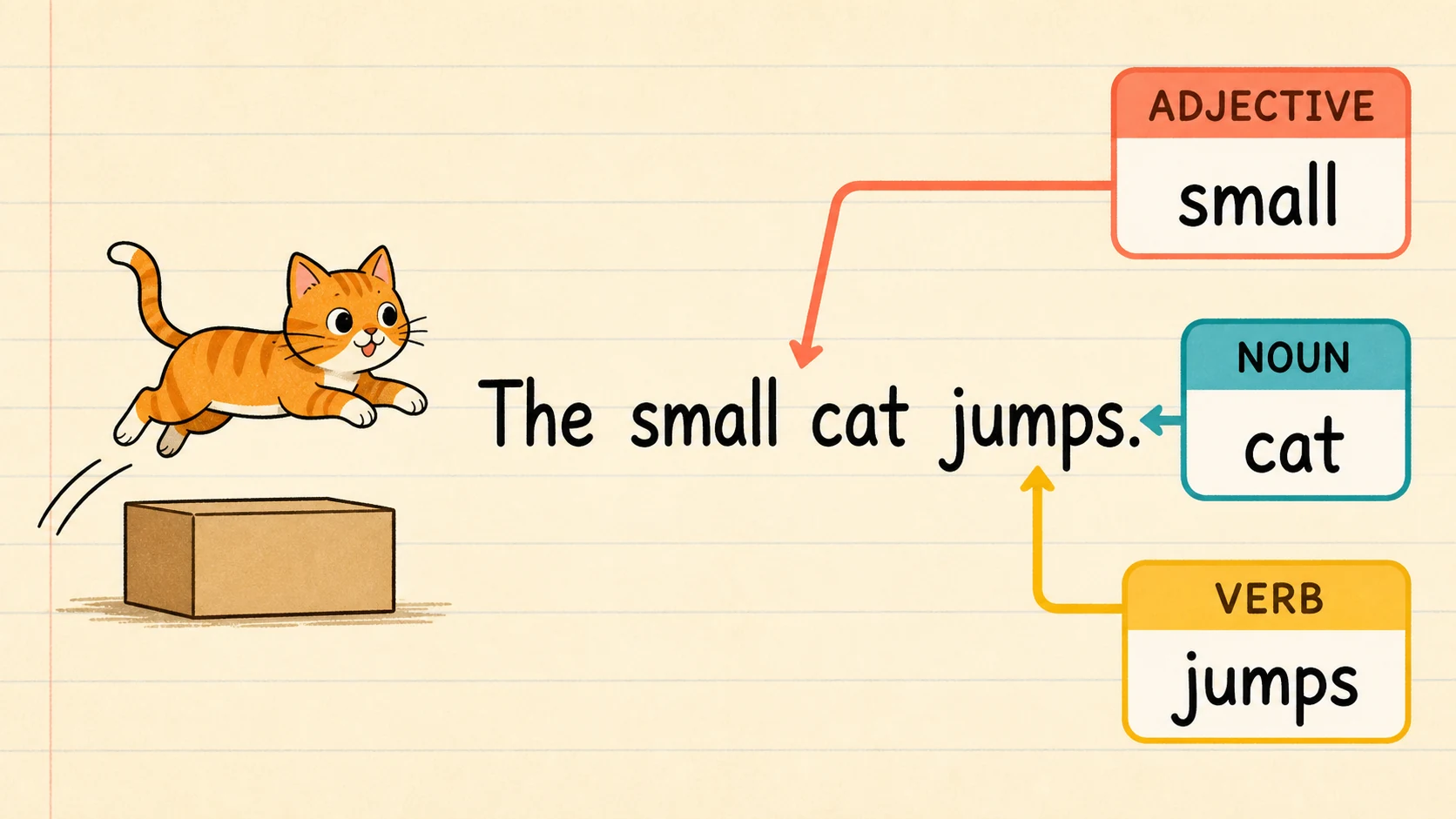
The useful part of a worked example is the connection between the selected word and its job in the sentence.
After modeling, ask the learner to restate the routine: “What did I check first?” A suitable response is “You checked which kind of word you needed.” If the learner instead starts naming definitions, redirect to the task sequence.
Run guided practice before independent work
Guided practice should still require the learner to think. Offer one question at a time, wait for a response, and ask for a short reason. Avoid turning every example into a speech by the adult.
Worked example 2: Find the verb
Sentence: Mia kicks the ball.
Target: verb
Ask, “What is happening?” The learner may say “Mia kicks.” Follow with, “Which single word tells the action?”
- Mia names a person.
- Ball names a thing.
- Kicks tells what Mia does.
Checked answer: kicks — verb
A concise explanation is enough: “Kicks is the action in the sentence.”
Worked example 3: Find the adjective
Sentence: We saw a red kite.
Target: adjective
Ask, “Which word tells more about the kite?”
- We refers to people, but it does not describe the kite.
- Saw tells what happened.
- Kite names the thing.
- Red tells which kind of kite by naming its color.
Checked answer: red — adjective
The key relationship is red → kite. Encourage the learner to say both words: “Red describes kite.”
Worked example 4: Find the noun when an adjective is nearby
Sentence: The tall plant grows.
Target: noun
This example checks whether the learner can separate an object from its description.
- Tall tells what kind of plant.
- Plant names the thing.
- Grows tells what the plant does.
Checked answer: plant — noun
If the learner chooses tall, ask, “Does tall name the thing, or tell us more about the thing?” That prompt preserves the skill because the learner must still classify the word.
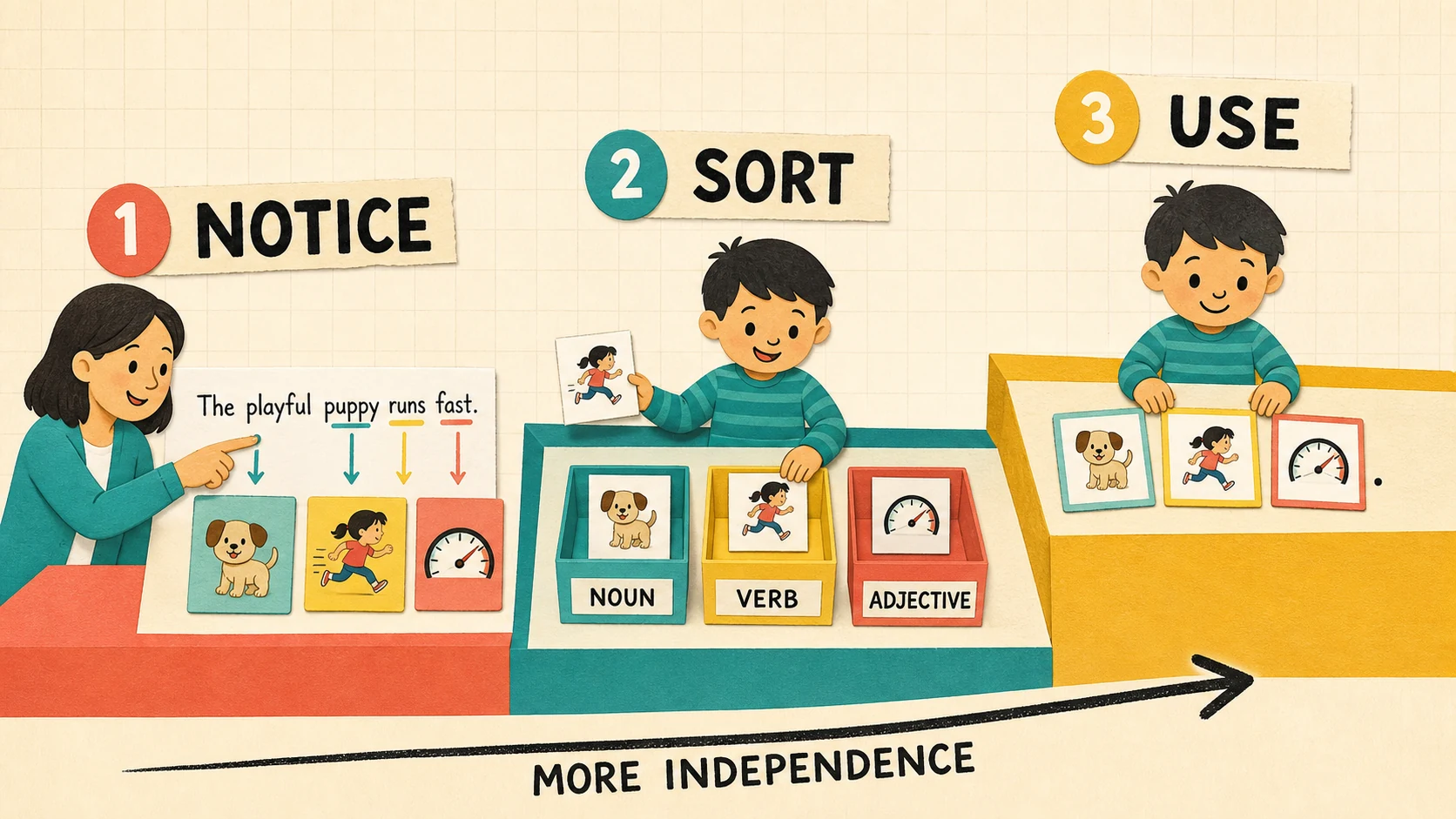
During guided practice, ask for the word and a brief reason before confirming the answer.
Decide when to release responsibility
Move to independent work when the learner can do three things:
- notice the requested category;
- read or understand the complete sentence;
- explain at least one correct choice by referring to the word’s function.
This is not a requirement for three consecutive perfect answers. It is a practical readiness check. If the learner answers correctly but cannot explain any choice, complete another guided item. If the learner gives a sound explanation but makes a minor marking mistake, clarify how to record the answer and continue.
For a learner ready to work alone, say: “Try the next three. If one feels uncertain, put a small dot beside it and continue.” Check those three before assigning the rest. This gives you early evidence without hovering over every response.
Keep the focus on a word’s job in its sentence
Parts of speech are not always permanent labels attached to words. The same spelling can perform different jobs in different sentences. First-grade practice usually begins with clear examples, but adults should understand this boundary so they do not teach an inaccurate shortcut.
Boundary case 1: “Play” can be a verb or a noun
Sentence A: The children play outside.
Here, play tells what the children do.
Checked classification: play — verb
Sentence B: We watched a play.
Here, play names the thing watched: a dramatic performance.
Checked classification: play — noun
The word alone is not enough. Its use in the sentence determines the classification.
Boundary case 2: “Light” can name or describe
Sentence A: Turn on the light.
Here, light names a thing.
Checked classification: light — noun
Sentence B: I carried the light bag.
Here, light describes the bag as not heavy.
Checked classification: light — adjective
These boundary cases are useful after straightforward examples. Do not use them to make an easy introductory lesson unnecessarily difficult. Their purpose is to correct the claim that a word must always belong to only one category.
Boundary case 3: More than one noun may appear
Consider: Sam carries a box.
Both Sam and box are nouns: one names a person, and the other names a thing. If a practice item appears to ask for one noun even though the sentence contains two, inspect the page’s exact marking or wording before correcting the learner. The intended answer may depend on which word is highlighted, underlined, or placed in a blank.
That is also why the answer key should be used with the printable in front of you. A key supplies intended answers; it does not replace careful reading of the task.
Adapt support without changing the skill
An adaptation should make the noun–verb–adjective decision more accessible while keeping that decision in the learner’s hands. Reading the sentence aloud, reducing visual clutter, or offering a category reminder preserves the skill. Telling the learner which word to mark does not.
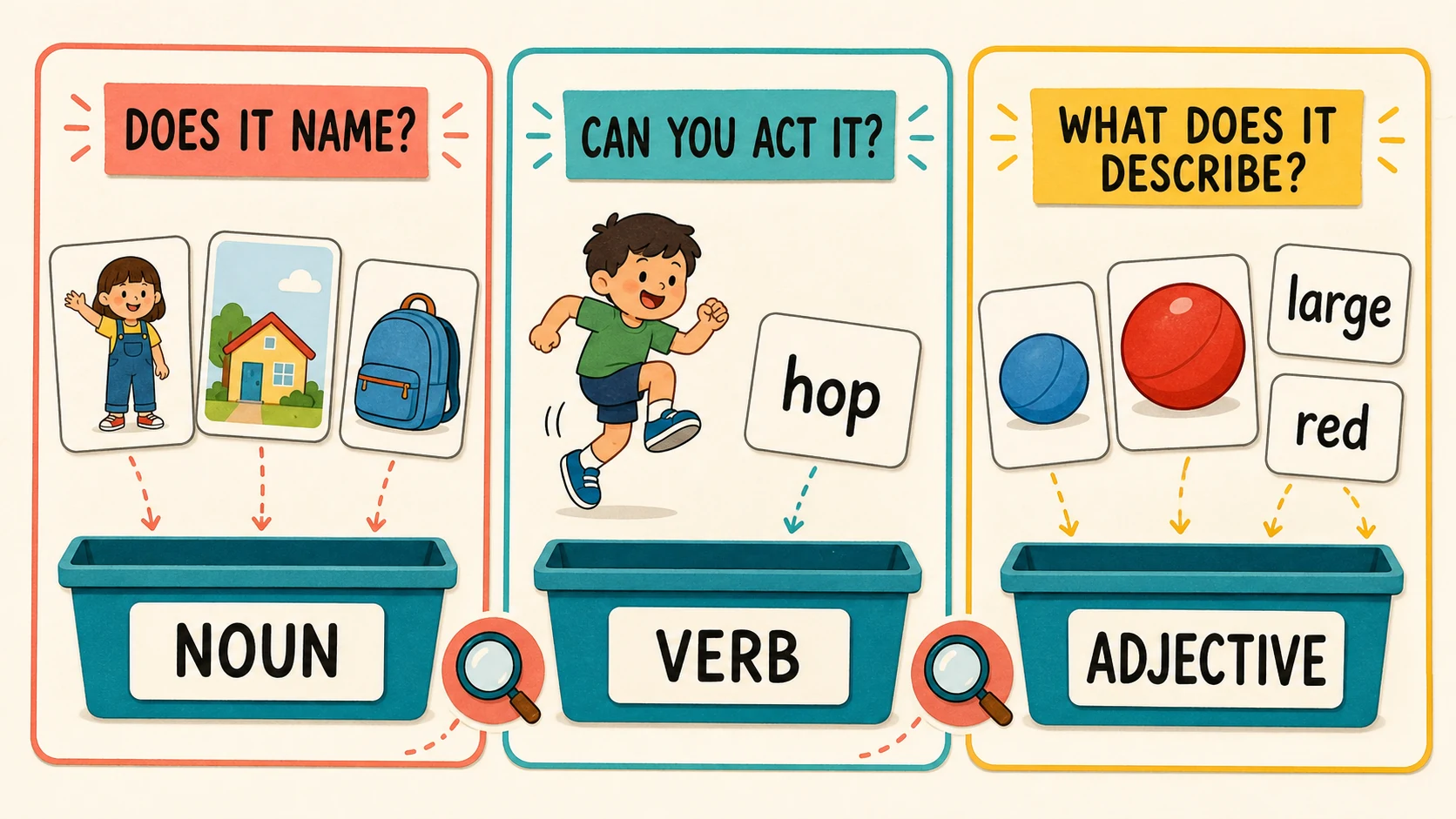
Adjust access, prompting, or workload while keeping the learner responsible for identifying the word’s grammatical job.
When reading the sentence is the barrier
Read the sentence aloud neutrally. Do not emphasize the answer word. Then ask the learner to identify the requested category. This separates sentence decoding support from the grammar decision.
You can also have the learner repeat the sentence or point to each word as it is read. If the learner classifies words accurately after hearing the sentence, record that observation. It suggests that reading the print and analyzing the grammar are creating different levels of difficulty.
This is an instructional observation, not a diagnosis. The worksheet cannot establish the cause of a persistent reading difficulty or provide medical guidance.
When the three labels are hard to remember
Place a small reference card beside the page:
| Category | Reminder | Quick check |
|---|---|---|
| Noun | names | Who or what is named? |
| Verb | acts or links | What happens, or what connects the subject to information? |
| Adjective | describes a noun | Which word tells more about a person, place, or thing? |
Use the card as a prompt rather than a matching game. The learner still needs to examine the sentence. Remove the card on one or two later items to see whether the distinction is becoming retrievable.
Physical demonstrations can also support the catalogue’s teaching suggestions. The learner might point to a book for a noun, clap to show a verb, and describe the book as thick or blue for an adjective. Then return immediately to a sentence so that the activity remains connected to sentence analysis.
When a full page causes overload
Cover all but one item with another sheet of paper. Complete a small set, take a natural pause, and return to the rest. The skill remains unchanged; only the visible quantity changes.
Another option is to divide the 12 items into two sittings. Do not assume that every learner should finish all 12 at once. Conversely, do not divide the page automatically if the learner is working accurately and comfortably. Let observed attention and reasoning guide the decision.
When the learner needs greater challenge
Ask for a reason after selected answers, not for extra speed. The learner can also identify another part of speech in the same sentence when the sentence clearly contains one.
For example, after finding the adjective in “The green frog jumps,” ask for the noun and verb:
- green — adjective, because it describes the frog;
- frog — noun, because it names the animal;
- jumps — verb, because it tells the action.
This extension deepens sentence analysis without moving prematurely into every part of speech. For a fuller progression, use the broader topic guide rather than trying to turn one easy printable into an entire grammar curriculum.
Interpret errors before assigning more practice
A score alone does not show why an answer was wrong. Review the learner’s selections and explanations to find a pattern.
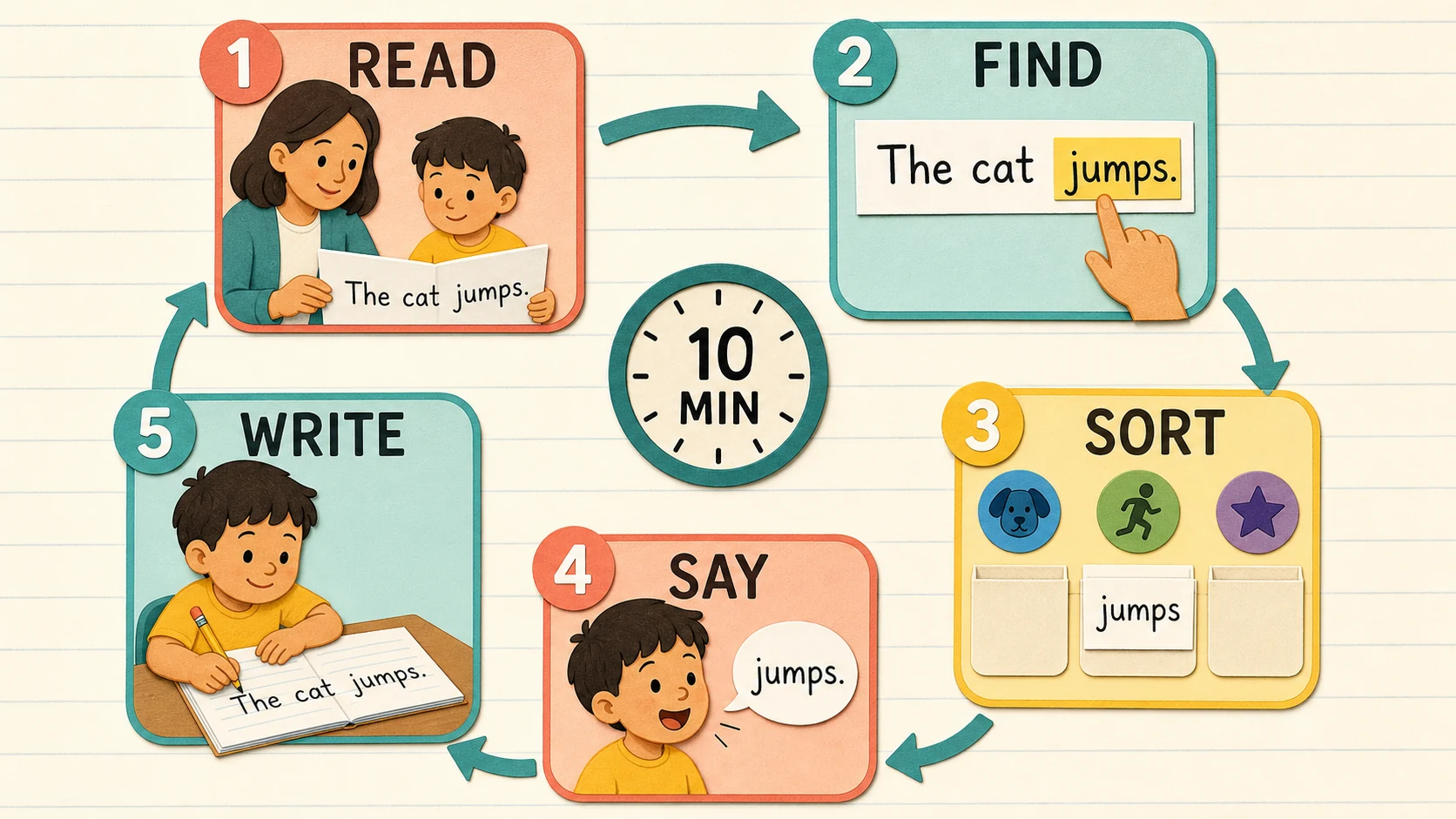
Check the requested category, the learner’s selected word, and the reason for the choice before deciding on the next prompt.
Misconception: every person or animal word is the action
A learner sees “The dog runs” and selects dog when asked for the verb. The learner may be identifying who performs the action instead of the action itself.
Prompt: “You found who does it. Now which word tells what the dog does?”
Then use a parallel contrast:
- dog — noun, because it names the animal;
- runs — verb, because it tells the action.
Misconception: adjectives are any exciting or detailed words
A learner may choose a noun such as dragon as the adjective because the word creates a vivid picture. Redirect attention from how interesting the word feels to what it does.
Ask: “Which noun is being described? What word tells more about that noun?” In “The green dragon sleeps,” green describes dragon. The fact that dragon is vivid does not make it an adjective.
Misconception: the first plausible word must be the answer
Some learners read only the beginning of a sentence and mark quickly. Ask them to reread the entire sentence and name the requested category before selecting anything. A simple oral frame can slow the process productively:
“I need a ____. I choose ____ because ____.”
For example: “I need a verb. I choose swims because it tells the action.”
Misconception: nouns are only objects a learner can touch
The topic scope includes nouns as people, places, things, or ideas. However, an easy first-grade worksheet may rely mainly on concrete examples. Do not infer that every noun on this exact printable is concrete, because the actual item text is not included in the supplied catalogue facts.
If an abstract noun arises elsewhere, explain it accurately but briefly. The immediate aim of this worksheet is classification within its sentences, not mastery of every noun subtype.
Error pattern: the learner knows the categories but misreads the direction
A learner may correctly identify a noun in an item that asks for an adjective. Before reteaching nouns and adjectives, ask, “What kind of word did this item request?” Highlighting or pointing to the target label can address task attention without giving away the answer.
Error pattern: oral success but difficulty on the printed page
If the learner can classify the words after hearing a sentence but not while reading it independently, the observed difference should influence support. Read selected items aloud and continue checking the grammar reasoning separately.
Do not claim that this pattern proves a particular learning need. It only shows that performance changed when the access method changed.
Use the answer key responsibly
The included answer key makes checking efficient, but responsible use requires more than comparing marks.
First, complete or reason through the item yourself. Then compare the learner’s answer with the key. If they differ, return to the exact sentence and ask the learner to explain the chosen word. This protects against three avoidable problems:
- correcting an answer without noticing what the item requested;
- overlooking another plausible word when the sentence contains multiple examples;
- treating a recording or reading error as if it were a grammar misconception.
Use neutral correction language: “The key lists jumps. Let’s check its job in the sentence.” Avoid “You weren’t paying attention” or “This is easy.” The difficulty label describes the catalogue level, not how a particular learner must experience every item.
Correct answers also deserve occasional checking. Ask the learner to explain two or three, especially one noun, one verb, and one adjective. Twelve correct marks produced by guessing do not provide the same evidence as twelve reasoned classifications.
The Common Core English Language Arts standards provide a public framework for grade-level language expectations, including early work with nouns, verbs, and frequently occurring adjectives. This printable practices a limited portion of that territory. It should not be described as comprehensive standards alignment or as evidence that the learner has mastered the complete grade-level language program.
For additional first-grade materials, browse the 1st Grade worksheet hub or narrow the selection through the 1st Grade Grammar collection.
Decide what to do after checking the page
Classify the result by pattern rather than relying only on a percentage.
If the learner is mostly accurate and explains choices
Briefly revisit any uncertain item, then move to a new set of sentences or use the same skill in reading and writing. During shared reading, choose one short sentence and ask for its noun and verb. During writing, ask the learner to add an adjective to a clear noun.
A sentence such as “The cat runs” can become “The striped cat runs.” Check the addition precisely: striped describes cat, so it functions as an adjective.
If one category is consistently confused
Do not repeat all three categories equally. Give two or three contrasting examples that isolate the confused pair.
For noun versus adjective:
- blue cup: blue describes; cup names.
- soft pillow: soft describes; pillow names.
- small boat: small describes; boat names.
For noun versus verb:
- Birds sing: birds names; sing acts.
- Rabbits hop: rabbits names; hop acts.
- Children read: children names; read acts.
Return to one previously missed worksheet item afterward. That return checks whether the learner can transfer the clarified distinction.
If errors occur across all categories
Reduce the task to a concrete oral sentence. Identify the naming word and action word first; then introduce a describing word.
“Dogs run.”
- Dogs names the animals: noun.
- Run tells the action: verb.
“Small dogs run.”
- Small describes the dogs: adjective.
Once the learner can explain this contrast, try another guided worksheet item. More pages are not automatically the best response to an unclear concept.
Schedule retrieval instead of ending after grading
A completed page shows what the learner did during one sitting. Retrieval on later occasions provides additional evidence about what remains available without immediate modeling.
The following schedule is a practical suggestion, not a sourced or universal timetable:
| Review point | Short activity |
|---|---|
| Later the same session | Revisit one corrected item without showing the prior answer. |
| About 1–2 days later | Classify words in two new, clear sentences. |
| About 1 week later | Retry two worksheet items or use three parallel examples. |
| About 2–3 weeks later | Identify a noun, verb, and adjective in a short familiar sentence. |
Adjust the intervals according to observed work. If the learner remembers the distinctions and explains them comfortably, increase the delay or apply the skill in writing. If the learner again confuses the same categories, shorten the interval and provide another contrast before independent retrieval.
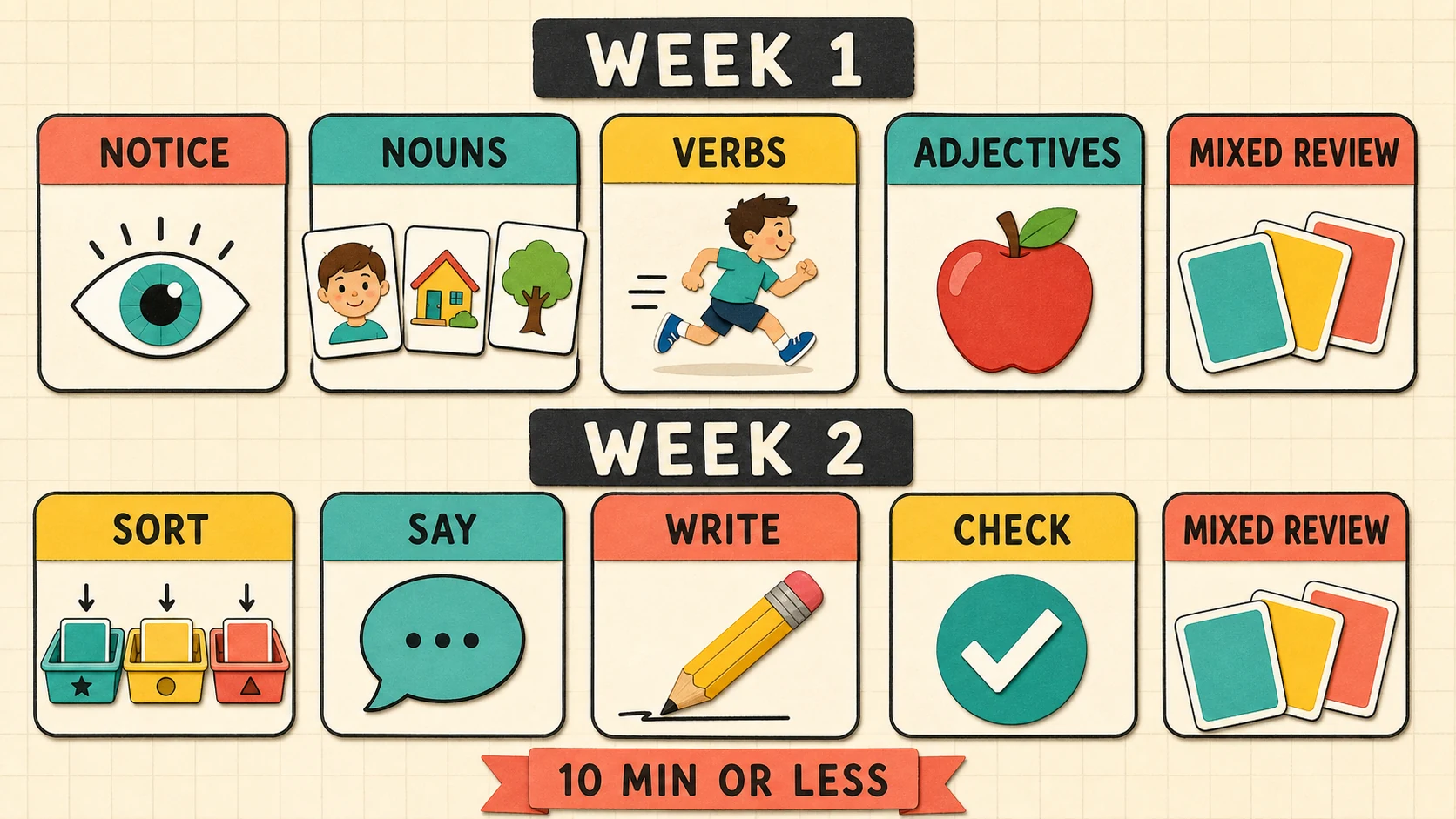
Later reviews can be short; their purpose is to retrieve and apply the distinction again, not to repeat an entire lesson automatically.
Keep retrieval examples unambiguous at first:
- “The fox runs.” Target verb: runs.
- “I see a yellow bus.” Target adjective: yellow.
- “The baby laughs.” Target noun: baby.
Then vary the sentence while preserving the categories:
- “The fox sleeps.” Target verb: sleeps.
- “I see a long bus.” Target adjective: long.
- “The teacher laughs.” Target noun: teacher.
This variation checks whether the learner understands the category rather than remembers a single answer.
Know what this printable can and cannot show
The worksheet can provide useful evidence about whether a learner identifies nouns, verbs, and adjectives in 12 easy-level sentence exercises. It can reveal recurring confusions, response habits, and differences between guided and independent performance.
It cannot by itself show complete grammar mastery, overall reading ability, writing quality, or command of all parts of speech. It does not cover the entire progression described in the topic catalogue. It also cannot determine why a learner struggles, provide a diagnosis, guarantee an outcome, or establish that one instructional timetable suits every setting.
Treat the printable as one focused practice sample. Combine it with oral explanations, new examples, and observations from the learner’s own reading or writing. If school expectations are relevant, compare the activity with the learner’s local curriculum rather than assuming every first-grade sequence introduces the same content at the same time.
Take the next useful step
Begin with the free 1st Grade Parts of Speech worksheet, using one modeled example and a small guided set before independent work. After checking the page, choose the next resource from the evidence: consult the Parts of Speech topic guide for the broader progression, use the 18-worksheet 1st Grade Parts of Speech pack when focused additional practice is warranted, or create fresh retrieval sentences with the free worksheet generators.
Put it into practice
Use the guide with a real printable
Move from explanation to a short, observable practice task. Check the first item together, then adjust the next session from the learner's actual work.
See the 18-worksheet pack